GLP-1 Science
Is a 'Natural GLP-1 Booster' a Real Thing? Native GLP-1 vs. the Drugs
Native GLP-1 has a roughly 2-minute half-life. The drugs last about a week. That single number explains most of what a 'natural booster' can, and can't, realistically do.
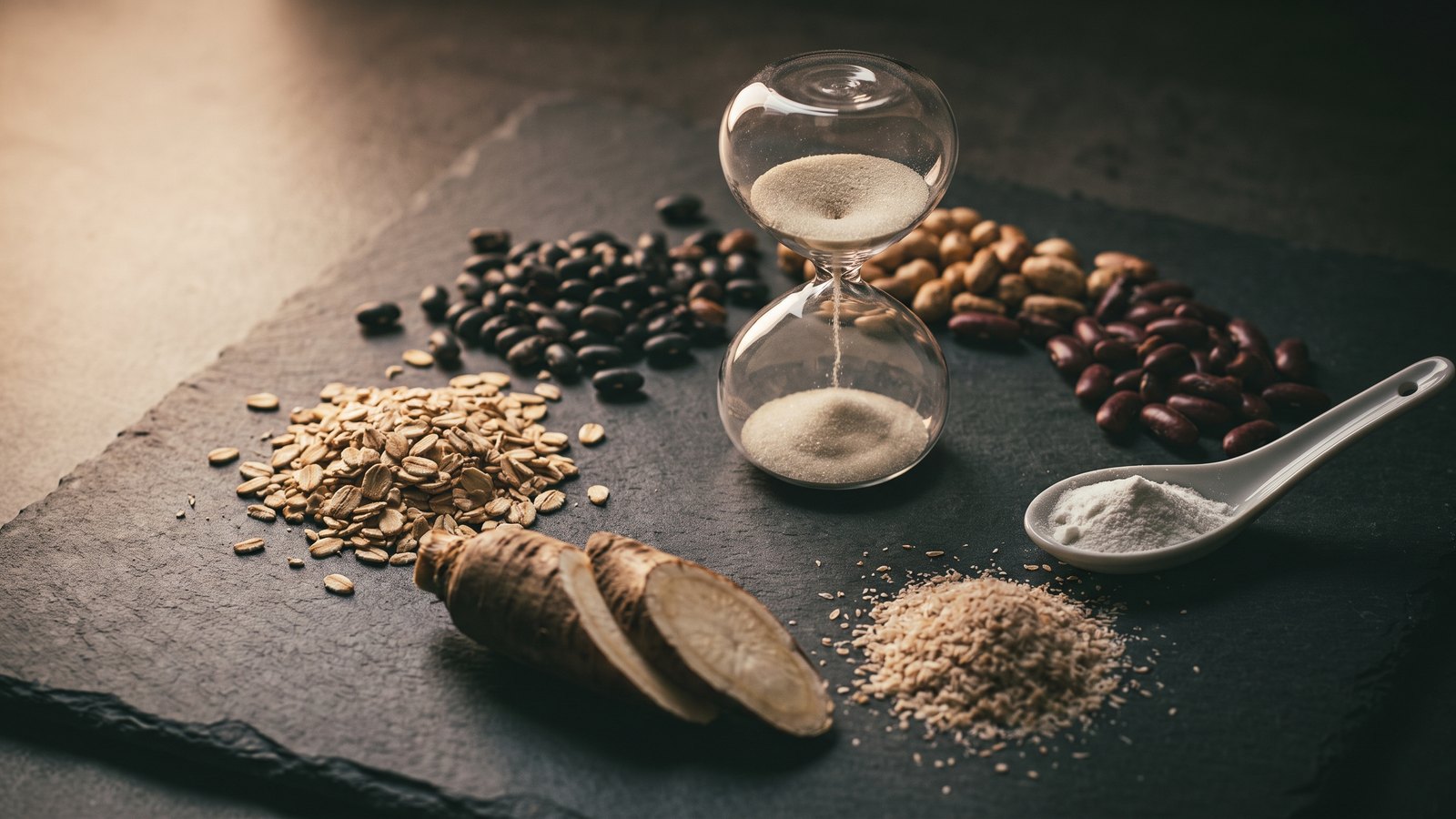
"Natural GLP-1 booster" is on everything right now. Capsules, drink sticks, gummies, fiber tubs, all borrowing the glow of the injectable drugs everyone's heard of.
The marketing leans on a real hormone and a real mechanism. It also skips the one number that decides how far the comparison can actually go. So let's put that number front and center and build out from there.
None of these supplements contain a GLP-1 drug. What the honest ones try to do is nudge your body to release a bit more of its own GLP-1, or lean on nearby appetite pathways. That's a legitimate structure/function idea. It is also a much gentler, much shorter-lived thing than a weekly injection, and the gap between the two is mostly a story about time.
The two-minute hormone
GLP-1 (glucagon-like peptide-1) is a hormone your gut releases after you eat. It tells your brain you're full, slows how fast your stomach empties, and helps steady blood sugar. Useful stuff.
Here's the catch your body built in on purpose. Native human GLP-1 gets shut off almost immediately by an enzyme called DPP-4, which gives it a half-life of roughly 2 minutes (Min et al., Drug Des Devel Ther, 2025; PubMed). Your own GLP-1 is designed to fire in a quick pulse and then vanish.
That's the whole reason the drugs had to be engineered the way they were. You can't just bottle GLP-1 and inject it, because it would be gone before it did much.
Why the drugs last a week
The injectable GLP-1 receptor agonists are built to dodge that shut-off switch. They resemble the shape and function of your own GLP-1, but they're modified so DPP-4 can't chew them up, which stretches their half-life way out (Sfairopoulos et al., Hormones (Athens), 2018; PubMed).
The tricks are clever. Swapping amino acids so the enzyme can't grab the molecule, bolting on a fatty-acid chain, or fusing it to a blood protein so the kidneys clear it slowly (Min et al., 2025). The result is a drug that sticks around for days instead of minutes.
Semaglutide is the headline example. At a 0.5 or 1 mg dose it has a half-life of about 7 days and takes 4 to 5 weeks to reach steady levels in the blood (Hall et al., Clin Pharmacokinet, 2018; PubMed). In its clinical trials that translated to roughly 5 to 10% weight reduction from baseline (Hall et al., 2018).
So line them up. Your own GLP-1: about 2 minutes. The drug: about 7 days. That's a difference of around 5,000-fold in how long the signal lasts. Any honest comparison has to start there.
So what does "boost your own GLP-1" actually mean?
A supplement can't rewrite that half-life. What it can try to do is get your gut to release more of its own GLP-1, more often, from real food and food-derived ingredients. The most studied lever is fiber.
Fiber and fermentation
Here's the pathway. You eat a fermentable fiber, it travels to your lower gut, and the bacteria there ferment it into short-chain fatty acids. Those short-chain fatty acids appear to prod the L-cells in your gut wall to release more GLP-1 (Grammatiki et al., Nutrients, 2026; PubMed).
The interesting part is the timing. In rodents, feeding resistant starch raised total GLP-1 (and its cousin PYY) in a steady, day-long way through fermentation, not just as a quick spike after a meal (Zhou et al., Am J Physiol Endocrinol Metab, 2008; PubMed). That's a gentle, background nudge rather than a drug-like flood. Worth flagging that this specific finding is from rodents, so read it as a mechanism, not a promise.
The other natural levers
Fiber isn't the only angle, and this is where the newest research is pointing. A 2026 review lays out a few more (Grammatiki et al., 2026):
- Low-glycemic-index carbs. Slower-digesting carbs deliver more nutrients further down the gut, where more of the GLP-1-releasing L-cells live.
- Mediterranean-style eating. The mix of unsaturated fats, fiber, and polyphenols may promote GLP-1 release, and some components might even gently slow DPP-4, the same enzyme the drugs are built to evade.
None of this is a knockoff of an injection. It's a set of food-based ways to keep your own signal a little busier. The reviewers are careful to say the evidence is strongest in people without diabetes and still needs better trials (Grammatiki et al., 2026), which is exactly the kind of hedge you want to see.
The honest gap: how big is the effect?
This is the part the marketing tends to skip, so we'll say it plainly.
A 2026 review in Advances in Nutrition put fiber and the GLP-1 drugs side by side. Its read: dietary fiber genuinely engages the same gut-brain axis through fermentation and endogenous GLP-1, but weight loss with fiber alone is typically more modest than with the drugs, and it depends heavily on the type of fiber, the dose, and how long you stick with it (Wang et al., Adv Nutr, 2026; PubMed).
That's the fair framing. Same road, very different speed. A natural approach works with your body's own machinery, which is why it's gentle. That gentleness is also why you shouldn't expect it to do what a purpose-built weekly drug does.
And "natural" doesn't mean "no downside." Ramp fiber too fast and you get bloating and gas (Wang et al., 2026). More is not automatically better, which is a theme we keep hitting in this category.
Where a natural approach genuinely earns its place
None of the above means fiber and food-based tools are pointless. The same 2026 review makes a case for them that doesn't rely on beating the drugs (Wang et al., 2026):
- Fiber can help settle the gut side effects (constipation, irregularity) that lead a lot of people to quit the drugs.
- It supports the gut barrier and feeds a healthier short-chain-fatty-acid supply along the way.
- For people who aren't candidates for medication, or who want a daily habit rather than a prescription, working the endogenous pathway is a reasonable, low-risk place to start.
The reviewers frame fiber and lifestyle as the foundation, with drugs reserved for higher-risk cases (Wang et al., 2026). That's a sober take, and it's roughly how we think about this whole shelf.
One endpoint the drugs get credit for that supplements have never been tested on is the constant food chatter people report going quiet, which we cover in our explainer on what food noise actually is.
How to read a "natural GLP-1" label without getting played
A few habits keep you honest:
- Watch the verbs. "Supports your body's own GLP-1" is a fair structure/function claim. Anything implying it works like or replaces a prescription drug is over its skis.
- Look for a real dose of a real fiber. A fermentable fiber at a sensible, disclosed amount is doing actual work. A pinch hidden in a proprietary blend is mostly there for the label.
- Expect gentle, not dramatic. A background nudge to your own signaling is the honest ceiling here.
- Give it a runway. Fermentation-based effects build over days and depend on consistency (Zhou et al., 2008; Wang et al., 2026), so a one-week trial tells you almost nothing.
If you are about to spend money on one of these, read our checklist for buying a natural GLP-1 supplement first. If you want the deeper version of this, we break down the individual ingredient families in our piece on whether natural GLP-1 supplements work, and how we weigh dose disclosure and mechanism in our scoring methodology. The full lineup lives in the GLP-1 support category.
The takeaway
Is a "natural GLP-1 booster" a real thing? The pathway is real. Fermentable fiber and a few food patterns can genuinely encourage your gut to release more of its own GLP-1 (Grammatiki et al., 2026), and that own supply matters.
What's not real is the implied equivalence to the drugs. Your GLP-1 lasts about 2 minutes by design (Min et al., 2025); the injectables were engineered over years specifically to last about a week (Hall et al., 2018). A supplement plays a completely different game, a gentler one, and the honest sell is exactly that. Treat "natural GLP-1" as a way to support a system you already own, not a needle-free copy of a prescription, and you'll buy with your eyes open.
References
Based on articles retrieved from PubMed:
- Min JS, Jo SJ, Lee S, et al. A Comprehensive Review on the Pharmacokinetics and Drug-Drug Interactions of Approved GLP-1 Receptor Agonists and a Dual GLP-1/GIP Receptor Agonist. Drug Des Devel Ther. 2025. PubMed
- Hall S, Isaacs D, Clements JN. Pharmacokinetics and Clinical Implications of Semaglutide: A New Glucagon-Like Peptide (GLP)-1 Receptor Agonist. Clin Pharmacokinet. 2018. PubMed
- Sfairopoulos D, Liatis S, Tigas S, Liberopoulos E. Clinical pharmacology of glucagon-like peptide-1 receptor agonists. Hormones (Athens). 2018. PubMed
- Grammatiki M, Tsekmekidou X, Koufakis T, Kotsa K. Nutritional Interventions in Type 1 Diabetes: Boosting Residual GLP-1 Responses-Is It an Option? Nutrients. 2026. PubMed
- Wang Y, Liu J, Verbeke K, et al. Dietary Fiber and Glucagon-Like Peptide-1 Receptor Agonists in Obesity Management: Converging Mechanisms, Interactions, and Strategies for Durable Weight Control. Adv Nutr. 2026. PubMed
- Zhou J, Martin RJ, Tulley RT, et al. Dietary resistant starch upregulates total GLP-1 and PYY in a sustained day-long manner through fermentation in rodents. Am J Physiol Endocrinol Metab. 2008. PubMed
FAQ
Can a supplement really boost my own GLP-1?
It can encourage it, gently. Fermentable fiber gets broken down by your gut bacteria into short-chain fatty acids, which appear to prod your gut's L-cells to release more of your own GLP-1. That's a real, food-based pathway, but the effect is a background nudge, not a drug-like surge, and it builds over days of consistent intake.
Is a natural GLP-1 booster the same as Ozempic or Wegovy?
No, and it's not close. Those are prescription drugs engineered so your body can't quickly break them down, giving semaglutide a roughly 7-day half-life. Your own GLP-1 has about a 2-minute half-life by design. A supplement works with your natural signaling rather than replacing it, so it's far gentler and far less powerful.
Why does GLP-1 disappear so fast in the first place?
An enzyme called DPP-4 shuts it off almost immediately, which gives native GLP-1 a half-life of roughly 2 minutes. Your body uses GLP-1 as a quick post-meal pulse, not a long-lasting signal. The injectable drugs are specifically built to resist DPP-4, which is how they last days instead of minutes.
If it's weaker than the drugs, is a natural approach worth it?
It can be, for the right reasons. A recent review frames fiber and food-based habits as a sensible foundation: gentle, low-risk, supportive of gut health, and helpful for the digestive side effects that make people quit the drugs. Just go in expecting modest, gradual support of a system you already have, not a needle-free version of a prescription.
Products mentioned
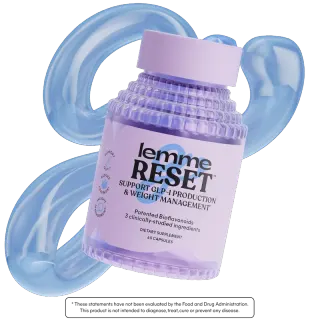
Lemme GLP-1 Daily (Lemme Reset)
Lemme · capsuleThe most transparent standalone GLP-1 capsule: fully-disclosed branded actives in a simple once-daily pill, though it covers fewer hunger pathways than the Ozzi capsule.
Fully disclosed, standardized branded actives (no proprietary blend).
No published trial on the finished three-ingredient combination.
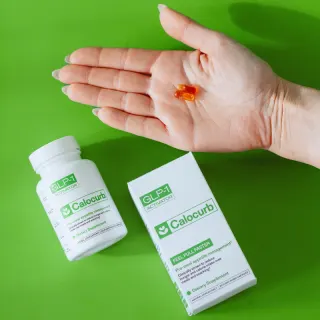
Calocurb GLP-1 Activator
Calocurb · capsuleThe best-evidenced single-mechanism appetite trigger — clinically interesting, but premium-priced and a pre-meal, short-window tool rather than all-day support.
Amarasate is one of the most directly studied appetite ingredients — multiple human RCTs, dosed on-label at 250 mg.
Acute, short-window effect: a pre-meal tool (up to 4 capsules/day), not all-day craving support.
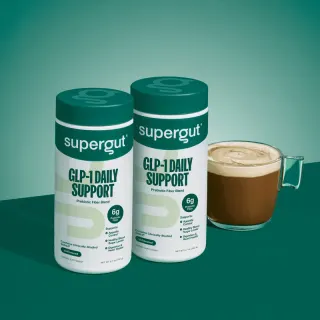
Supergut GLP-1 Daily Support
Supergut · powderA drinkable, gut-first option — but it leans on a proprietary fiber blend and a heavy fiber load.
Drinkable and caffeine-free.
Individual fiber doses are hidden inside a proprietary blend.
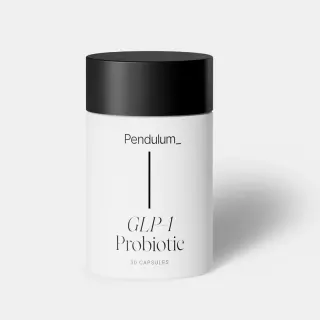
Pendulum GLP-1 Probiotic
Pendulum Therapeutics · capsuleStrong science pedigree on Akkermansia, but a proprietary CFU blend and refrigeration requirement.
Akkermansia has the strongest individual research pedigree of the probiotic actives.
Per-strain doses are hidden inside a proprietary blend.