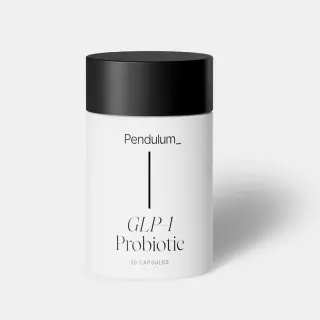
Pendulum GLP-1 Probiotic
by Pendulum Therapeutics · capsule ·
Strong science pedigree on Akkermansia, but a proprietary CFU blend and refrigeration requirement.
- Format
- capsule Pill
- Best price
- $2.63 per serving
- Pathways
- 3 hunger dimensions
- Headline dose
- Proprietary Akkermansia muciniphila
- Caffeine
- Caffeine-free evening-friendly
- Bloat risk
- Low Probiotic, trace fiber
3/7 hunger pathways
- GLP-1 / gut-hormone Akkermansia muciniphila, Clostridium butyricum
- Gut microbiome / prebiotic Bifidobacterium infantis, Probiotic blend, Chicory inulin
- Blood-sugar stability
The short version
Pendulum GLP-1 Probiotic is a one-capsule-a-day probiotic built on Akkermansia muciniphila, the gut bacterium with the best journal pedigree in this category. It's worth considering if the microbiome route is the one that convinces you and you can live with a hidden per-strain dose, refrigeration, and no published trial on this exact capsule. If you want a measured GLP-1 result or a trial on the product in the bottle, this isn't it.
How it scores
Every score is derived from publicly verifiable facts. See the full methodology and Value Index formula.
Ingredients & doses
| Ingredient | Dose | Pathway | Notes |
|---|---|---|---|
| Akkermansia muciniphila (WB-STR-0001) | Undisclosed proprietary blend | GLP-1 / gut-hormone | Generates postbiotics linked to GLP-1 signaling; strain dose hidden in the blend. |
| Clostridium butyricum (WB-STR-0006) | Undisclosed proprietary blend | GLP-1 / gut-hormone | Produces butyrate; strain dose hidden. |
| Bifidobacterium infantis (WB-STR-0002) | Undisclosed proprietary blend | Gut microbiome / prebiotic | |
| Probiotic blend (total) | 500 million AFU proprietary blend | Gut microbiome / prebiotic | Total across three strains; per-strain breakdown not disclosed. |
| Chicory inulin | 174 mg | Gut microbiome / prebiotic | Prebiotic fiber to support the strains. |
How it claims to work
Probiotic strains described as producing short-chain-fatty-acid postbiotics (butyrate, propionate, acetate) and the metabolite p9 in the gut, which the brand says supports the body’s own GLP-1 signaling and satiety.
The evidence
Akkermansia muciniphila has human and preclinical research linking it to metabolic and GLP-1 pathways, but there is no published RCT showing this consumer formula causes weight loss or measurable GLP-1 increases.
Strengths
- Akkermansia has the strongest individual research pedigree of the probiotic actives.
- Caffeine-free, single small capsule.
- Disclosed prebiotic inulin to feed the strains.
Watch-outs
- Per-strain doses are hidden inside a proprietary blend.
- Needs refrigeration to preserve potency — a routine and travel hassle.
- No RCT on the finished product for weight or GLP-1 outcomes.
Price & value
Taste & format: One small acid-resistant capsule once daily with food; flavorless, but recommended to be refrigerated to preserve the live strains.
Pendulum GLP-1 Probiotic: the full review
What it is and who it's for
Pendulum GLP-1 Probiotic is a single acid-resistant capsule taken once a day with food. It's caffeine-free, flavorless, and carries no fiber load to speak of, which makes it one of the easier products in the GLP-1 support category to fit into a routine.
The brand's pitch is that three live bacterial strains produce short-chain fatty acids and a metabolite called P9 in the gut, and that those signals support your body's own GLP-1 and satiety. It's a chain of plausible steps rather than a measured outcome, and that distinction runs through this whole review.
It suits people who find the microbiome story convincing and want a low-effort capsule with no stimulant. It's a poor fit if you travel often (the brand recommends refrigeration), or if you want to check a label dose against a trial, because the number that matters isn't printed.
What the label says
The label lists three strains: Akkermansia muciniphila (WB-STR-0001), Clostridium butyricum (WB-STR-0006) and Bifidobacterium infantis (WB-STR-0002), at a combined 500 million AFU. The per-strain split isn't published. There's also 174 mg of chicory inulin, a prebiotic fiber included to feed the strains.
| Label line | Listed amount | What the research used |
|---|---|---|
| Akkermansia muciniphila | Inside a 500 million AFU blend | About 10 billion bacteria a day, pasteurized or live (Depommier 2019) |
| Clostridium butyricum | Inside the blend | Part of a 5-strain formulation, WBF-011 (Perraudeau 2020) |
| Bifidobacterium infantis | Inside the blend | Part of WBF-011 |
| Chicory inulin | 174 mg | Disclosed; a prebiotic support dose |
Two things stand out. First, the Akkermansia trial that produced the headline result used about 10 billion bacteria a day, and you can't tell from the label how much of the 500 million AFU total is Akkermansia. Second, the human data favored a pasteurized preparation, while this product sells live strains that need to stay cold. Our Akkermansia deep dive covers why that live-versus-pasteurized detail matters.
What the evidence shows
Akkermansia has the strongest single-organism research in this category. Depommier and colleagues enrolled 40 overweight or obese, insulin-resistant volunteers (32 completed) and gave them about 10 billion bacteria a day, live or pasteurized, for 3 months. The pasteurized form improved insulin sensitivity by 28.62% against placebo, cut insulinemia by 34.08% and total cholesterol by 8.68%. Body weight fell 2.27 kg and fat mass 1.37 kg, but neither reached statistical significance. The trial was safe and well tolerated, and the authors called it a proof-of-concept study.
Pendulum has also run and published its own placebo-controlled trial, which most brands here never do. Perraudeau and colleagues randomized 76 people with type 2 diabetes to placebo, WBF-010 or WBF-011 for 12 weeks. WBF-011 improved glucose total area under the curve by 36.1 mg/dL over 180 minutes (p=0.0500, right on the line), with glycated hemoglobin down 0.6. Every author was a Pendulum employee, stated openly in the paper.
Read the fine print before you buy. WBF-011 contains inulin plus five strains, and the GLP-1 Probiotic as listed carries three. So the company trial supports a related, larger formulation, in a diagnosed population. A 2025 trial in Cell Metabolism added a wrinkle: across 58 participants, 12 weeks of Akkermansia supplementation showed no significant difference from placebo overall, with benefit only in people who started with low gut levels of the bacterium.
Neither trial measured GLP-1. The GLP-1 angle rests on a 2021 mouse and cell study identifying the P9 protein that Akkermansia secretes, which triggered GLP-1 release in that setting. Our Lemme versus Pendulum comparison puts that mechanism-only case next to a product that did measure the hormone.
Side effects, tolerability and who should skip it
Tolerability looks good on the available data. The 3-month Akkermansia trial reported it was safe and well tolerated, and Pendulum's own 12-week trial reported no safety or tolerability problems. The product carries no caffeine and no meaningful fiber load, so the bloating risk we track is low.
The practical issues are about handling rather than side effects. Akkermansia is an oxygen-sensitive anaerobe that's historically finicky to keep alive, which is why the brand recommends refrigeration. If you can't keep it cold, you can't be sure the capsule is what the label says.
Skip it if you're pregnant, nursing, immunocompromised, on medication, or managing a health condition without talking to your doctor first. Every headline trial above ran in people with a metabolic diagnosis, so if you're in that group this is a conversation for your doctor rather than a solo supplement decision.
Price and value
Pendulum is $79 for 30 servings, about $2.63 a serving. A subscription is available, but we don't have a published subscription price to report, and we have no stated money-back guarantee to report either. That puts it within a few cents of Lemme GLP-1 Daily on a per-serving basis.
Our rubric scores it 15 out of 25: a 3 on pathway coverage, 2 on ingredient transparency, 4 on science, 3 on value and 3 on format. It lands 5th in our ranking of appetite suppressant pills and 4th among natural GLP-1 supplements. The science score is for the organism, not for this capsule.
How to take it and what to expect
One capsule once daily with food, kept in the fridge. There's no timing restriction and no stimulant, so an evening dose is fine if that's when it fits.
Set expectations to what was measured. The strongest human outcomes for Akkermansia were insulin sensitivity and cholesterol markers over 3 months, with weight changes that didn't reach significance. Pendulum's own trial measured post-meal glucose over 12 weeks. Nothing published on this formula measured hunger, snacking or GLP-1, so if you're buying it for cravings you're running your own uncontrolled experiment.
The 2025 trial also suggests the response may depend on how much Akkermansia you already carry, which you'd need a stool test to know.
How it compares
Against Lemme GLP-1 Daily, Pendulum wins on single-ingredient pedigree and on having published a company trial at all. Lemme wins on disclosed doses and on GLP-1 measured as an actual endpoint. We ran the full matchup in Lemme vs Pendulum.
If gut health is the real goal, our gut health rankings put the Akkermansia evidence next to psyllium and resistant starch. And if the question is whether any of this compares to a prescription, it doesn't, and Pendulum doesn't claim it does. See natural GLP-1 versus the drugs for the ceiling on the whole category, and our methodology for how we weigh thin-but-promising evidence like this.
Frequently asked questions
Does Pendulum GLP-1 Probiotic work?
No published trial on this capsule has measured weight, appetite or GLP-1. The Akkermansia strain has one small 3-month human trial where a pasteurized version improved insulin sensitivity, and Pendulum's own 12-week trial tested a larger 5-strain formulation and measured post-meal glucose. The mechanism is reasonable, but the finished product is untested.
Does Pendulum GLP-1 Probiotic raise GLP-1?
Not as far as any published trial shows. The GLP-1 link comes from a 2021 mouse and cell study of a protein Akkermansia secretes, called P9. Neither of the human Akkermansia trials, nor Pendulum's company trial, measured GLP-1 as an outcome.
What are the side effects of Pendulum GLP-1 Probiotic?
The human trials reported it was safe and well tolerated, with no safety or tolerability problems in Pendulum's 12-week study. It's caffeine-free and carries no fiber load, so bloating risk is low. Talk to your doctor if you're pregnant, nursing, immunocompromised or on medication.
Does Pendulum have caffeine?
No. It's a caffeine-free probiotic capsule with no timing restriction, so it can be taken in the evening.
Do you have to refrigerate Pendulum?
The brand recommends it to preserve the live strains, and Akkermansia is an oxygen-sensitive bacterium that's hard to keep alive. If you want the product to match the label, yes. It's the main practical drawback for travel and office use.
How much does Pendulum GLP-1 Probiotic cost?
$79 for 30 servings, about $2.63 a serving. A subscription is offered but we don't have a published subscription price, and we have no money-back guarantee to report.
References
- Depommier C, Everard A, Druart C, et al. Supplementation with Akkermansia muciniphila in overweight and obese human volunteers: a proof-of-concept exploratory study. Nat Med. 2019;25(7):1096-1103. PubMed PMID 31263284
- Perraudeau F, McMurdie P, Bullard J, et al. Improvements to postprandial glucose control in subjects with type 2 diabetes: a multicenter, double blind, randomized placebo-controlled trial of a novel probiotic formulation. BMJ Open Diabetes Res Care. 2020;8(1):e001319. PubMed PMID 32675291
- Zhang Y, Liu R, Chen Y, et al. Akkermansia muciniphila supplementation in patients with overweight/obese type 2 diabetes: Efficacy depends on its baseline levels in the gut. Cell Metab. 2025;37(3):592-605.e6. PubMed PMID 39879980
- Yoon HS, et al. Akkermansia muciniphila secretes a glucagon-like peptide-1-inducing protein that improves glucose homeostasis and ameliorates metabolic dysfunction in mice. Nat Microbiol. 2021. PubMed PMID 33820962
This review is for education only and isn't medical advice. Product details are as the brand or its retailers list them. Talk to your doctor before starting any supplement.