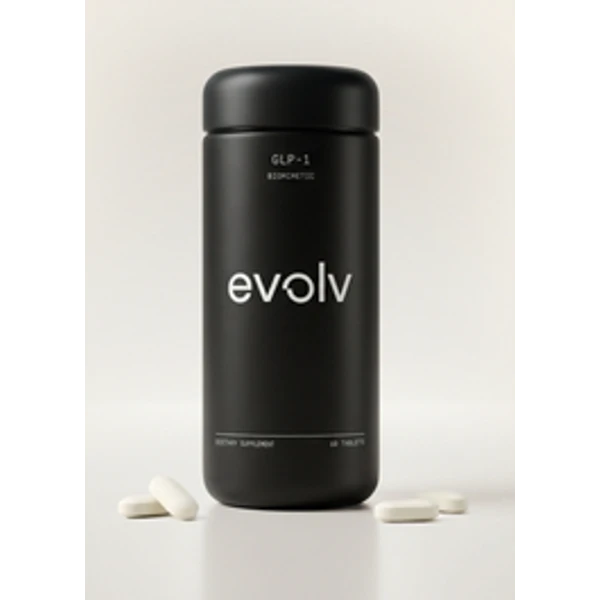
Evolv GLP-1
by Evolv · tablet ·
A genuinely novel idea wrapped in the category’s worst claim hygiene: "up to" headlines several times the actual averages, an unpublished and unpowered interim readout, the highest price in our set, and no refunds.
- Format
- tablet Pill
- Best price
- $4.19 per serving
- Pathways
- 1 hunger dimensions
- Headline dose
- 560 mg Saccharomyces cerevisiae S288C EV1-Peptide
- Caffeine
- Caffeine-free evening-friendly
- Bloat risk
- Low Yeast biomass, no fiber
1/7 hunger pathways
- GLP-1 / gut-hormone EV1 Peptide
The short version
Evolv GLP-1 is a caffeine-free two-tablet daily product built on a single engineered peptide grown in yeast. It's hard to recommend to anyone right now: the active dose isn't published, the only data is an unpublished interim readout the company itself describes as not yet statistically powered, the price is the highest we track at $4.93 a serving, the brand issues no refunds, and FDA sent its maker a warning letter in August 2026 saying the safety evidence for the ingredient is inadequate. If the full 12-week results are published and the FDA matter is closed out, it becomes a more interesting product.
How it scores
Every score is derived from publicly verifiable facts. See the full methodology and Value Index formula.
Ingredients & doses
| Ingredient | Dose | Pathway | Notes |
|---|---|---|---|
| Saccharomyces cerevisiae S288C EV1-Peptide EV1 Peptide | 560 mg | GLP-1 / gut-hormone | 560 mg per 2-tablet serving is the weight of the inactivated yeast biomass carrying the peptide, not the peptide itself. How much EV1 peptide that 560 mg contains is not disclosed anywhere we could find, so the active dose is effectively unknown. S288C is the standard laboratory reference strain of brewer’s/baker’s yeast. |
How it claims to work
Marketed as an oral "biomimetic" peptide: the brand says it engineered a novel peptide (EV1), grew it inside Saccharomyces cerevisiae, and dried the yeast into a powder, and that the peptide then survives digestion and interacts with GLP-1 and GIP receptors in the gut and brain to support fullness and appetite regulation.
The evidence
No peer-reviewed publication on the finished product, and we found no ClinicalTrials.gov registration. The company’s evidence is an 8-week interim readout of an ongoing 12-week randomized controlled study, self-published on its own blog by a co-founder, with no sample size, confidence intervals or p-values given. That post reports group averages of −2.87% body weight and −4.02% waist vs control at week 8, and states the full 12-week study "will provide statistical power" — i.e. the advertised data is not yet powered. The marketed "up to 12+ lbs" and "4+ inches" figures are per-protocol maxima from the experimental group, several times the reported averages. The "~750 fewer calories per day" headline is not measured intake: the brand’s own footnote derives it arithmetically from the 12 lb best case. On 2026-08-24 FDA issued a warning letter (CMS 731846) stating the EV1 peptide is a new dietary ingredient lacking adequate safety evidence, that the product is adulterated under section 402(f)(1)(B), and that FDA had objected to two prior new dietary ingredient notifications (NDI 1388 and 1396) before launch.
Strengths
- Simple, caffeine-free two-tablet daily routine with no timing restriction — usable in the evening craving window.
- Single-ingredient label with no proprietary blend, and the brand is running an actual randomized controlled trial, which most of this category never attempts.
- Manufactured in a cGMP-compliant US facility per the brand.
Watch-outs
- FDA warning letter (August 24, 2026): FDA says there is inadequate information to show the EV1 peptide is reasonably safe, calls the product adulterated, and says the brand launched after FDA objected to its safety filing. Not a court ruling or recall; the brand can respond.
- The most expensive product in our set at about $4.93 a serving, and the only one with no money-back guarantee of any kind.
- The disclosed 560 mg is yeast biomass, not peptide — the actual active dose is not published.
- Headline results are "up to" per-protocol maxima; the study’s own reported averages are roughly −2.87% body weight and −4.02% waist at 8 weeks.
- Nothing peer-reviewed or registered; the interim data is self-published by a co-founder and, per the company, not yet statistically powered.
- The claim that an orally dosed peptide reaches GLP-1 and GIP receptors in the gut and brain is unevidenced, and runs against a drug-delivery literature in which oral peptide bioavailability is exceedingly low.
Price & value
Taste & format: Two coated tablets daily, caffeine-free and with no timing restriction, so evening use is fine; the label allows adjusting up to three tablets a day, which cuts a 60-tablet bottle to 20 days.
Evolv GLP-1: the full review
What it is and who it's for
Evolv GLP-1 is a coated tablet, two a day, marketed as an oral "biomimetic" peptide. The brand says it engineered a novel peptide called EV1, grew it inside Saccharomyces cerevisiae (baker's yeast), dried the yeast into a powder, and that the peptide survives digestion and interacts with GLP-1 and GIP receptors in the gut and brain to support fullness.
It's caffeine-free with no timing restriction, so evening use is fine, and the routine is about as simple as this category gets. That's the strongest thing we can say for it.
It's aimed at people who want a GLP-1-branded pill with a novel mechanism. Given what follows, we'd steer anyone toward a product with a disclosed dose and published human trials instead, and we'd steer anyone who's pregnant, on prescription medication, or has kidney or liver issues to their doctor before touching it.
What the label says
The Supplement Facts panel is short: serving size 2 tablets, 30 servings per bottle, one active, Saccharomyces cerevisiae S288C EV1-Peptide at 560 mg. Daily Value not established. Other ingredients are cellulose and a tablet coating. There's no proprietary blend, which is a point in its favor.
| Label line | Listed amount | What it measures |
|---|---|---|
| S. cerevisiae S288C EV1-Peptide | 560 mg per 2 tablets | The weight of the dried yeast biomass carrying the peptide, by the brand's own description |
| EV1 peptide itself | Not published | No figure anywhere we could find |
That second row is the problem. The 560 mg is yeast, not peptide, so the active dose is effectively unknown and there's nothing to check against any research. S288C is the standard laboratory reference strain of baker's yeast. The label also allows going up to 3 tablets a day, which turns a 60-tablet bottle into a 20-day supply.
What the evidence shows
There's no peer-reviewed publication on the finished product, and we found no ClinicalTrials.gov registration when we searched by sponsor and intervention (absence of a record isn't proof none exists). The company's evidence is an 8-week interim readout of an ongoing 12-week randomized controlled study, self-published on its blog by a co-founder, with no sample size, confidence intervals, p-values or dropout count.
That post reports group averages of 2.87% lower body weight and 4.02% lower waist versus control at week 8. For a 200-pound participant, 2.87% is about 5.7 pounds. The product page advertises "up to 12+ lbs" and "up to 4+ inches," which its own footnote describes as per-protocol maxima from the experimental group: the single best result among people who completed the protocol, not the average. We explain why that framing matters in what "up to" means on a supplement label.
The "~750 fewer calories per day" headline isn't a measurement of intake. The footnote derives it arithmetically from the 12-pound best case using the 3,500-calories-per-pound rule, a static formula that Hall and colleagues showed overestimates loss because energy expenditure adapts as weight falls.
The post also states the full 12-week study "will provide statistical power," which means the advertised 8-week data is, in the company's own words, not yet powered. On mechanism, the claim that an orally dosed peptide reaches GLP-1 and GIP receptors is unsupported by any pharmacokinetic data, and runs against a drug-delivery literature in which oral peptide bioavailability is described as exceedingly low. Our full Evolv teardown runs the arithmetic line by line.
Side effects, the FDA warning letter, and who should skip it
We have no published side-effect data to report. The interim post lists no adverse events; it says no participant-reported hair or muscle concerns were documented. The product is caffeine-free with no fiber load.
The regulatory record is the bigger issue. On August 24, 2026, FDA sent Evolv's maker, BioDrive, Inc., a warning letter (CMS 731846). As our line-by-line read of the letter reports, FDA states that EV1 is a new dietary ingredient, that there is "inadequate information to provide reasonable assurance that EV1-Peptide does not present a significant or unreasonable risk of illness or injury," that the product is therefore adulterated, that FDA had identified safety concerns due to potential toxicity in two earlier new dietary ingredient notifications (NDI 1388 and NDI 1396), and that the company marketed the product despite those objections.
What the letter does not say matters too. It doesn't mention any reported injuries, doesn't state what the toxicity concern is (that reasoning is redacted), isn't a recall, and isn't a court ruling. FDA's own description of warning letters is that they're informal and advisory, and the company can respond. As of October 1, 2026, the product was still listed for sale at $148.
Our read: skip it while this is open. If you're already taking it, there's no reported harm to panic about, but it's reasonable to pause and check with your doctor or pharmacist, especially if you're pregnant, on prescription medication, or have kidney or liver issues.
Price and value
$148 for 30 servings, about $4.93 a serving, or $125.80 on subscription. At the label's 3-tablet ceiling a bottle lasts 20 days and the cost passes $7 a day. That makes it the most expensive product in our set by a distance. Calocurb runs about $2.00 to $4.00 a day depending on dose.
There is no guarantee of any kind. In the brand's own words, it "cannot accept returns or issue refunds once an order has been placed." Every other product we track offers something: Calocurb refunds first orders for 30 days, PhenQ runs 60 days, Leanbean goes to 90 on a bundle.
On our rubric it scores 12 out of 25: 2 on pathway coverage, 3 on ingredients, 2 on science, 1 on value, 4 on format. That's near the bottom of our appetite suppressant pill ranking, held up mostly by the convenient caffeine-free tablet.
How to take it and what to expect
Two coated tablets daily, with no timing restriction; the label allows up to three. There's no stimulant, so it can be taken in the evening.
Expect what the company's own averages show rather than the headlines: 2.87% body weight and 4.02% waist versus control at 8 weeks in an unpublished, self-described underpowered readout. Nobody measured anyone's food intake, and no body composition tool was used, so the lean-mass claim is inferred from a tape measure.
What would change our view is specific: the completed 12-week results with sample size, dropouts, intention-to-treat analysis and p-values; peer review or a registry record; the peptide dose rather than the yeast weight; any evidence the peptide is absorbed intact; and headlines stated as averages. The first item is coming either way.
How it compares
The closest comparison is Calocurb: both premium, both caffeine-free, both single-active products aimed at the same gut-hormone pathway. Calocurb's ingredient has four published, registered human trials, including an independent one that found nothing. Evolv's is a blog post. Calocurb also costs less and refunds first orders. Full side-by-side in Evolv vs Calocurb.
No product in the GLP-1 support category is a GLP-1 drug or equivalent to one, and Evolv doesn't claim to be. Our checklist for reading a natural GLP-1 label covers what to look for instead, and the methodology page shows how the scores above are built.
Frequently asked questions
Does Evolv GLP-1 work?
Nobody can say from published evidence, because there isn't any. The company's own 8-week interim readout reports averages of 2.87% body weight and 4.02% waist versus control, with no sample size, confidence intervals or p-values, and the company states the data isn't yet statistically powered. The advertised 12+ pounds is a single best result, not the average.
Is Evolv GLP-1 safe? What did the FDA say?
On August 24, 2026, FDA sent Evolv's maker a warning letter stating there is inadequate information to provide reasonable assurance the EV1 peptide does not present a significant or unreasonable risk, that the product is adulterated, and that the company launched after FDA objected to its safety filings. The letter mentions no reported injuries and isn't a recall or a court ruling. Check with your doctor before taking it.
What are the side effects of Evolv GLP-1?
No published side-effect data exists. The company's interim post reports no participant-reported hair or muscle concerns and nothing else on adverse events. FDA's letter refers to safety concerns due to potential toxicity in the ingredient's filings, but the specific reasoning is redacted.
Does Evolv GLP-1 have caffeine?
No. It's a caffeine-free tablet with no timing restriction, so it can be taken in the evening.
How much does Evolv GLP-1 cost, and can you return it?
$148 for 30 servings, about $4.93 a serving, or $125.80 on subscription. The brand states it cannot accept returns or issue refunds once an order is placed, which makes it the only product we track with no guarantee of any kind.
How do you take Evolv GLP-1?
Two coated tablets a day, any time. The label allows up to three a day, which cuts a 60-tablet bottle to 20 days and pushes the cost past $7 a day.
References
- Hall KD, Sacks G, Chandramohan D, et al. Quantification of the effect of energy imbalance on bodyweight. Lancet. 2011;378(9793):826-37. PubMed PMID 21872751
- Nayak S, Dessai AD, Nayak UY. Current trends in semaglutide therapy and strategies to improve its bioavailability. Expert Opin Drug Deliv. 2026;23(8):1495-1509. PubMed PMID 42288971
This review is for education only and isn't medical advice. Product details are as the brand or its retailers list them. Talk to your doctor before starting any supplement.