Brand Review
Supergut Review: The Fiber Powder, the Bars and What Works
Real fibers, real gut data, hidden doses. The appetite promise is the weak part.
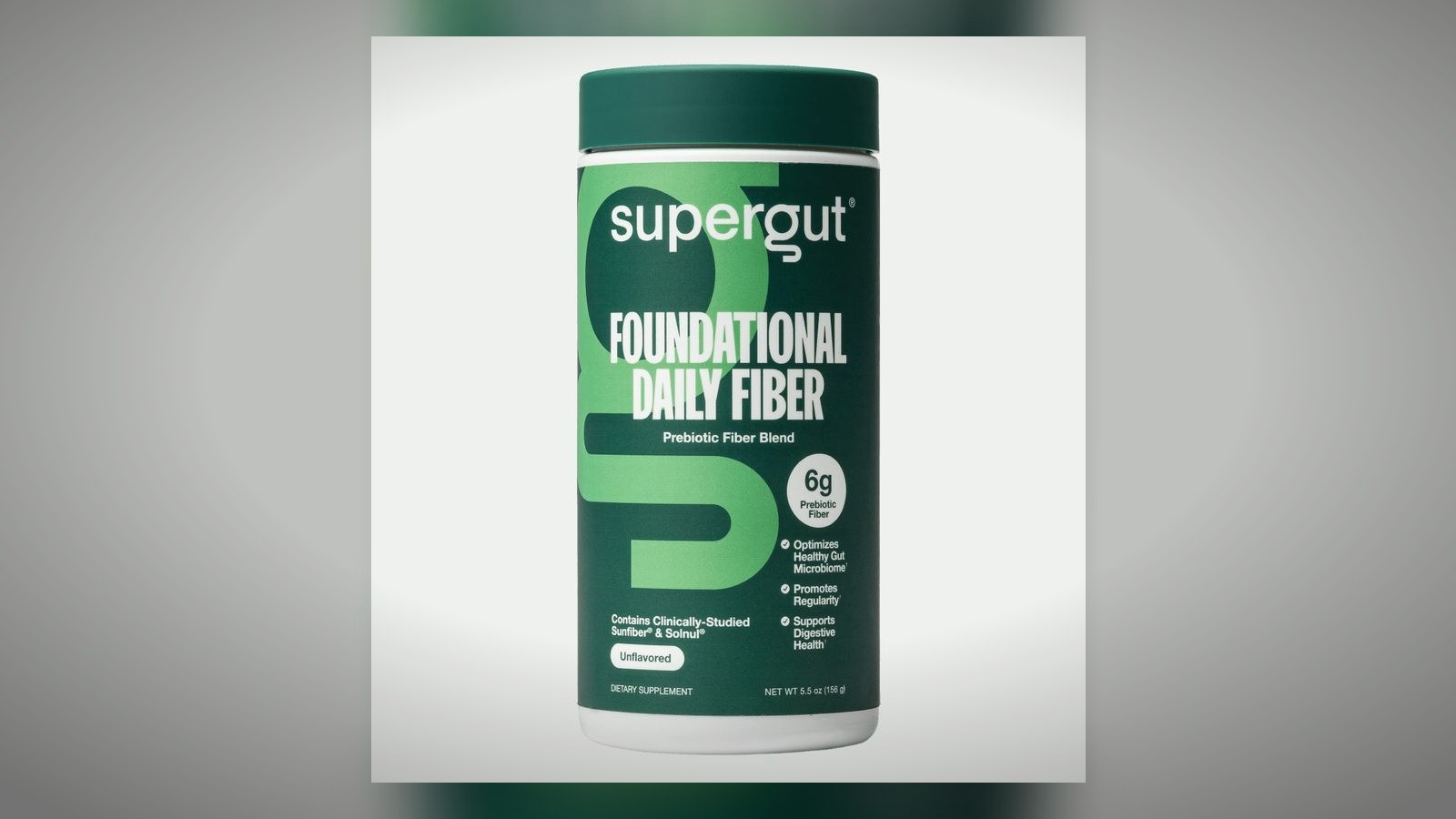
Supergut is a legit, widely sold prebiotic fiber brand, and its products do what fiber does: feed gut bacteria and steady your bathroom habits. What it can't show you is how much of each fiber you're getting, or that its powders and bars cut appetite. Its Foundational Daily Fiber is the best value in the range at about $1.25 a serving, and the bars are the weakest buy.
Supergut sells three things: a plain fiber powder, a GLP-1 branded fiber powder, and prebiotic bars. This review covers the whole company. The GLP-1 powder gets its own deep dive in our Supergut GLP-1 Booster review, fiber by fiber.
What Supergut sells, and what's in it
Supergut's core product, Foundational Daily Fiber, is a 6 g scoop of 4 fibers: Solnul resistant potato starch, soluble corn fiber, Sunfiber guar fiber and green banana resistant starch. Retail listings show 20 calories, 7 g of carbs and 6 g of fiber per scoop, 4 g of it soluble. The 4 fibers sit in a proprietary blend, so the label doesn't say how much of each you get.
The GLP-1 Daily Support powder (still sold in places as the Gut Healthy GLP-1 Booster) swaps the guar for oat beta-glucan and promises 6 to 7 g of fiber. The bars carry 10 g of prebiotic fiber and 10 g of protein each, with the brand saying under 2 g of sugar. Ingredient lists differ by flavor, and the Strawberry Almond bar lists tree nuts and dairy.
There's no caffeine and no stimulant anywhere in the range. These are fiber products, and they belong in our fiber and fullness category more than on any appetite-suppressant shelf.
Is Supergut legit?
Supergut is a real company selling real food fibers, stocked at Target, Walmart, H-E-B and Vitamin Shoppe as well as its own site. The fibers it uses are ordinary, studied ingredients, not invented compounds. The two named ones, Solnul and Sunfiber, are branded ingredients with their own published trials.
Where it gets slippery is the marketing. The GLP-1 powder leans on brand-run studies we couldn't find published, and the bars are pitched to stop mindless snacking. Fiber can help with fullness, but neither claim has a published trial on the finished product behind it.
Does Supergut work? The fiber evidence
Supergut's fibers have decent human evidence for gut bacteria and stool habits, and weak evidence for appetite. That split runs through every product in the range.
Resistant potato starch (Solnul)
In a 4-week placebo-controlled trial, 3.5 g a day of Solnul raised Bifidobacterium and Akkermansia more than placebo and cut both diarrhea-type and constipation-type bowel movements; 7 g did about the same (Bush, Nutrients 2023). The lead author works for the company that makes Solnul. Supergut doesn't list its Solnul dose, so you can't check whether a scoop reaches 3.5 g.
Sunfiber guar fiber
In a 3-month trial of 44 healthy adults who tended toward loose stools, partially hydrolyzed guar gum moved stool form toward normal compared with placebo, without changing how often people went (Yasukawa, Nutrients 2019). Several authors work for Taiyo Kagaku, which makes Sunfiber. It's a regularity result, not an appetite one.
Soluble corn fiber
Soluble corn fiber was well tolerated at 6, 12 and 18 g of fiber a day in a 2-week trial, and 6 g raised bifidobacteria the most (Costabile, PLoS One 2016). Each dose group had only 8 people, so treat it as a tolerance signal.
Green banana and resistant starch blends
A different company's blend of potato starch, green banana flour and apple fiber improved GI symptom scores at roughly 5 g of resistant starch a day over 6 weeks, but didn't detectably change short-chain fatty acids (Hanes, Frontiers in Nutrition 2022). It's a close cousin of Supergut's formula, not the same product.
Fullness and cravings
Resistant starch has a flat record on appetite in the cleanest test we know. In a 12-week trial of 59 adults with prediabetes, 45 g a day of resistant maize starch didn't change appetite ratings, buffet intake or gut hormones versus a control starch (White, Journal of the Academy of Nutrition and Dietetics 2020). That's a different starch at about 7 times Supergut's whole serving, so it warns against the premise rather than ruling on this blend. If fullness is your goal, psyllium has a much deeper human record, which our psyllium husk evidence review walks through.
Supergut side effects and complaints
The most common Supergut complaint is gas and bloating in the first week or two, which is what fermentable fiber does while your gut adjusts. The label itself says to increase intake gradually.
Start with half a scoop for a few days if fiber has bothered you before. Our explainer on why high-fiber, low-sugar snacks upset some stomachs covers the same fermentation problem at bigger doses. Pregnant, on medication or managing a condition? Ask your doctor first, since fiber can change how some drugs absorb.
Is Supergut gluten free?
Supergut's fiber powder is listed as gluten-free, dairy-free and vegan by retailers including Vitamin Shoppe, and the bars are sold as gluten-free. We didn't see a certified gluten-free seal on Supergut's own product pages, so if you have celiac disease, check the label on the tub you buy.
Price per serving
Supergut's Foundational Daily Fiber costs $50 for a 40-serving tub, or about $1.25 a serving; the 20-serving tub is $27 ($1.35) and 15 travel packets are $30 ($2.00). The GLP-1 powder runs $1.50 a serving on the 40-serving tub.
The bars are $40 for 12, about $3.33 each. That's a lot for 10 g of fiber. For comparison, our Metamucil psyllium fiber card shows a plain fiber supplement for a fraction of that.
Our verdict on Supergut
Supergut is a good fit if you eat too little fiber and want a flavorless powder for coffee or a smoothie. Only about 5% of Americans meet fiber recommendations (Quagliani, American Journal of Lifestyle Medicine 2016), so 6 g a day is a real top-up. Pick the Foundational Daily Fiber; the GLP-1 version costs more and its extra claims aren't backed by published data.
Skip it if you want doses you can check against studies, or if you're buying it to stop cravings. Our Supergut vs Metamucil comparison shows where psyllium wins on fullness evidence and price. The full scoring is on our Supergut product card, rated on our public methodology.
References
- Bush JR, Baisley J, Harding SV, Alfa MJ. Consumption of Solnul resistant potato starch produces a prebiotic effect in a randomized, placebo-controlled clinical trial. Nutrients, 2023. PubMed 37049425
- Yasukawa Z, Inoue R, Ozeki M, et al. Effect of repeated consumption of partially hydrolyzed guar gum on fecal characteristics and gut microbiota: a randomized, double-blind, placebo-controlled, and parallel-group clinical trial. Nutrients, 2019. PubMed 31509971
- Costabile A, Deaville ER, Morales AM, Gibson GR. Prebiotic potential of a maize-based soluble fibre and impact of dose on the human gut microbiota. PLoS One, 2016. PubMed 26731113
- Hanes D, Nowinski B, Lamb JJ, et al. The gastrointestinal and microbiome impact of a resistant starch blend from potato, banana, and apple fibers: a randomized clinical trial using smart caps. Frontiers in Nutrition, 2022. PubMed 36245486
- White U, Peterson CM, Beyl RA, Martin CK, Ravussin E. Resistant starch has no effect on appetite and food intake in individuals with prediabetes. Journal of the Academy of Nutrition and Dietetics, 2020. PubMed 32280055
- Quagliani D, Felt-Gunderson P. Closing America's fiber intake gap: communication strategies from a food and fiber summit. American Journal of Lifestyle Medicine, 2016. PubMed 30202317
- Supergut product range and prices: supergut.com, checked 2026-11-04. Foundational Daily Fiber label and diet listings: Vitamin Shoppe product page, checked 2026-11-04.
FAQ
Is Supergut legit?
Supergut is a legitimate fiber brand sold at Target, Walmart, H-E-B and Vitamin Shoppe, made from common food fibers such as resistant potato starch, guar fiber and soluble corn fiber. Its gut and regularity claims rest on published ingredient trials; its appetite and GLP-1 claims rest on brand studies we couldn't find published.
Does Supergut work?
Supergut's fibers have human trials showing more beneficial gut bacteria and steadier stool habits, such as 3.5 g a day of Solnul potato starch over 4 weeks. Evidence that these fibers reduce appetite or cravings is weak, and a 12-week trial of a high dose of resistant starch found no change in appetite.
What are the most common Supergut complaints?
Gas and bloating in the first week or two are the most common Supergut complaints, because the fibers are fermented by gut bacteria. Starting with half a scoop and building up slowly, as the label advises, usually helps. The bars also draw complaints about price at about $3.33 each.
Is Supergut gluten free?
Supergut's Foundational Daily Fiber is listed as gluten-free, dairy-free and vegan by retailers, and its bars are sold as gluten-free. We didn't find a certified gluten-free seal on Supergut's own pages, so people with celiac disease should check the tub's label.
Products mentioned
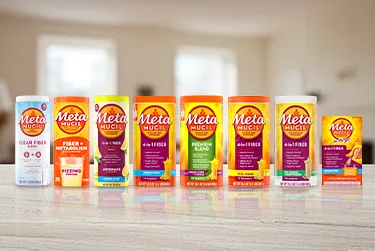
Metamucil 4-in-1 Fiber (Psyllium Husk)
Metamucil (Procter & Gamble) · powderBest Value: cheap, drinkable, and well-evidenced as a fiber — but single-pathway and a heavy gel load.
Pennies per serving — by far the cheapest in the set.
Single pathway — a fiber, not a craving formula.
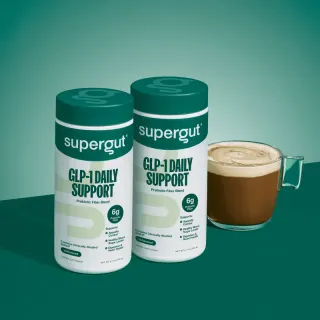
Supergut GLP-1 Daily Support
Supergut · powderA drinkable, gut-first option — but it leans on a proprietary fiber blend and a heavy fiber load.
Drinkable and caffeine-free.
Individual fiber doses are hidden inside a proprietary blend.