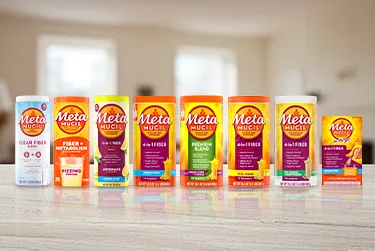
Metamucil 4-in-1 Fiber (Psyllium Husk)
by Metamucil (Procter & Gamble) · powder ·
Best Value: cheap, drinkable, and well-evidenced as a fiber — but single-pathway and a heavy gel load.
- Format
- powder Drink
- Best price
- $0.21 per serving
- Pathways
- 1 hunger dimensions
- Headline dose
- 3.4 g Psyllium husk
- Caffeine
- Caffeine-free evening-friendly
- Bloat risk
- Medium 3.4 g psyllium (start slow)
1/7 hunger pathways
- Fiber satiety (fullness) Psyllium husk, Soluble fiber
The short version
Metamucil is 3.4 g of psyllium husk per serving at about $0.21, the cheapest product in our set and the one with the deepest human evidence for cholesterol, post-meal blood sugar and short-term fullness. It's worth buying if you want a plain, caffeine-free fiber and you're willing to take 2 servings before meals, because one scoop was the weakest dose in the satiety trials. It isn't a craving product: it adds fullness, nothing more.
How it scores
Every score is derived from publicly verifiable facts. See the full methodology and Value Index formula.
Ingredients & doses
| Ingredient | Dose | Pathway | Notes |
|---|---|---|---|
| Psyllium husk | 3.4 g | Fiber satiety (fullness) | Total psyllium husk per serving (varies slightly by SKU). |
| Soluble fiber (from psyllium) | 2.4 g | Fiber satiety (fullness) | Soluble fiber content per serving. |
How it claims to work
Psyllium husk is a gel-forming soluble fiber that absorbs water to form a viscous gel, which the brand says promotes fullness, supports regularity, and helps maintain healthy blood sugar and cholesterol already in the normal range.
The evidence
Psyllium has reasonably strong human RCT evidence for cholesterol lowering, glycemic response, and regularity, and moderate evidence for short-term satiety; the strongest claims are digestive rather than weight loss.
Strengths
- Pennies per serving — by far the cheapest in the set.
- Psyllium has genuinely strong human evidence (digestive, glycemic, cholesterol).
- Drinkable and caffeine-free.
Watch-outs
- Single pathway — a fiber, not a craving formula.
- 3.4 g of gelling psyllium can cause bloating and gas, and must be drunk quickly before it thickens.
- Gritty gel texture is not for everyone.
Price & value
Taste & format: Powder mixed into 8 oz water; gels quickly so it must be drunk promptly. Flavored and unflavored SKUs; gritty texture is divisive.
Metamucil 4-in-1 Fiber (Psyllium Husk): the full review
What Metamucil is, and who it's for
Metamucil 4-in-1 Fiber is a psyllium husk powder from Procter and Gamble. Psyllium comes from the seed husks of Plantago ovata, and its one trick is that it grabs water and swells into a thick gel. That gel slows the meal down mechanically on its way through, which is the basis for every benefit anyone claims for it.
What sets psyllium apart from trendier fibers is that your gut bacteria mostly leave it alone. It passes through largely intact instead of fermenting into gas.
It fits someone who wants a cheap, well-studied fiber for fullness before meals, steadier post-meal blood sugar, or regularity. It doesn't fit someone whose problem is wanting something sweet after dinner, since it works on how full you are, not on the craving itself. The rest of the field is in our fiber and satiety category.
What the label says
A serving lists 3.4 g of psyllium husk, of which about 2.4 g is soluble fiber. You stir it into 8 oz of water and drink it promptly, because it thickens in the glass while you stand there. It comes in flavored and unflavored versions, and some flavored tubs are sweetened with sugar while others aren't, so read the label on the one you pick. Caffeine is 0 mg.
| Outcome | Metamucil serving | Dose in the trials |
|---|---|---|
| Fullness between meals | 3.4 g | 6.8 g gave the most consistent benefit; 3.4 g was the weakest arm |
| LDL cholesterol | 3.4 g | Median of about 10 g a day across 28 trials |
| Weight (pooled) | 3.4 g | Mean of 10.8 g a day, about 3 servings |
So the label dose is real psyllium at a real amount, and it's below what the trials used for every outcome. At this price that's an arithmetic problem rather than a dealbreaker, and we work through it below. For the ingredient on its own, see our psyllium deep dive.
What the evidence shows
Psyllium has the deepest file of any fiber in this aisle, and the strongest parts aren't about weight.
Cholesterol. An independent University of Toronto meta-analysis pooled 28 randomized trials in 1,924 people and found a median dose of about 10 g a day lowered LDL cholesterol by roughly 13 mg/dL and non-HDL cholesterol by about 15 mg/dL, with the evidence graded moderate to high quality (Jovanovski and colleagues, American Journal of Clinical Nutrition 2018).
Blood sugar. A meta-analysis of 35 trials found that in people being treated for type 2 diabetes, psyllium before meals lowered fasting glucose by about 37 mg/dL and HbA1c by roughly 0.97 points, with the benefit proportional to how much control had been lost; people with normal blood sugar got essentially nothing (Gibb and colleagues, American Journal of Clinical Nutrition 2015). Those authors were affiliated with a psyllium manufacturer, and the participants had a diagnosed condition and were often on medication, so read it as what the trial enrolled and measured, not as a product treating anything.
Fullness. Brum and colleagues tested 3.4 g, 6.8 g and 10.2 g before breakfast and lunch in randomized, double-blind, placebo-controlled crossover trials. All three doses moved hunger, desire to eat and fullness in the right direction, but 6.8 g gave the most consistent benefit and 3.4 g was the weakest (Appetite 2016). Two of the four authors worked for Procter and Gamble. An independent 2025 triple-blind crossover in 25 healthy adults found the same direction through a different door: psyllium baked into meatballs blunted the post-meal rise in glucose and triglycerides and lowered hunger for hours afterward (Günal and colleagues, Food Science and Nutrition 2025).
Weight. A pooled analysis of 6 trials in 354 people found psyllium before meals at a mean of 10.8 g a day, over roughly 4.8 months, produced 2.1 kg of weight loss, 0.8 kg/m2 of BMI and 2.2 cm off the waist (Gibb and colleagues, Journal of the American Association of Nurse Practitioners 2023). Manufacturer-affiliated authors again, and a small trial pool. The network meta-analysis that ranked 18 supplement ingredients put psyllium at 3.70 kg below placebo with moderate certainty, against 1.36 kg for glucomannan with low certainty (Shahinfar and colleagues, Pharmacological Research 2023). A few pounds over several months is a legitimate assist, nothing more.
Side effects, tolerability, and who should skip it
The firm rule: take it with plenty of water. Psyllium swells fast, and taken with too little liquid it can start gelling in the throat or esophagus before it reaches the stomach. There are documented cases of choking and blockage. Mix it, drink it promptly, and don't take it right before lying down.
The routine side effects are ordinary fiber ones: some gas, bloating, or changes in stool, worst if you ramp up too fast. In the Brum trials, adverse events were mostly mild digestive complaints at rates similar to placebo. The texture is what people quit over more than the side effects. The gel is gritty and divisive, and it has to be drunk before it thickens.
Psyllium's gel can slow the absorption of prescription medication taken alongside it, so space doses a couple of hours apart and check with a pharmacist. Skip it if you have any swallowing difficulty, and talk to your doctor first if you manage a health condition, since the trials above ran in people under medical care.
Price and value
A tub is $23.98 for 114 servings, about $0.21 a serving, which is by far the cheapest product in our set. The brand offers a subscription. We found no money-back guarantee listed.
The price is what makes the dose gap workable. Two servings gets you to the 6.8 g that performed best for fullness at about $0.42 a day. Three servings gets you to roughly 10.2 g, close to the 10.8 g average in the weight-loss pooled analysis, for about $0.63 a day.
Metamucil scores 17 out of 25 on our rubric, with 5 of 5 on value and 4 of 5 on science. It loses points on pathway coverage (2 of 5), because it's a fiber and nothing else, and on format and timing (3 of 5) for the gel load. The scoring logic is on our methodology page.
How to take it, and what to expect
Stir one serving into a full 8 oz glass of water and drink it right away, before a meal, so the gel is in place when food arrives. The satiety and blood sugar benefits in the trials both leaned on before-meal timing.
Start at one serving a day, or even half, for the first week, then build toward 2 servings a day if fullness is the goal. Expect some gas while you adjust. The fullness effect is immediate with the meal; the cholesterol and blood sugar numbers in the trials came over weeks to months at higher daily doses.
It's caffeine-free and won't affect sleep, so a serving before dinner is fine. What it won't do is switch off an after-dinner sweet craving.
How Metamucil compares
Against Lipozene, Metamucil wins on evidence and on price, and it isn't close. Psyllium had the larger pooled weight effect with better certainty, the stronger cholesterol and blood sugar record, and it ferments less. Lipozene's one advantage is the capsule. The full head-to-head is in Metamucil vs Lipozene.
Against Supergut, the two aren't substitutes. Supergut is 6 to 7 g of fermentable fiber aimed at gut bacteria at about $1.50 a serving, with the individual doses hidden in a blend. Metamucil has more evidence tied to appetite and costs a seventh as much. We compared them in Supergut vs Metamucil.
Metamucil also shows up in our blood sugar supplement rankings as the cheapest option with a glucose number attached, with the caveat that the trial behind it used about 4 servings a day. For the wider question of whether fiber deserves its current hype, see is fiber the next protein.
Frequently asked questions
Does Metamucil have caffeine?
No. Metamucil 4-in-1 Fiber contains 0 mg of caffeine. It's psyllium husk powder, so it can be taken in the evening without affecting sleep.
Does Metamucil work for appetite?
It takes a modest edge off between-meal hunger. In the main satiety trial, 6.8 g before breakfast and lunch gave the most consistent benefit, and the 3.4 g label serving was the weakest of the three doses tested. It adds fullness; it doesn't stop cravings.
What are the side effects of Metamucil?
Gas, bloating, or changes in stool, mostly while you ramp up. The serious risk is gelling in the throat or esophagus if it's taken with too little water, so always use a full 8 oz glass and drink it promptly. It can also slow absorption of medications taken at the same time.
How long does Metamucil take to work?
Fullness shows up with the meal you take it before. The cholesterol and blood sugar changes in the trials came over weeks to months at roughly 10 g a day, about 3 servings, not one.
How much does Metamucil cost?
About $23.98 for 114 servings, roughly $0.21 a serving, with a subscription available. Two servings a day, the dose that performed best for fullness, is about $0.42 a day.
How do you take Metamucil?
Stir one serving into 8 oz of water and drink it right away, before a meal. Start at one serving a day and build up over a week or two, and never take it right before lying down.
References
- Jovanovski E, Yashpal S, Komishon A, et al. Effect of psyllium (Plantago ovata) fiber on LDL cholesterol and alternative lipid targets, non-HDL cholesterol and apolipoprotein B: a systematic review and meta-analysis of randomized controlled trials. Am J Clin Nutr. 2018. PMID 30239559
- Gibb RD, McRorie JW, Russell DA, et al. Psyllium fiber improves glycemic control proportional to loss of glycemic control: a meta-analysis of data in euglycemic subjects, patients at risk of type 2 diabetes mellitus, and patients being treated for type 2 diabetes mellitus. Am J Clin Nutr. 2015. PMID 26561625
- Brum JM, Gibb RD, Peters JC, Mattes RD. Satiety effects of psyllium in healthy volunteers. Appetite. 2016;105:27-36. PMID 27166077
- Günal AM, Öngün Yılmaz H, Baş M. Enrichment of Hamburger Meatballs With Psyllium: Effects on Postprandial Lipidemia, Glycemia, Appetite, and Food Intake in a Triple-Blind Randomized Controlled Crossover Trial. Food Sci Nutr. 2025. PMID 41078451
- Gibb RD, Sloan KJ, McRorie JW. Psyllium is a natural nonfermented gel-forming fiber that is effective for weight loss: A comprehensive review and meta-analysis. J Am Assoc Nurse Pract. 2023;35(8):468-476. PMID 37163454
- Shahinfar H, Jayedi A, Torabynasab K, et al. Comparative effects of nutraceuticals on body weight in adults with overweight or obesity: A systematic review and network meta-analysis of 111 randomized clinical trials. Pharmacol Res. 2023;196:106944. PMID 37778464
This review is for education only and isn't medical advice. Product details are as the brand or its retailers list them. Talk to your doctor before starting any supplement.