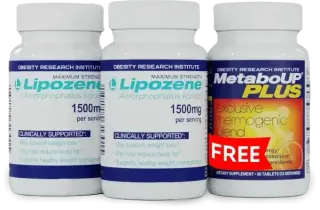
Lipozene
by Obesity Research Institute · capsule ·
Cheap single-ingredient glucomannan — fine as a fiber, but it does only one thing.
- Format
- capsule Pill
- Best price
- $1.00 per serving
- Pathways
- 1 hunger dimensions
- Headline dose
- 1500 mg Glucomannan
- Caffeine
- Caffeine-free evening-friendly
- Bloat risk
- Medium 1.5 g glucomannan
1/7 hunger pathways
- Fiber satiety (fullness) Glucomannan
The short version
Lipozene is a single-ingredient glucomannan capsule, 1.5 g per serving, at about $1.00 a serving. It's worth buying if you want a plain, disclosed viscous fiber you can swallow instead of drink, and you'll take it with a full glass of water before meals. It isn't worth buying as a weight-loss pill: the pooled trials put glucomannan at roughly 1 kg below placebo with low certainty, and Metamucil gets you more fiber evidence for a fifth of the price.
How it scores
Every score is derived from publicly verifiable facts. See the full methodology and Value Index formula.
Ingredients & doses
| Ingredient | Dose | Pathway | Notes |
|---|---|---|---|
| Glucomannan (konjac root fiber) | 1500 mg | Fiber satiety (fullness) | Per 2-capsule serving (up to 3 servings/day), taken with 8 oz water before meals. |
How it claims to work
A single-ingredient glucomannan capsule. The soluble fiber absorbs water and expands in the stomach to promote fullness; non-stimulant and caffeine-free.
The evidence
Glucomannan has some human support for modest satiety when taken before meals with water, but results are mixed and Lipozene’s marketing has drawn FTC scrutiny historically. Evidence is for the fiber generally, not this brand.
Strengths
- Single, disclosed ingredient.
- Inexpensive per serving.
- Caffeine-free.
Watch-outs
- One pathway only (fiber satiety).
- Must be taken with a full glass of water; expanding fiber carries a choking/blockage risk if not.
- Brand has a history of FTC scrutiny over marketing claims.
Price & value
Taste & format: Tasteless capsules taken with a full 8 oz glass of water 30 minutes before meals; up to 6 capsules daily.
Lipozene: the full review
What Lipozene is, and who it's for
Lipozene is a glucomannan capsule sold by Obesity Research Institute. Glucomannan is the soluble fiber from konjac root, and it has one unusual property: it absorbs water and swells into a thick gel, more so gram for gram than psyllium, oat beta-glucan or guar gum.
That gel is the whole pitch. Taken before a meal with water, it takes up room in the stomach and slows how fast food leaves, which is supposed to make you eat less. There's nothing else in the capsule, no caffeine and no proprietary blend.
It fits one kind of buyer: someone who wants a cheap, disclosed fiber in capsule form and won't drink a gel. It doesn't fit someone chasing cravings, since fiber fullness and the urge for something sweet are different problems. We cover the wider field in the fiber and satiety category.
What the label says
A serving is 2 capsules carrying 1,500 mg of glucomannan. The label allows up to 3 servings a day, each taken with 8 oz of water about 30 minutes before a meal, so the daily maximum is 6 capsules and 4.5 g of fiber.
| Item | Lipozene label | What the research used |
|---|---|---|
| Glucomannan per serving | 1,500 mg | About 1 g per pre-meal dose (EFSA satiety level, 3 g a day) |
| Daily total at label maximum | 4,500 mg | Roughly 2 to 4 g a day across the trials |
| Water | 8 oz per serving | A full glass every time, no exceptions |
That's the one place Lipozene lines up well. At 3 servings a day you're inside the range most glucomannan trials used, and above the 3 g a day that European regulators reference for a satiety claim. The dose isn't the weak point. The size of the effect is, and we go through that next.
For the ingredient on its own, see our glucomannan deep dive.
What the evidence shows
None of the research is on Lipozene itself. It's on glucomannan, which is fine, because the fiber is the only thing in the bottle.
The short-term fullness data is the encouraging part. Shang and colleagues ran a randomized crossover in 22 healthy adults and found that as the viscosity of a konjac preparation went up, stomach emptying slowed and hunger, fullness and desire to eat all shifted (Food and Function 2020). The catch in the same paper: the drop in how much people ate at lunch was small. Feeling fuller and eating less are two different outcomes.
The weight data is where the marketing outruns the trials. Sood and colleagues pooled 14 trials in 531 people and found glucomannan lowered body weight by about 0.79 kg, with its better results in LDL cholesterol (down about 16 mg/dL) and fasting glucose (American Journal of Clinical Nutrition 2008). Onakpoya and colleagues pooled 8 trials and found no statistically significant weight loss, a difference of roughly 0.22 kg (Journal of the American College of Nutrition 2014).
Two bigger poolings landed slightly higher and still small. Bessell and colleagues put glucomannan at 1.27 kg below placebo across placebo-controlled trials, then noted it missed the 2.5 kg threshold they'd set for clinical significance (International Journal of Obesity 2021). Shahinfar's network meta-analysis of 111 trials gave 1.36 kg, with the certainty rated low (Pharmacological Research 2023). In the same analysis psyllium came out at 3.70 kg with moderate certainty.
One capsule-format trial deserves a mention because it's closest to how Lipozene is taken. An 8-week trial at 1.33 g before each meal found nothing on weight, hunger or fullness (Keithley and colleagues, Journal of Obesity 2013). The fair read is a fiber with modest, repeatable effects on fullness and cholesterol, and a weight effect somewhere between nothing and about a kilogram.
Side effects, tolerability, and who should skip it
The water rule is the important one. Glucomannan swells aggressively, and taken dry or with too little liquid it can expand in the throat or esophagus before it reaches the stomach. Compressed glucomannan tablets were restricted or pulled in several countries for exactly this reason. Capsules with a full glass of water, and never right before lying down, avoid most of the concern.
The routine side effects are the usual fiber ones: gas, bloating, and loose stools or constipation, worst when you ramp up fast. Glucomannan is a fermentable fiber, unlike psyllium, and fermentation is what produces gas. A 180-day trial of a glucomannan, inulin and psyllium blend reported gastrointestinal side effects in 74.6% of the supplement group and none on placebo (Pokushalov and colleagues, Nutrients 2024). That was three fibers at once, so don't map the number onto one bottle, but it shows what a fast fiber ramp does to a lot of people.
Skip it if you have any swallowing difficulty, if you won't reliably take it with water, or if gas and bloating are what usually make you quit a fiber. Talk to your doctor first if you take daily medication, since a gel-forming fiber can slow absorption of other things taken alongside it.
Price and value
A bottle is $29.95 for 30 servings, about $1.00 a serving. The brand lists a 30-day money-back guarantee. We found no subscription option.
The per-serving number hides the real cost. At the label maximum of 3 servings a day you're spending about $3.00 daily and finishing a bottle in 10 days. Metamucil at 3 servings a day costs about $0.63 for roughly 10.2 g of psyllium, so you're paying about 5 times more for the fiber with the smaller pooled effect and the lower certainty rating.
Lipozene scores 12 out of 25 on our rubric, with its best mark on value (4 of 5) and its lowest on pathway coverage (1 of 5). The full scoring logic is on our methodology page.
One piece of brand history, stated precisely. In June 2005 the FTC filed a complaint and stipulated final order against Obesity Research Institute and FiberThin over ads for two other glucomannan products, FiberThin and Propolene. The defendants paid $1.5 million in consumer redress against a $41 million suspended judgment. That action didn't concern Lipozene, it's 21 years old, and the FTC notes a stipulated order isn't an admission of a violation. It's context on the company's advertising history, not a finding about the capsule.
How to take it, and what to expect
Take 2 capsules with a full 8 oz glass of water about 30 minutes before a meal, up to 3 times a day. Start at 1 serving a day for the first week and build up, because the gas and bloating show up fastest when people jump straight to the maximum.
What to expect: some extra fullness going into meals, which is the mechanism working. Don't expect a switch on cravings, and don't expect the scale to move much on the fiber alone. The regulators who allow a glucomannan weight claim in Europe only allow it inside an energy-restricted diet, which is the right frame: a helper, not the engine.
It's caffeine-free, so timing is flexible and an evening dose won't affect sleep.
How Lipozene compares
Against Metamucil, the comparison goes one way. Psyllium had the larger pooled weight effect with better certainty, it has the deeper cholesterol and blood sugar record, it ferments less, and it costs about a fifth as much per serving. Lipozene's only edge is the capsule. We ran the full head-to-head in Metamucil vs Lipozene.
Against Leanbean, the other glucomannan capsule in our set, Lipozene is half the dose per serving (1.5 g against 3 g) at about half the price, with the same water requirement and no extra actives. If glucomannan is all you want, Lipozene is the cheaper route to it.
For the full field of appetite products ranked on the same rubric, see our best appetite suppressant pills ranking and the stimulant-free options, where Lipozene sits at 12 of 25.
Frequently asked questions
Does Lipozene work?
It does what glucomannan does, which is modest. The fiber reliably adds some fullness before meals, but pooled trials put its weight effect between roughly 0.22 kg and 1.36 kg below placebo, with low certainty, and one analysis found it missed its own 2.5 kg threshold for clinical significance.
What are the side effects of Lipozene?
Gas, bloating, and loose stools or constipation, mostly when you ramp up too fast. The serious one is swelling in the throat or esophagus if it's taken with too little water, so the full glass per serving is a rule, not a suggestion.
How long does Lipozene take to work?
The fullness effect is immediate, within the meal you take it before. Any effect on weight in the trials showed up over weeks to months and was small, and a capsule trial at 1.33 g before each meal for 8 weeks found nothing on weight or hunger.
Does Lipozene have caffeine?
No. Lipozene is glucomannan only, with 0 mg of caffeine, so it can be taken before dinner without affecting sleep.
How much does Lipozene cost?
$29.95 for 30 servings, about $1.00 a serving, with a 30-day money-back guarantee. At the label maximum of 3 servings a day that's about $3.00 daily and a bottle every 10 days.
How do you take Lipozene?
2 capsules with a full 8 oz glass of water about 30 minutes before a meal, up to 3 times a day. Start with 1 serving daily and build up over a week or two.
References
- Sood N, Baker WL, Coleman CI. Effect of glucomannan on plasma lipid and glucose concentrations, body weight, and blood pressure: systematic review and meta-analysis. Am J Clin Nutr. 2008;88(4):1167-1175. PMID 18842808
- Onakpoya I, Posadzki P, Ernst E. The efficacy of glucomannan supplementation in overweight and obesity: a systematic review and meta-analysis of randomized clinical trials. J Am Coll Nutr. 2014. PMID 24533610
- Bessell E, Maunder A, Lauche R, Adams J, Sainsbury A, Fuller NR. Efficacy of dietary supplements containing isolated organic compounds for weight loss: a systematic review and meta-analysis of randomised placebo-controlled trials. Int J Obes. 2021;45(8):1631-1643. PMID 33976376
- Shahinfar H, Jayedi A, Torabynasab K, et al. Comparative effects of nutraceuticals on body weight in adults with overweight or obesity: A systematic review and network meta-analysis of 111 randomized clinical trials. Pharmacol Res. 2023;196:106944. PMID 37778464
- Shang L, Wang Y, Ren Y, et al. Gastric emptying characteristics of konjac glucomannan with different viscosity and its effects on appetite regulation. Food Funct. 2020;11(9):7596-7610. PMID 32869813
- Keithley JK, Swanson B, Mikolaitis SL, et al. Safety and efficacy of glucomannan for weight loss in overweight and moderately obese adults. J Obes. 2013;2013:610908. PMID 24490058
- Pokushalov E, Ponomarenko A, Garcia C, et al. The Impact of Glucomannan, Inulin, and Psyllium Supplementation on Weight Loss in Adults with FTO, LEP, LEPR, and MC4R Polymorphisms: A Randomized, Double-Blind, Placebo-Controlled Trial. Nutrients. 2024;16(4):557. PMID 38398881
This review is for education only and isn't medical advice. Product details are as the brand or its retailers list them. Talk to your doctor before starting any supplement.