Head to Head
Metamucil vs Lipozene: The Dose on the Label Isn't the Dose in the Studies
Two fibers, a five-fold price gap, and one number on each label that lands short of what the trials used.
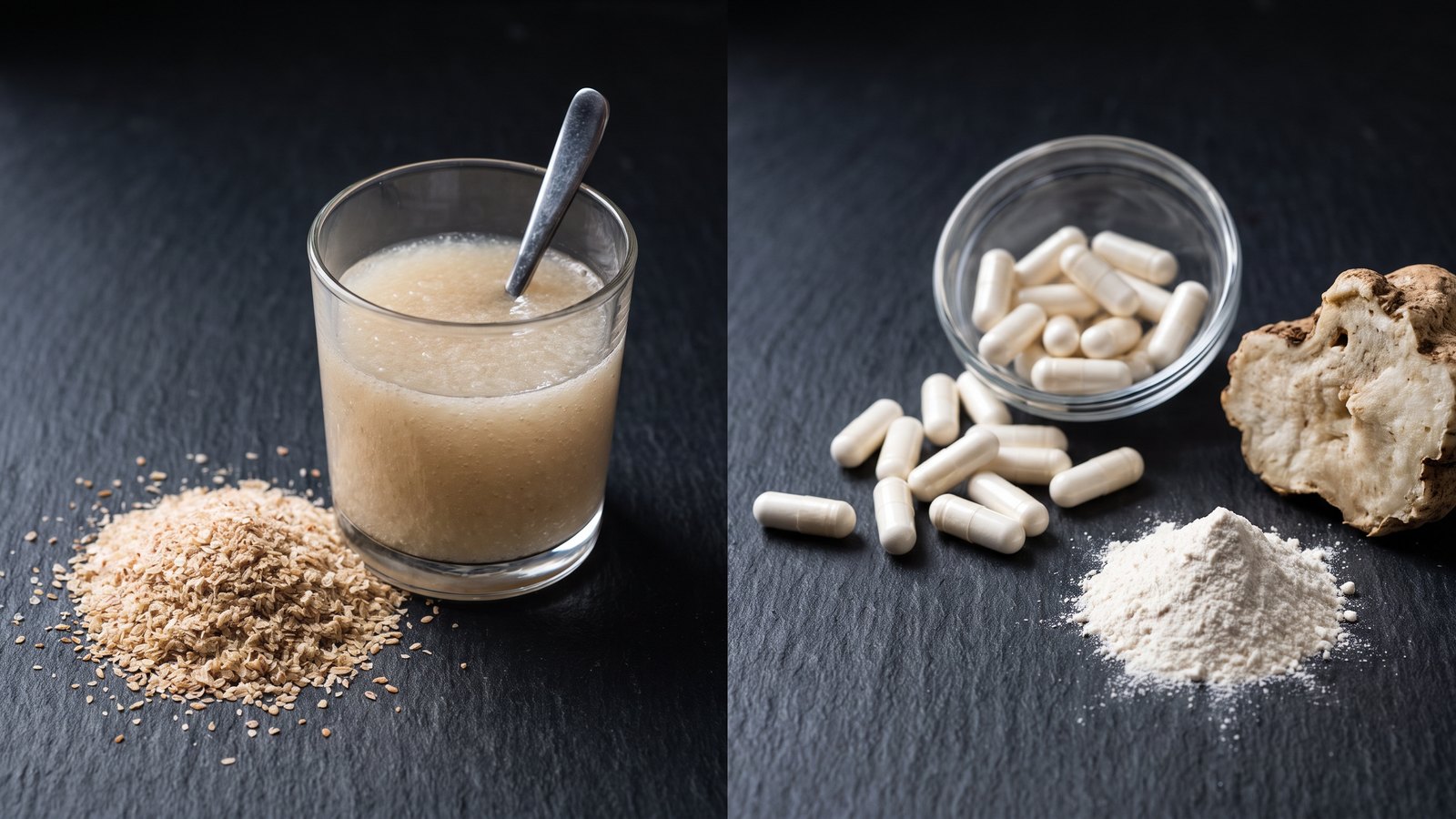
Put these two bottles side by side and the pitch sounds identical. A soluble fiber, taken with water before meals, that swells in your stomach so you eat less.
The prices are not identical. Metamucil works out to about $0.21 a serving. Lipozene is about $1.00. Same category, roughly five times the money.
The interesting question isn't which fiber is better in the abstract. It's whether either label gives you the amount that showed up in the trials. Neither one quite does, and they miss by different margins, in different directions, at very different costs.
What's actually in each bottle
Metamucil's 4-in-1 powder is psyllium husk, from the seed of Plantago ovata. A serving lists 3.4 g of psyllium, of which about 2.4 g is soluble fiber. You stir it into 8 oz of water and drink it fast, because it thickens in the glass while you're standing there.
Lipozene is glucomannan, the fiber from konjac root. A serving is 2 capsules carrying 1.5 g, with the label allowing up to 3 servings a day taken with a full glass of water 30 minutes before meals. Nothing else is in it. That single-ingredient honesty is genuinely a point in its favor, and it's rarer in this aisle than it should be.
So: 3.4 g of one fiber in a drink, 1.5 g of another in a capsule. Both are viscous soluble fibers. From there they diverge more than the shelf suggests.
The mechanism is viscosity, not milligrams
Both products sell you a gram count. What the research actually measures is thickness.
Shang and colleagues ran the cleanest demonstration of this we've found. They tested konjac glucomannan preparations at different viscosities, first in a mechanical human gastric simulator and then in a randomized crossover trial in 22 healthy adults who ate four different test breakfasts on four separate days, followed by a free-eating lunch (Food and Function 2020). As viscosity went up, stomach emptying slowed. Hunger, fullness, desire to eat and prospective food consumption all shifted significantly (p values of 0.006, 0.000, 0.002 and 0.001). Glucose and the satiety hormones, including GLP-1, PYY and CCK, moved with it.
Read the last line of that study carefully, though. Despite all of that, the drop in how much people actually ate at lunch was small. Feeling fuller and eating less are two different outcomes, and the gap between them is where most of this category oversells itself.
The practical upshot: a fiber that hydrates into a thick gel does more than a fiber that doesn't, and how you take it matters as much as how much. Psyllium in a glass has already started gelling before it reaches you. Glucomannan in a capsule has to dissolve, hydrate and expand on its own, which is exactly why the label insists on a full glass of water. That instruction isn't a formality. Dry expanding fiber is a swelling risk, and it's the one direction where this product can cause a real problem rather than just fail to help.
What the weight trials say when you line them up
Someone finally ranked these fibers against each other. Shahinfar and colleagues built a network meta-analysis of 111 randomized trials covering 6,171 adults with overweight or obesity, comparing 18 different supplement ingredients (Pharmacological Research 2023). Psyllium came out at 3.70 kg below placebo, with moderate certainty. Glucomannan came out at 1.36 kg below placebo, with the certainty rated low.
That is the single most direct comparison available, and it favors psyllium on both size and confidence. Hold it loosely anyway, because network meta-analysis compares across trials rather than head to head in the same room.
The glucomannan number is consistent across other reviews, which is its own kind of evidence. Bessell and colleagues pooled 67 placebo-controlled trials of isolated compounds and put glucomannan at 1.27 kg below placebo (International Journal of Obesity 2021). They also set a threshold for what counts as clinically meaningful at 2.5 kg, and reported that none of the supplements they analyzed reached it, glucomannan included. Sood and colleagues, working from 14 trials in 531 people, landed on 0.79 kg (American Journal of Clinical Nutrition 2008). Their finding was that glucomannan's better results were in cholesterol and fasting glucose, not the scale.
None of this makes glucomannan useless. It makes it a fiber with modest, repeatable effects that are smaller than the marketing around it.
The dose gap nobody puts on the front of the box
Here's where both labels get uncomfortable.
Brum and colleagues tested psyllium at 3.4 g, 6.8 g and 10.2 g before breakfast and lunch in randomized, double-blind, placebo-controlled crossover trials. All three doses moved hunger, desire to eat and fullness in the right direction. But the 6.8 g dose gave the most consistent benefit, and 3.4 g was the weakest of the three (Appetite 2016). Metamucil's serving is 3.4 g. The dose in the box is the one that performed least reliably in the study.
It gets starker for weight. Gibb and colleagues pooled 6 trials totaling 354 participants and found psyllium taken just before meals produced 2.1 kg of weight loss, 0.8 kg/m2 of BMI and 2.2 cm off the waist. The mean dose across those trials was 10.8 g a day, over roughly 4.8 months (Journal of the American Association of Nurse Practitioners 2023). That's about 3 Metamucil servings daily. Worth naming: those authors were at Procter and Gamble, which makes Metamucil, and the Brum trial carries the same affiliation. Read both with that attached.
Lipozene sits differently. At the label maximum of 3 servings you're taking 4.5 g of glucomannan a day, which does land inside the range most glucomannan trials used. So the dose isn't the flaw there. The ceiling on the effect is.
We work through each fiber on its own in the psyllium deep dive and the glucomannan review.
One of these fibers ferments. That's the tolerability story.
Psyllium is gel-forming and largely resistant to fermentation in the colon. Glucomannan is fermentable. That difference is the practical one, because fermentation is what produces gas.
The clearest signal we found on fiber tolerability came from a trial that combined all of this. Pokushalov and colleagues randomized 112 adults with obesity to a glucomannan, inulin and psyllium blend or placebo for 180 days and reported meaningful reductions in body weight and fat mass. They also reported gastrointestinal side effects in 74.6% of the supplement group and none in the placebo group (Nutrients 2024). Three fibers at once is a heavier load than either product here, so don't map that number onto a single bottle. It's a fair illustration of what ramping fiber fast does to a lot of people, which is the same lesson we drew from the high-fiber candy problem.
If gas and bloating are what usually make you quit, the nonfermented option is the safer bet. Start at half a serving either way.
The Lipozene brand history, stated precisely
This comes up in every discussion of Lipozene, usually garbled, so here is the verifiable version.
In June 2005 the FTC filed a complaint and stipulated final order against Obesity Research Institute, LLC and FiberThin, LLC, along with their owners and two endorsers, over marketing for two glucomannan-based supplements called FiberThin and Propolene. The agency's complaint said the ads made "Red Flag" claims, including rapid substantial weight loss with no need to diet or exercise. The defendants paid $1.5 million in consumer redress against a $41 million suspended judgment, and were permanently barred from making those claims or misrepresenting scientific studies. The FTC notes that a stipulated order is not an admission of a violation.
Obesity Research Institute markets Lipozene. That 2005 action concerned FiberThin and Propolene, not Lipozene, and it's 21 years old. It's context on the company's advertising history, not a finding about the product in the bottle today. The glucomannan inside is the same fiber studied in the papers above regardless of who sells it.
What each one costs at a dose that matched a study
Run the arithmetic on the doses that actually produced results, using our tracked prices.
Metamucil at 3 servings a day gets you to roughly 10.2 g, close to the 10.8 g average in the weight-loss pooled analysis, for about $0.63 a day. Lipozene at its own label maximum of 3 servings is 4.5 g of glucomannan for about $3.00 a day, which burns a 30-serving bottle in 10 days.
That is roughly five times the cost for the fiber with the smaller pooled effect and the lower certainty rating. If you want more glucomannan specifically, Leanbean runs 3,000 mg per serving, though it bundles other actives and costs more again.
The verdict
Metamucil wins this on evidence and on price, and it isn't close. Psyllium has the larger effect in the only analysis that ranked them together, the stronger non-weight record, and it doesn't ferment. The catch is that the win requires 2 to 3 servings a day, which nobody tells you, and 3.4 g once a day is not the protocol that produced those numbers.
Lipozene is defensible as one thing: a plain, disclosed glucomannan capsule for someone who won't drink a gel and wants a fiber they can swallow. You're paying a large premium for the capsule, and the evidence behind the fiber is modest even at full dose.
Neither is a craving product. Both create fullness by slowing the stomach down. If you're full and still want something sweet, more viscosity isn't the missing piece, and we went through what is in our roundup of appetite control supplements. The rest of the field sits in the fiber and satiety category, scored on the same five axes described in our methodology.
One line worth keeping from the older literature. Pittler and Ernst reviewed the whole over-the-counter weight-loss supplement field, glucomannan and psyllium included, and concluded there was no evidence beyond reasonable doubt that any specific one reduced body weight (American Journal of Clinical Nutrition 2004). Twenty-two years and a lot of trials later, the numbers have firmed up and stayed small. That's still the honest frame for both of these.
References
- Shahinfar H, Jayedi A, Torabynasab K, et al. Comparative effects of nutraceuticals on body weight in adults with overweight or obesity: A systematic review and network meta-analysis of 111 randomized clinical trials. Pharmacol Res. 2023;196:106944. PMID 37778464
- Bessell E, Maunder A, Lauche R, Adams J, Sainsbury A, Fuller NR. Efficacy of dietary supplements containing isolated organic compounds for weight loss: a systematic review and meta-analysis of randomised placebo-controlled trials. Int J Obes (Lond). 2021;45(8):1631-1643. PMID 33976376
- Sood N, Baker WL, Coleman CI. Effect of glucomannan on plasma lipid and glucose concentrations, body weight, and blood pressure: systematic review and meta-analysis. Am J Clin Nutr. 2008;88(4):1167-1175. PMID 18842808
- Brum JM, Gibb RD, Peters JC, Mattes RD. Satiety effects of psyllium in healthy volunteers. Appetite. 2016;105:27-36. PMID 27166077
- Gibb RD, Sloan KJ, McRorie JW. Psyllium is a natural nonfermented gel-forming fiber that is effective for weight loss: A comprehensive review and meta-analysis. J Am Assoc Nurse Pract. 2023;35(8):468-476. PMID 37163454
- Shang L, Wang Y, Ren Y, et al. Gastric emptying characteristics of konjac glucomannan with different viscosity and its effects on appetite regulation. Food Funct. 2020;11(9):7596-7610. PMID 32869813
- Pokushalov E, Ponomarenko A, Garcia C, et al. The Impact of Glucomannan, Inulin, and Psyllium Supplementation on Weight Loss in Adults with FTO, LEP, LEPR, and MC4R Polymorphisms: A Randomized, Double-Blind, Placebo-Controlled Trial. Nutrients. 2024;16(4):557. PMID 38398881
- Pittler MH, Ernst E. Dietary supplements for body-weight reduction: a systematic review. Am J Clin Nutr. 2004;79(4):529-536. PMID 15051593
- Federal Trade Commission. FTC Settles Claims with Marketers of FiberThin and Propolene. June 2005. ftc.gov
Citations retrieved via PubMed, plus the public FTC case record. This article is for education only and isn't medical advice. Talk to your doctor before starting any supplement, especially if you're pregnant, nursing, on medication, or managing a health condition.
FAQ
Is Metamucil or Lipozene better for weight loss?
On the available evidence, psyllium (Metamucil) has the stronger case. A network meta-analysis of 111 randomized trials put psyllium at 3.70 kg below placebo with moderate certainty and glucomannan (Lipozene) at 1.36 kg with low certainty. Both effects are small, and a separate review of 67 trials set a clinical significance threshold of 2.5 kg that glucomannan did not reach. Neither is a weight-loss treatment.
Does one serving of Metamucil match the dose in the studies?
No. A serving is 3.4 g of psyllium, which was the weakest of the three doses tested in the Brum satiety trials; 6.8 g gave the most consistent results. The pooled weight-loss analysis averaged 10.8 g a day, about 3 servings. At roughly $0.21 a serving you can afford to take more than one, but you should know the label dose is not the study dose.
Why does Lipozene tell you to take it with a full glass of water?
Because glucomannan absorbs water and expands, and the capsule has to hydrate somewhere. Taken with enough water it swells in the stomach, which is the intended mechanism. Taken dry or with too little, expanding fiber is a genuine swelling and blockage risk on the way down. Follow the label instruction exactly rather than treating it as boilerplate.
Which one causes less bloating?
Psyllium, generally. It forms a gel but largely resists fermentation in the colon, and fermentation is what produces gas. Glucomannan is fermentable. Neither is free of digestive side effects: a 180-day trial of a glucomannan, inulin and psyllium blend reported gastrointestinal events in 74.6% of the supplement group versus none on placebo. Start at half a serving and build up slowly either way.
What was the FTC case involving Lipozene's manufacturer?
In June 2005 the FTC filed a complaint and stipulated final order against Obesity Research Institute, LLC and FiberThin, LLC over ads for two glucomannan supplements, FiberThin and Propolene, alleging rapid-weight-loss claims made without diet or exercise. The defendants paid $1.5 million in consumer redress against a $41 million suspended judgment. That action concerned those two products, not Lipozene, and a stipulated order is not an admission of a violation.
Products mentioned
Metamucil 4-in-1 Fiber (Psyllium Husk)
Metamucil (Procter & Gamble) · powderBest Value: cheap, drinkable, and well-evidenced as a fiber — but single-pathway and a heavy gel load.
Pennies per serving — by far the cheapest in the set.
Single pathway — a fiber, not a craving formula.

Leanbean
Ultimate Life Ltd · capsuleA maximal glucomannan dose — which is also its risk: top-of-range fiber means you must take it carefully with plenty of water.
Glucomannan dosed at the full 3 g/day EFSA satiety level, fully disclosed.
At 3 g/day, glucomannan sits at the very top of the studied range — large glucomannan doses carry a documented risk of throat, esophageal, or GI blockage if not taken with enough water.
Lipozene
Obesity Research Institute · capsuleCheap single-ingredient glucomannan — fine as a fiber, but it does only one thing.
Single, disclosed ingredient.
One pathway only (fiber satiety).