Gut-Brain Science
What Is the Gut-Brain Axis, and Why Does It Decide What You Crave?
It explains why you're hungry, why stress lands in your stomach, and why your bacteria get a vote. It does not explain everything the internet says it does.
The gut-brain axis is the two-way communication network between your digestive tract and your brain. Signals travel in both directions, constantly, through four channels: the nervous system (mainly the vagus nerve), hormones released by your gut, metabolites made by your gut bacteria, and immune signals.
That's the short answer. The longer answer is more useful, because this network is doing something you feel every day: it's deciding when you're hungry, when you've had enough, and, to a degree people underrate, what you want to eat.
The phrase has also become a magnet for overclaiming. So we'll go through what's solid, what's promising, and which popular line about it is flatly wrong.
The four cables
According to research retrieved from PubMed, a 2025 review in Molecular and Cellular Endocrinology maps the whole system. It describes the gut-brain axis as a bidirectional network integrating endocrine, neural, and immune signals, with the gut microbiota as a critical component influencing gut hormones, neurotransmission, and neural development (Khan et al., 2025, DOI).
Break that into the four channels:
- Nerves. The vagus nerve is the main physical cable between gut and brain, and your gut also has its own nervous system (the enteric nervous system) embedded in its walls.
- Hormones. Your gut releases GLP-1, PYY, CCK, and ghrelin depending on what you've eaten and when. These are chemical messages about food.
- Microbial metabolites. Your bacteria ferment fiber into short-chain fatty acids like butyrate, and those molecules carry information.
- Immune signals. Most of your immune system lives near your gut, and inflammation is part of the conversation.
The important word is bidirectional. Your brain talks to your gut (which is why nerves make your stomach drop), and your gut talks back (which is why an empty one makes you irritable).
Hunger is a signal, not a character flaw
Here's the part that matters most for anyone fighting cravings.
When food arrives in your small intestine, specialized cells release GLP-1. That GLP-1 doesn't have to travel all the way to your brain through your bloodstream to do its job. It acts locally on vagal nerve endings sitting right there in the gut wall, and the nerve carries the message up.
A 2020 review in Peptides lays this out: intestinal GLP-1 is an endogenous satiation signal, and its effects on eating are primarily mediated by vagal afferents, the sensory fibers running gut to brain (Krieger, 2020, DOI). Your gut senses food and pulls a lever labeled "that's enough."
Sit with the implication. The feeling of having had enough is a physical signal, generated by your intestine, transmitted up a nerve. When that signal is weak or late, you eat more. That's not weak character, it's a communication problem.
The same review is honest about the gaps: the central circuits processing those vagal signals still aren't fully mapped, and whether GLP-1 signaling is genuinely broken in obesity remains unresolved. We took apart what "boosting" your own GLP-1 can realistically do here.
Your bacteria are in the conversation
Your gut bacteria ferment the fiber you eat and produce short-chain fatty acids, chiefly acetate, propionate, and butyrate. Those molecules are the microbiome's half of the dialogue.
A 2020 review in Frontiers in Endocrinology covers how SCFAs participate in gut-brain communication, feeding into neuro-immunoendocrine regulation. The authors are careful: they describe the mechanisms as speculated and not fully elucidated (Silva et al., 2020, DOI).
Butyrate is the one that gets the most attention, and a review in Advances in Nutrition titled it well: a double-edged sword. It fuels the cells lining your colon, supports the gut barrier, and has real effects on the gut-brain axis, while its role in obesity stays genuinely contested (Liu et al., 2018, DOI).
We went deep on butyrate specifically, including why swallowing it in a capsule is a different proposition from making it in your colon, in our butyrate and GLP-1 breakdown.
About that serotonin stat
You've seen this one: "95% of your serotonin is made in your gut, so your gut controls your mood."
The first half is true. The second half doesn't follow, and this is the most abused claim in the entire category.
The enterochromaffin cells scattered through your gut lining do produce over 95% of your body's serotonin, and only about 5% of it sits in the mature brain (Fouquet et al., 2018, DOI). Those numbers are real.
What gets skipped is where that serotonin goes and what it does. Serotonin doesn't freely cross the blood-brain barrier, so gut-made serotonin isn't topping up your brain. Your brain manufactures its own supply from tryptophan.
Look at what the landmark study actually measured. A 2015 paper in Cell showed that spore-forming bacteria from the gut microbiota promote serotonin production by colonic enterochromaffin cells, supplying the mucosa, the gut lumen, and circulating platelets. The downstream effects the researchers documented were gut motility and platelet function (Yano et al., 2015, DOI). Digestion and blood clotting. Not mood.
So your bacteria really do control most of your body's serotonin. That serotonin runs your plumbing. Anyone selling you a supplement on the strength of that 95% figure is relying on you not asking where it goes.
The "second brain" is a metaphor
Your gut has its own nervous system, and it's genuinely impressive: it can run local reflexes like moving food along without checking in with your head. That's what earned it the nickname.
It's still a metaphor. Your enteric nervous system doesn't think, plan, or feel. It coordinates digestion. Useful shorthand, bad literal claim, and it gets stretched hard in marketing copy.
Stress runs down the same wires
The gut-brain axis explains why anxiety shows up in your stomach, and the traffic in the other direction is being studied seriously.
A 2022 review in Brain Research Bulletin traces the brain-gut-microbiota axis in depression, including a striking experimental result: in rodents, cutting the vagus nerve blocked depression-like behavior that otherwise followed a fecal transplant from stressed animals. If severing the cable blocks the effect, the cable was carrying the message (Chang et al., 2022, DOI).
Two honest flags. That's rodent work, and the authors say plainly that the mechanisms underlying depression remain elusive. Nothing here means a probiotic treats a mood condition, and we're not going to imply it does.
The practical, uncontroversial version: stress changes how your gut behaves, and how your gut behaves changes how you feel. Most people already know this from experience. The research is filling in why.
What it means for cravings
Pull the threads together and you get a more useful model of appetite than willpower.
What you eat shapes which bacteria thrive. Those bacteria produce metabolites that influence the cells releasing your satiety hormones. Those hormones talk to your vagus nerve. Your vagus nerve tells your brain whether to keep eating. Meanwhile stress leans on the whole loop from the top.
A craving is the output of that system, not a moral event. Which reframes the question from "why am I so weak at 9pm" to "what's my gut actually signaling, and why."
It also explains why fiber keeps turning up in this conversation. Fiber is the raw material at the front of the chain, and it's the input with the deepest human evidence behind it. We looked at whether the fiber hype is earned in our piece on fiber as the next protein, and the products working this angle are in our GLP-1 support breakdown.
The honest limits
This field is exciting and young, which is a combination that produces a lot of overselling.
The 2025 review is candid about it: literature on the cellular and molecular mechanisms of the gut-brain axis is limited, and much of it is based on animal models (Khan et al., 2025). Mice are not small people. Plenty of clean rodent findings have failed to survive contact with human trials, and butyrate is a good example of exactly that.
What's solid: the network is real, the vagus nerve carries satiety signals, gut hormones like GLP-1 genuinely regulate how much you eat, and your microbiome participates. What's not solid: precise mechanisms, most claims about mood, and nearly every product promising to "fix" this axis. How we weigh evidence like this is in our scoring methodology.
The gut-brain axis is the best framework we have for understanding why appetite feels involuntary. It's also, right now, a better explanation than it is an instruction manual.
References
Based on articles retrieved from PubMed:
- Khan MT, Zohair M, Khan A, et al. From Gut to Brain: The roles of intestinal microbiota, immune system, and hormones in intestinal physiology and gut-brain-axis. Mol Cell Endocrinol. 2025. PubMed · DOI
- Krieger JP. Intestinal glucagon-like peptide-1 effects on food intake: Physiological relevance and emerging mechanisms. Peptides. 2020. PubMed · DOI
- Silva YP, Bernardi A, Frozza RL. The Role of Short-Chain Fatty Acids From Gut Microbiota in Gut-Brain Communication. Front Endocrinol. 2020. PubMed · DOI
- Liu H, Wang J, He T, et al. Butyrate: A Double-Edged Sword for Health? Adv Nutr. 2018. PubMed · DOI
- Fouquet G, Coman T, Hermine O, Côté F. Serotonin, hematopoiesis and stem cells. Pharmacol Res. 2018. PubMed · DOI
- Yano JM, Yu K, Donaldson GP, et al. Indigenous bacteria from the gut microbiota regulate host serotonin biosynthesis. Cell. 2015. PubMed · DOI
- Chang L, Wei Y, Hashimoto K. Brain-gut-microbiota axis in depression: A historical overview and future directions. Brain Res Bull. 2022. PubMed · DOI
FAQ
What is the gut-brain axis in simple terms?
It's the two-way communication network between your digestive tract and your brain. Messages travel in both directions through four channels: the nervous system (mainly the vagus nerve, plus your gut's own enteric nervous system), hormones your gut releases after eating like GLP-1 and ghrelin, metabolites your gut bacteria produce from fiber, and immune signals. It's why stress upsets your stomach and why an empty stomach affects your mood.
Is it true that 95% of serotonin is made in the gut?
The number is real, but the conclusion people draw from it usually isn't. Enterochromaffin cells in your gut lining do produce over 95% of your body's serotonin, and only about 5% sits in the brain. But serotonin doesn't freely cross the blood-brain barrier, so gut serotonin isn't topping up your brain, which makes its own from tryptophan. In the landmark study showing gut bacteria control serotonin production, the documented effects were on gut motility and platelet function, not mood.
How does the gut-brain axis affect cravings?
When food reaches your small intestine, cells there release GLP-1, which acts on vagus nerve endings in the gut wall and signals your brain that you've had enough. Fullness is a physical signal generated by your intestine and carried up a nerve, so when that signal is weak or late, you keep eating. Your gut bacteria feed into the same loop by producing short-chain fatty acids from fiber, and stress leans on it from the brain end.
Can you improve your gut-brain axis with supplements?
Be skeptical of anything promising to fix it. The network is real and well-documented, but the review literature is candid that much of the mechanistic work is based on animal models and the precise pathways aren't settled. Oral butyrate is a cautionary example: it looked strong in rodents and has been humbling in human trials. Eating more fermentable fiber is the input at the front of the chain with the deepest human evidence behind it.
Products mentioned

Metamucil 4-in-1 Fiber (Psyllium Husk)
Metamucil (Procter & Gamble) · powderBest Value: cheap, drinkable, and well-evidenced as a fiber — but single-pathway and a heavy gel load.
Pennies per serving — by far the cheapest in the set.
Single pathway — a fiber, not a craving formula.
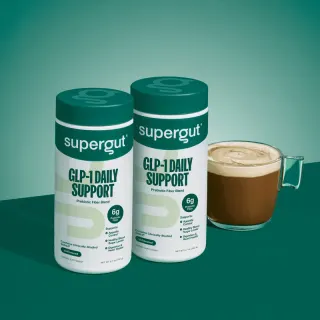
Supergut GLP-1 Daily Support
Supergut · powderA drinkable, gut-first option — but it leans on a proprietary fiber blend and a heavy fiber load.
Drinkable and caffeine-free.
Individual fiber doses are hidden inside a proprietary blend.
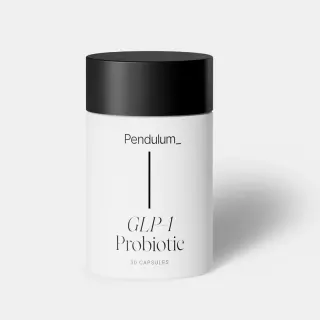
Pendulum GLP-1 Probiotic
Pendulum Therapeutics · capsuleStrong science pedigree on Akkermansia, but a proprietary CFU blend and refrigeration requirement.
Akkermansia has the strongest individual research pedigree of the probiotic actives.
Per-strain doses are hidden inside a proprietary blend.