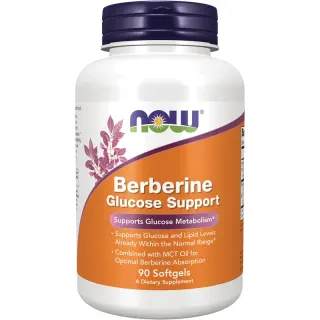
NOW Berberine Glucose Support
by NOW Foods · softgel ·
A cheap, no-frills berberine — same evidence, same berberine tolerability problem.
- Format
- softgel Pill
- Best price
- $1.00 per serving
- Pathways
- 2 hunger dimensions
- Headline dose
- 400 mg Berberine HCl
- Caffeine
- Caffeine-free evening-friendly
- Bloat risk
- Medium Berberine GI
2/7 hunger pathways
- Blood-sugar stability Berberine HCl, MCT Oil
- Insulin sensitivity
The short version
NOW Berberine Glucose Support is a cheap, no-frills way to take berberine at a dose close to what the trials used: 1,200 mg a day for about $1.00. It suits someone whose glucose or lipid numbers give berberine something to work on, who can keep a three-times-a-day schedule, who can handle the stomach effects, and who has cleared it with a doctor if they take any daily medication. It's a metabolic supplement, not a craving one, and nothing in its evidence base measured appetite.
How it scores
Every score is derived from publicly verifiable facts. See the full methodology and Value Index formula.
Ingredients & doses
| Ingredient | Dose | Pathway | Notes |
|---|---|---|---|
| Berberine HCl (from Berberis aristata bark) | 400 mg | Blood-sugar stability | Per softgel; label directs 1 softgel 3x daily (up to 1,200 mg/day). |
| MCT Oil | 700 mg | Blood-sugar stability | Lipid carrier intended to improve berberine absorption. |
How it claims to work
Berberine positioned to support healthy glucose metabolism already in the normal range, delivered in a softgel with MCT oil intended to improve absorption.
The evidence
Berberine itself has human RCT support for glucose and lipid markers; the MCT-oil delivery benefit is a brand rationale with limited independent confirmation. (Despite some listings, this product is berberine + MCT, not berberine + ALA.)
Strengths
- Inexpensive, disclosed berberine from a large reputable brand.
- Softgel + MCT may be a little easier on the stomach than powder-filled caps.
- Caffeine-free.
Watch-outs
- Berberine’s common GI side effects (cramping, diarrhea) still apply, especially across 1,200 mg/day.
- Three softgels a day, one per meal.
- Single-axis metabolic support, not a craving formula.
Price & value
Taste & format: Softgels taken one with each meal (3x daily); the schedule requires consistency.
NOW Berberine Glucose Support: the full review
What it is and who it is for
NOW Berberine Glucose Support is a softgel from NOW Foods that pairs berberine HCl with MCT oil. The brand positions it to support healthy glucose metabolism already in the normal range.
It's the budget pick in our berberine and metabolic category: more milligrams per day than the premium bottle, at a lower daily cost, from a large manufacturer. It scores 17 out of 25 on our rubric, level with Thorne.
It's for someone who wants berberine itself, at a dose that mirrors how the trials dosed it, and who will keep a one-with-each-meal routine for months. It isn't for someone chasing evening cravings. Berberine's trial record covers glucose, lipids and small changes in body weight, and none of it measured hunger or snacking.
What the label says
One softgel lists 400 mg of berberine HCl from Berberis aristata bark plus 700 mg of MCT oil. The label directs one softgel 3 times daily with food, which comes to 1,200 mg of berberine a day. A bottle holds 90 softgels, a 30-day supply at the label dose.
NOW states the medium-chain triglyceride is there to help absorption and keep the stomach comfortable. Treat that as a brand rationale. We haven't found independent human data confirming the MCT carrier does either job.
Despite some retail listings, this product is berberine plus MCT, not berberine plus alpha-lipoic acid. The label also warns against use while pregnant or nursing.
| Ingredient | On the label | Dose used in the research |
|---|---|---|
| Berberine HCl | 400 mg per softgel, 1,200 mg a day at 3 softgels | Roughly 1,000 to 1,500 mg a day, split across 2 or 3 meals, for months. A dose-response analysis put the efficient dose near 1 g a day. |
| MCT oil | 700 mg per softgel | No independent human trial of MCT as a berberine carrier that we could find. |
The dose match is the strongest thing about this bottle. The trials that built berberine's reputation used plain, poorly absorbed berberine at about this amount, split the same way.
What the evidence shows
Berberine has more human trials than almost anything in the supplement aisle, and nearly all of them enrolled adults with diagnosed type 2 diabetes, often alongside standard therapy. That's who the numbers below describe, and they were measured as a supplement added to treatment, not standing in for it.
Guo and colleagues pooled 46 randomized trials and reported HbA1c down 0.73 percentage points, fasting glucose down 0.86 mmol/L and 2-hour post-meal glucose down 1.26 mmol/L against control. Xie and colleagues pooled 37 trials covering 3,048 people and found fasting glucose down 0.82 mmol/L and HbA1c down 0.63 points.
The Xie analysis holds the most useful buying rule: the size of the effect tracked how high participants' numbers started. Berberine appears to work in a glucose-dependent way, so the closer your numbers already sit to normal, the less there is for it to move. A 2026 pooling that grouped berberine with probiotics found a smaller effect, 0.19 points on HbA1c, and called the improvements clinically modest and adjunctive.
Lipids are the second strong suit. Across 18 placebo-controlled trials with 1,788 people, berberine lowered LDL cholesterol by 0.46 mmol/L and triglycerides by 0.34 mmol/L.
Weight effects are real and small. A 2026 review of 23 randomized trials put body weight down 0.88 kg and waist circumference down 1.32 cm. Its authors also flagged weak reporting on purity and potency in the underlying studies, which is one argument for buying from a large manufacturer.
Timing matters more than labels admit. A dose-response meta-analysis landed on roughly 1 g a day as the efficient dose for lipids and weight and modeled the most efficient window for fasting glucose at about 40 weeks from the start. Our berberine deep dive covers the absorption problem behind those numbers: oral bioavailability sits under 1%, which is why the dose is large and split.
Side effects, tolerability and who should skip it
Stomach complaints are the reason most people quit berberine. Cramping, loose stools and constipation are common at 1,000 mg and up, and NOW's 1,200 mg a day sits above that line. In pooled placebo-controlled trials, gastrointestinal side effects were reported in 2% to 23% of people on berberine versus 2% to 15% on placebo, with no serious adverse events. The softgel-plus-oil format may be a little easier on the stomach than powder-filled capsules, though that's the brand's claim rather than a tested one.
The interaction list is the part most listings skip. In a randomized crossover trial, healthy men took 300 mg of berberine 3 times a day for 2 weeks, after which CYP2D6 and CYP2C9 activity fell and exposure to a CYP3A4 test drug rose 40%. A review of clinical herb-drug studies classed berberine as a weak inhibitor at common doses, which still matters for drugs with a narrow safety margin. In rats, a berberine-containing herb cut blood levels of cyclosporine by more than half.
Stacking berberine on prescription glucose-lowering drugs raises a real risk of blood sugar dropping too low. Skip it, or talk to a doctor or pharmacist first, if you take any daily medication and especially anything for glucose, if you're pregnant, nursing or trying to conceive, if your stomach is already touchy, or if you expect to feel something within a week.
Price and value
A 90-softgel bottle lists at $29.99. At the label dose of 3 a day that's 30 days and about $1.00 a day. There's no subscription and no money-back guarantee listed.
For context, Thorne Berberine lists 1,000 mg of berberine compounds per 2-capsule serving at $44 for 30 servings, about $1.47 a day. NOW delivers 1,200 mg for roughly 47 cents a day less. Thorne's counterargument is a phytosome with a human absorption study showing around 10 times higher bioavailability, but that study came from the ingredient maker's own research team, and no trial has compared the phytosome against plain berberine on outcomes. We walked through that trade in Thorne vs NOW Berberine.
Value scores 4 out of 5 here. It's the cheapest way in our set to take berberine at a studied dose.
How to take it and what to expect
One softgel with each meal, 3 times a day. That mirrors how most trials dosed, and the split exists for two reasons: berberine's short half-life and its habit of upsetting stomachs when it arrives all at once.
The schedule is the hidden cost. Three doses a day is harder to keep than Thorne's 2 capsules, and the dose you take at dinner is the last one you get. There's nothing left for a 9pm craving, and the research doesn't show berberine helping with that anyway.
Expect a slow, measurable job rather than a felt one. The research base points to months, with fasting glucose effects modeled to peak around 40 weeks. If a blood test gave berberine something to work on, that's the number to re-check. If you're otherwise healthy, the glucose-dependent effect means there may be little to move, and the right first step is a blood test rather than a bottle.
How it compares
Thorne Berberine is the same ingredient in a different jacket: fewer listed milligrams, a higher price, third-party contents certification and the phytosome bet. Our Thorne Berberine review covers it in full, interaction data included.
For a gentler route to steadier post-meal glucose with no drug-interaction list, a viscous fiber like Metamucil psyllium works through a different door at about 21 cents a serving. In one 8-week trial of 40 adults with type 2 diabetes, 10.5 g of soluble psyllium fiber a day, roughly 4 Metamucil servings, moved fasting glucose and HbA1c off a high baseline.
If you want the field ranked for glucose outcomes specifically, see our blood sugar supplement rankings. For pills aimed at appetite rather than glucose, the appetite suppressant pill rankings score NOW at 17 alongside the rest. The rubric is on our methodology page.
Frequently asked questions
Does NOW Berberine Glucose Support work?
The ingredient has a deep trial record: pooled analyses of randomized trials in adults with type 2 diabetes reported HbA1c down 0.63 to 0.73 percentage points and fasting glucose down about 0.8 mmol/L. The effect tracked how high people's numbers started, so someone already in the normal range has less to move. There's no trial on this specific product.
What are the side effects of NOW berberine?
Cramping, loose stools and constipation are the common ones, reported in 2% to 23% of people on berberine versus 2% to 15% on placebo in pooled trials. Berberine also slows the liver enzymes that clear many prescriptions and can add to glucose-lowering drugs, so check with a doctor or pharmacist if you take any daily medication. The label warns against use while pregnant or nursing.
How long does berberine take to work?
Months, not days. A dose-response meta-analysis modeled the most efficient window for fasting glucose at around 40 weeks from the start of supplementation. Nothing in the research supports expecting a change in the first week or two.
Does NOW Berberine Glucose Support contain caffeine?
No. It's caffeine-free, so timing isn't restricted by stimulants. The label still splits it into 3 doses with meals, which is how the trials dosed berberine.
How much does NOW berberine cost per day?
About $1.00. A 90-softgel bottle lists at $29.99, and at the label dose of one softgel 3 times daily that's a 30-day supply delivering 1,200 mg a day. There's no subscription option or money-back guarantee listed.
How do I take NOW berberine?
One softgel with each meal, 3 times a day, per the label. Splitting the dose with food is how the trials ran it and it's the standard way to reduce stomach upset. The three-a-day schedule is the main thing people find hard to keep.
References
- Guo J, Chen H, Zhang X, et al. The Effect of Berberine on Metabolic Profiles in Type 2 Diabetic Patients: A Systematic Review and Meta-Analysis of Randomized Controlled Trials. Oxid Med Cell Longev. 2021;2021:2074610. PMID 34956436
- Xie W, Su F, Wang G, et al. Glucose-lowering effect of berberine on type 2 diabetes: A systematic review and meta-analysis. Front Pharmacol. 2022;13:1015045. PMID 36467075
- Shadin M, Bhuia MS, Alfaifi M, et al. Probiotics, synbiotics and berberine in Type 2 diabetes mellitus: A systematic review, meta-analysis, and molecular dynamics simulation study. PLoS One. 2026;21(5):e0348907. PMID 42213651
- Blais JE, Huang X, Zhao JV. Overall and Sex-Specific Effect of Berberine for the Treatment of Dyslipidemia in Adults: A Systematic Review and Meta-Analysis of Randomized Placebo-Controlled Trials. Drugs. 2023;83(5):403-427. PMID 36941490
- Elahi Vahed I, Shahir-Roudi E, Nojumi S, et al. The effect of berberine on obesity indices: a systematic review and meta-analysis. Int J Obes (Lond). 2026;50(1):53-73. PMID 41310257
- Zamani M, Zarei M, Nikbaf-Shandiz M, et al. The effects of berberine supplementation on cardiovascular risk factors in adults: A systematic review and dose-response meta-analysis. Front Nutr. 2022;9:1013055. PMID 36313096
- Kong Y, Yang H, Nie R, et al. Berberine as a multi-target therapeutic agent for obesity: from pharmacological mechanisms to clinical evidence. Eur J Med Res. 2025. PMID 40506769
- Guo Y, Chen Y, Tan ZR, Klaassen CD, Zhou HH. Repeated administration of berberine inhibits cytochromes P450 in humans. Eur J Clin Pharmacol. 2012;68(2):213-7. PMID 21870106
- Hermann R, von Richter O. Clinical evidence of herbal drugs as perpetrators of pharmacokinetic drug interactions. Planta Med. 2012;78(13):1458-77. PMID 22855269
- Yu CP, Huang CY, Lin SP, Hou YC. Activation of P-glycoprotein and CYP 3A by Coptidis Rhizoma in vivo: Using cyclosporine as a probe substrate in rats. J Food Drug Anal. 2017;26(2S):S125-S132. PMID 29703381
- Petrangolini G, Corti F, Ronchi M, et al. Development of an Innovative Berberine Food-Grade Formulation with an Ameliorated Absorption: In Vitro Evidence Confirmed by Healthy Human Volunteers Pharmacokinetic Study. Evid Based Complement Alternat Med. 2021;2021:7563889. PMID 34904017
- Abutair AS, Naser IA, Hamed AT. Soluble fibers from psyllium improve glycemic response and body weight among diabetes type 2 patients (randomized control trial). Nutr J. 2016;15(1):86. PMID 27733151
This review is for education only and isn't medical advice. Product details are as the brand or its retailers list them. Talk to your doctor before starting any supplement.