Munchies Science
Does CBD Make You Hungry? What the Trials Show
CBD doesn't trip the munchies switch THC does. It can still change how much you eat, in either direction.
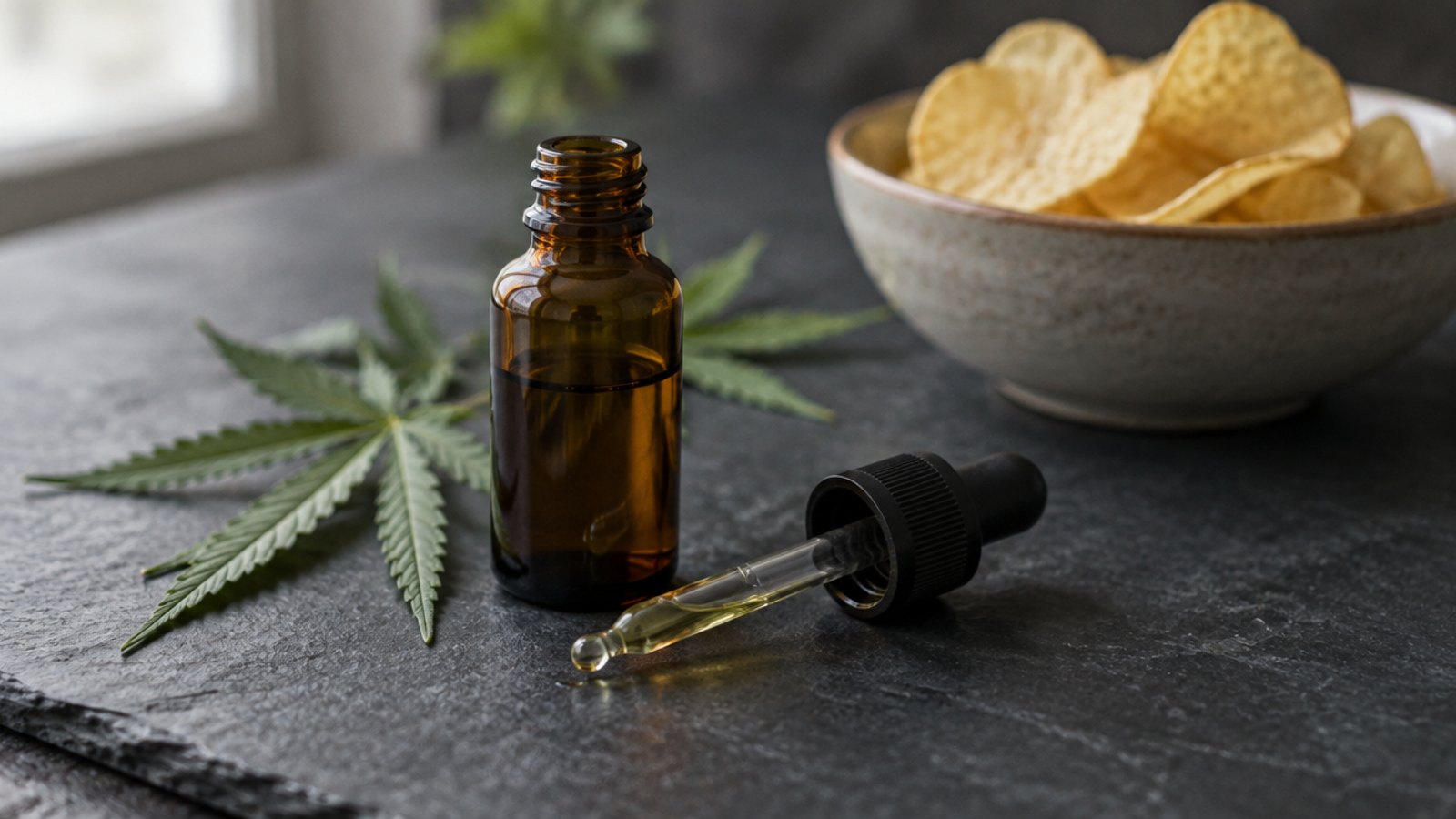
CBD can make you hungry, but it isn't reliable and it isn't the munchies. In the one trial built to test it, a single 298 mg dose made 15 healthy adults eat 193 more calories at lunch, even though they didn't feel any hungrier. At the much bigger doses used in epilepsy trials, the opposite shows up: reduced appetite is one of the most common side effects.
If a CBD product reliably sends you looking for snacks, look at two things before you blame the CBD: whether it's full-spectrum, and what else you took with it.
The one trial that measured eating after CBD
The cleanest test of CBD and hunger is a 2026 crossover trial from Loughborough University. Fifteen healthy adults took 298 mg of CBD isolate or a placebo, ate a standard breakfast 30 minutes later, then got an eat-as-much-as-you-like lunch 3 hours after the dose (Johnson and colleagues, Appetite 2026).
On CBD they ate 979 calories at lunch. On placebo, 786. That gap held up statistically, and the authors called it the first evidence that CBD isolate can raise how much people eat.
The strange part is how it happened. Hunger ratings didn't change. Ghrelin, the hormone that usually climbs as your next meal gets closer, ran lower after CBD. So people ate more without the usual hunger signal behind it (which is not how the munchies from weed feel at all).
Two limits matter. It was one dose in 15 people, and 298 mg is far more than most people take in a day. Check your own label before you assume the result applies to you.
Epilepsy trials point the other way
At prescription doses, CBD is more likely to cut appetite than raise it. In the long-term extension of a tuberous sclerosis trial, 199 patients took purified CBD at an average of 27 mg per kilogram of body weight per day, and 20% reported decreased appetite, making it one of the three most common side effects (Thiele and colleagues, Epilepsia 2022).
For a 70 kg (154 lb) adult, 27 mg per kg works out to about 1,890 mg a day. A 25 mg gummy is about 1/75 of that.
The appetite drop usually faded. In the main trial, diarrhea, decreased appetite and sleepiness were the most common side effects, and most of them resolved during the 16 weeks (Wu and colleagues, Epilepsia 2022). A 2026 meta-analysis of 46 studies and 2,592 patients with severe epilepsies found the same pattern: decreased appetite sat among the top side effects, mostly mild to moderate (de Oliveira and colleagues, CNS Drugs 2026).
The wider trial record leans the same way. A 2022 systematic review of 11 randomized trials found most reported less appetite, lower body weight or both, some found no change, and one found an increase (Pinto and Martel, Clinical Drug Investigation 2022). The reviewers flagged risk-of-bias concerns in most of them, and many of those trials enrolled patients who were also on other medicines.
Why CBD doesn't act like THC
CBD doesn't switch on the receptor that drives the munchies. THC activates CB1 receptors in the brain, which is the main reason weed makes you hungry through a fullness circuit, sharper smell and food that stays rewarding. In cell experiments, CBD did something different: it bound to a separate site on CB1 and turned down how strongly THC and the body's own cannabinoid 2-AG could signal through it (Laprairie and colleagues, British Journal of Pharmacology 2015).
That's a lab finding in cells, not a measured effect on eating in people. It does explain why nobody gets the classic munchies from pure CBD, and why the human results scatter in both directions instead of all pointing up.
Full-spectrum CBD can carry THC
A likely reason a "CBD" product makes someone hungry is the THC in it. When researchers tested 18 CBD tinctures sold online in the US, every full-spectrum product contained both delta-9 and delta-8 THC, and 2 of the broad-spectrum products contained delta-9 THC too. All stayed under the legal hemp limit, but 12 of the 18 had CBD amounts that missed the label by more than 10% (Sullivan and colleagues, Cannabis and Cannabinoid Research 2025).
Under the legal limit doesn't mean zero, and the munchies don't need you to feel high. We cover that split in the evidence on getting the munchies without the high.
If you want to rule THC out, buy isolate and read the batch lab report. It lists THC by name.
Taking CBD with food changes the dose
When you take CBD matters almost as much as how much you take. In a phase 1 trial in healthy adults, a high-fat meal raised the peak blood level of CBD about 4.85 times and total exposure about 4.2 times compared with taking it fasted (Taylor and colleagues, CNS Drugs 2018).
The same trial gave healthy adults up to 1,500 mg twice a day for a week. Diarrhea, nausea, headache and sleepiness were the most common side effects. Appetite wasn't among the main ones at those doses in healthy people, which is another sign the effect depends on who's taking it.
So a gummy taken with dinner can hit harder than the same gummy on an empty stomach. Edibles with THC work the same way, which is part of why edibles can bring on stronger munchies than smoking.
CBD won't cancel out the munchies from weed
Adding CBD to THC didn't soften THC's effects in the best trial on it. Forty-six healthy, infrequent cannabis users inhaled vaporized cannabis with 10 mg THC and 0, 10, 20 or 30 mg CBD across four visits. CBD at any of those ratios didn't change THC's effects on memory, psychotic symptoms, how high people felt, or the body measures the researchers tracked (Englund and colleagues, Neuropsychopharmacology 2023).
That trial didn't measure eating, so it can't rule out an appetite effect. But "high-CBD strains stop the munchies" isn't something any human data supports yet. The same goes for THCV, the cannabinoid sold as the real munchies blocker; see what the THCV research does and doesn't show.
If the munchies are the problem, timing and food choices do more than a ratio on a label. Our appetite and cravings hub ranks the options on the same public rubric.
References
- Johnson DA, Funnell MP, Cable TG, et al. A single dose of cannabidiol increases ad libitum energy intake in healthy adults but does not affect postprandial glucose or lipid metabolism. Appetite. 2026;222:108531. PubMed
- Thiele EA, Bebin EM, Filloux F, et al. Long-term cannabidiol treatment for seizures in patients with tuberous sclerosis complex: an open-label extension trial. Epilepsia. 2022;63(2):426-439. PubMed
- Wu JY, Cock HR, Devinsky O, et al. Time to onset of cannabidiol treatment effect and resolution of adverse events in tuberous sclerosis complex: post hoc analysis of randomized controlled phase 3 trial GWPCARE6. Epilepsia. 2022;63(5):1189-1199. PubMed
- de Oliveira HM, Oliveira Fonseca PE, Trejo Elías JE, et al. Cannabidiol use in developmental and epileptic encephalopathies: a syndrome- and age-stratified systematic review and meta-analysis. CNS Drugs. 2026;40(7):973-995. PubMed
- Pinto JS, Martel F. Effects of cannabidiol on appetite and body weight: a systematic review. Clinical Drug Investigation. 2022;42(11):909-919. PubMed
- Laprairie RB, Bagher AM, Kelly MEM, Denovan-Wright EM. Cannabidiol is a negative allosteric modulator of the cannabinoid CB1 receptor. British Journal of Pharmacology. 2015;172(20):4790-4805. PubMed
- Sullivan Z, Lapierre C, Weiser Erlandson L, Pham L. Substances of health concern: label accuracy of cannabidiol and tetrahydrocannabinol in commercial cannabidiol tinctures from the United States. Cannabis and Cannabinoid Research. 2025. PubMed
- Taylor L, Gidal B, Blakey G, Tayo B, Morrison G. A phase I, randomized, double-blind, placebo-controlled, single ascending dose, multiple dose, and food effect trial of the safety, tolerability and pharmacokinetics of highly purified cannabidiol in healthy subjects. CNS Drugs. 2018;32(11):1053-1067. PubMed
- Englund A, Oliver D, Chesney E, et al. Does cannabidiol make cannabis safer? A randomised, double-blind, cross-over trial of cannabis with four different CBD:THC ratios. Neuropsychopharmacology. 2023;48(6):869-876. PubMed
FAQ
Does CBD give you the munchies?
CBD on its own doesn't cause the classic munchies, because it doesn't activate the CB1 receptor the way THC does. One 2026 trial did find that 298 mg of CBD isolate made 15 healthy adults eat 193 more calories at lunch, with no change in how hungry they felt.
Does full-spectrum CBD make you hungrier than CBD isolate?
Full-spectrum CBD is more likely to make you hungry because it can contain THC. In a test of 18 US tinctures, every full-spectrum product contained delta-9 and delta-8 THC, though all stayed under the legal hemp limit. CBD isolate with a clean lab report removes that variable.
Does CBD stop the munchies from weed?
CBD hasn't been shown to cancel the munchies. In a trial of 46 infrequent cannabis users, adding up to 30 mg of CBD to 10 mg of THC didn't change THC's effects on memory, mood or how high people felt. That trial didn't measure eating, so the question is still open.
Can CBD lower your appetite?
Reduced appetite is a common side effect of CBD at prescription doses. In a long-term epilepsy study, 20% of patients taking about 27 mg per kilogram a day reported it, and it usually eased over time. That dose is roughly 75 times a 25 mg gummy for a 70 kg adult, so it says little about everyday products.
Products mentioned

Metamucil 4-in-1 Fiber (Psyllium Husk)
Metamucil (Procter & Gamble) · powderBest Value: cheap, drinkable, and well-evidenced as a fiber — but single-pathway and a heavy gel load.
Pennies per serving — by far the cheapest in the set.
Single pathway — a fiber, not a craving formula.
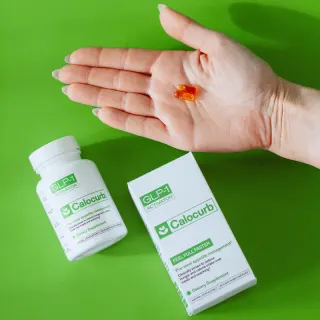
Calocurb GLP-1 Activator
Calocurb · capsuleThe best-evidenced single-mechanism appetite trigger — clinically interesting, but premium-priced and a pre-meal, short-window tool rather than all-day support.
Amarasate is one of the most directly studied appetite ingredients — multiple human RCTs, dosed on-label at 250 mg.
Acute, short-window effect: a pre-meal tool (up to 4 capsules/day), not all-day craving support.