Munchies Science
Can You Get the Munchies Without Being High? What the Studies Show
Feeling high and eating more usually arrive together. In the lab, they come apart.
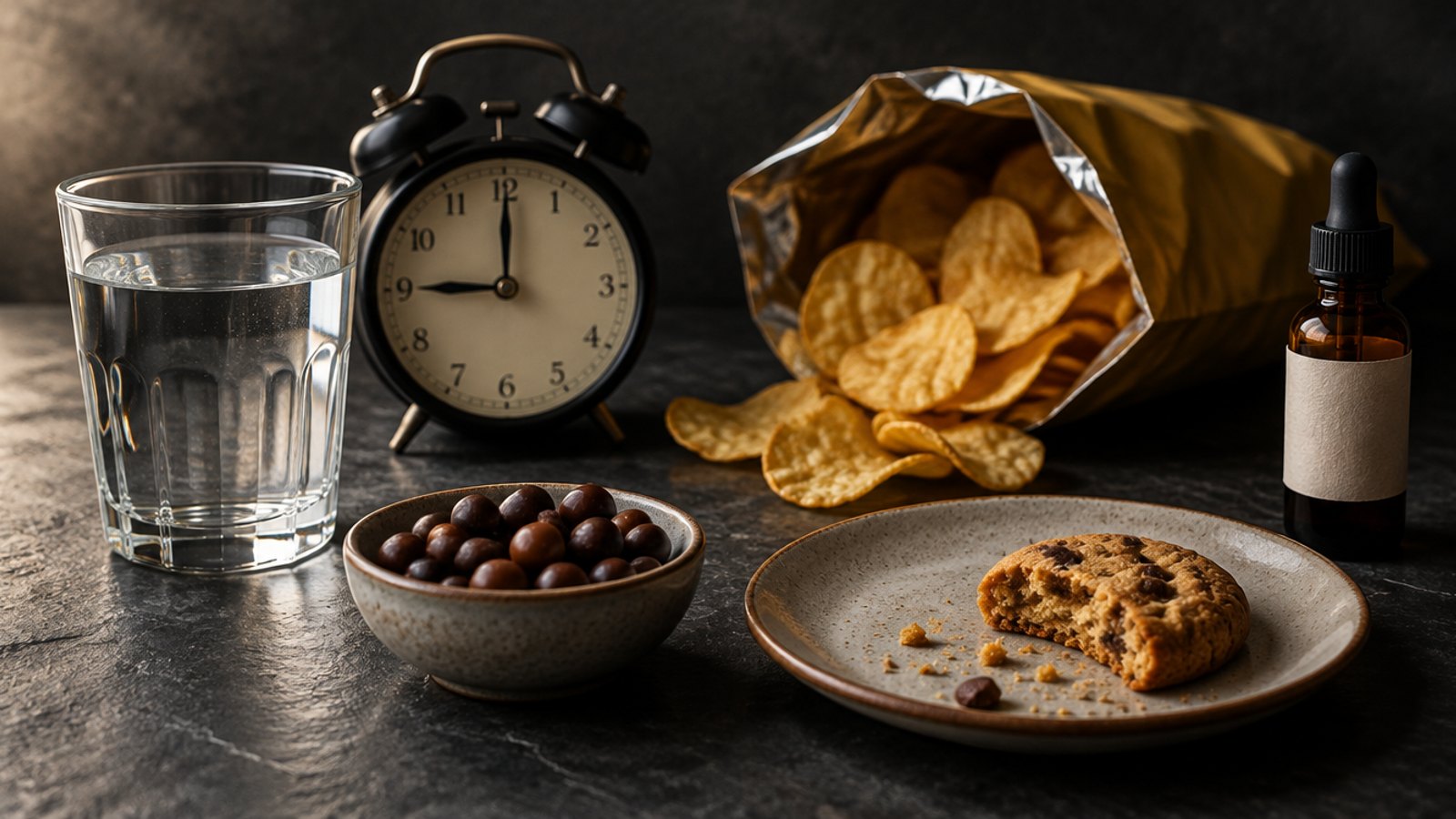
The munchies and the high are separate effects of THC, and in a 20-day lab study of 12 cannabis smokers they came apart: the high faded as tolerance built, while food intake stayed 35 to 45% above baseline. So you can be eating like you're stoned without feeling stoned.
THC isn't the only route either. A single large dose of CBD raised lunch intake in a 2026 trial, short sleep turns up the body's own cannabinoids, and plain evening hunger gets called the munchies all the time.
The high and the munchies are two separate effects
Tolerance wore down the high in the best study on this question, and it left the eating alone. Researchers at Columbia housed 6 men and 6 women, all regular cannabis smokers, in a residential lab for 20 days and gave them THC capsules 4 times a day: 20 mg per dose for 4 days, and later 30 mg per dose for 4 days (Haney and colleagues, Psychopharmacology 1999).
THC raised ratings of "High" and pushed food intake up by 35 to 45%. Then the two split. In the authors' words, tolerance developed to the subjective effects of THC but not to its effects on food intake.
That lines up with a 2025 study of vaporized cannabis, where people ate more in the first 30 minutes snacks were available whatever dose they'd been given (Hume and colleagues, PNAS 2025). The rat half of that paper traced the eating to CB1 receptors in the brain, with no change in circulating appetite hormones.
Two cautions. The Columbia doses were heavy (80 to 120 mg a day), and it's one study of 12 people. But if you use cannabis most days and feel like it barely touches you anymore, that's not evidence your appetite got the same memo. The timing still follows the drug, which we mapped in our timeline of how long the munchies last by route.
Low-dose THC raised appetite at 2.5 mg, in one specific group
A dose of 2.5 mg of THC twice a day raised appetite in a placebo-controlled trial, but the people in it were patients who had lost their appetite to illness. The trial randomized 139 patients with AIDS-related appetite loss to prescription THC (dronabinol) or placebo, and 88 could be evaluated (Beal and colleagues, Journal of Pain and Symptom Management 1995).
Appetite rose 38% above baseline on THC against 8% on placebo. Side effects were mostly mild to moderate, and euphoria was on the list, so this wasn't a dose nobody could feel.
Here's the gap. We couldn't find a study that gave healthy adults a THC dose too small to notice and then measured what they ate. A low-dose gummy that leaves you feeling normal may still nudge appetite, and the 1995 trial makes that plausible. It doesn't prove it for someone who is healthy and already hungry on schedule.
If you take a small edible and wonder whether the snacking an hour later is related, the clock fits. Edible effects take 30 to 60 minutes to register, which we cover in our breakdown of when the munchies kick in for smoking, vaping and edibles.
CBD and the munchies: one new trial says more, older trials say less
CBD doesn't get you high, and in one 2026 trial a single dose still made people eat more. Researchers at Loughborough University gave 15 healthy adults 298 mg of CBD or a placebo in a double-blind crossover, fed them a standard breakfast 30 minutes later, and offered an eat-as-much-as-you-like lunch at the 3 hour mark (Johnson and colleagues, Appetite 2026).
After CBD, people ate 193 more calories at lunch (979 against 786). They didn't report feeling hungrier, and their ghrelin, a hormone that normally rises with hunger, ran lower. The authors called it the first evidence that CBD isolate can raise energy intake in humans.
The older research points the other way. A 2022 systematic review found 11 randomized trials that reported on CBD and appetite or body weight. Most reported reduced appetite, reduced weight or both, some found no change, and one found an increase (Pinto and Martel, Clinical Drug Investigation 2022). The reviewers flagged risk-of-bias concerns in most of them.
So the fair read on CBD is "mixed", with one small, well-controlled trial now pointing up. Two practical notes. 298 mg is a large dose, so check it against your own label. And full-spectrum CBD products can contain some THC; the lab report says how much.
The day after: the lab data found less eating, not more
Leftover munchies the day after cannabis didn't show up in the two residential studies we found. When daily dosing stopped, eating dropped. In a 21-day study of 12 cannabis smokers, switching from active to placebo cannabis brought more anxiety, irritability and stomach pain, and a significant fall in food intake compared with baseline (Haney and colleagues, Psychopharmacology 1999).
The oral THC study from the same group put a number on it: food intake fell 20 to 30% below baseline in the days after dosing stopped.
Both studies dosed people 4 times a day for days on end, so they describe stopping after steady use. Nobody has run the clean version for a single evening. But if you're unusually hungry the morning after, the next two causes are better suspects than THC still working.
Short sleep turns up your body's own cannabinoids
Sleep restriction raised the body's own cannabinoid signal and made snacks harder to refuse in a randomized crossover study. Healthy young adults spent 4 nights at 8.5 hours in bed and 4 nights at 4.5 hours while researchers tracked 2-arachidonoylglycerol (2-AG), which acts on the same receptor system THC does (Hanlon and colleagues, Sleep 2016).
Short sleep amplified the daily 2-AG rhythm and stretched its afternoon peak. Hunger and appetite rose with that peak, and participants were less able to hold back on palatable snacks.
Tasty food seems to pull the same lever. In a pilot study, 8 healthy adults who had already eaten were given either a favorite food or a plain food matched for calories and nutrients. Eating for pleasure raised blood levels of 2-AG and ghrelin; the plain food didn't (Monteleone and colleagues, Journal of Clinical Endocrinology and Metabolism 2012). Eight people is a small sample, so treat it as a lead.
That's the munchies with no cannabis anywhere in the picture: a tired body, a raised cannabinoid signal, and food that suddenly looks better than it should.
Evening hunger that gets called the munchies
Hunger peaks around 8 PM because of the body clock, with or without anything else on board. In a 13-day lab protocol that spread meals and sleep evenly around the clock, 12 healthy adults showed a built-in hunger rhythm with its low point near 8 AM and its high point near 8 PM, a 17% swing (Scheer and colleagues, Obesity 2013). Appetite for sweet, salty and starchy food peaked at the same hour.
A lot of what people describe as sober munchies is that curve. We went through the hormone timing in our explainer on why the munchies hit at night, and the habits that blunt it in our guide to stopping nighttime snacking.
How to tell which one you've got
- You used cannabis in the last few hours and feel fine: assume THC. In the tolerance study the eating outlasted the high.
- You took CBD only: check the dose and whether the product is full-spectrum. One trial at 298 mg found more eating; most older trials found less.
- You slept 5 hours: the afternoon and evening pull toward snacks matches the sleep data.
- It's 9 PM and it happens every night: that's the body clock, and it responds to dinner timing and protein more than to anything in a capsule.
On products: no supplement has been tested on cannabis-driven eating, with or without the high. We compare what's sold for it, on what can be verified, in our comparison of supplements for the munchies, and the wider field sits in our appetite suppressant reviews and rankings.
The bottom line
Feeling high and eating more are separate effects. In one residential study, tolerance erased the first and left the second at 35 to 45% above baseline. CBD's record is mixed, with one 2026 trial showing 193 extra calories at lunch. And short sleep or the 8 PM hunger peak can produce the same pull with no cannabis involved.
References
- Haney M, Ward AS, Comer SD, Foltin RW, Fischman MW. Abstinence symptoms following oral THC administration to humans. Psychopharmacology (Berl). 1999;141(4):385-394. PubMed 10090646
- Hume C, Cuttler C, Baglot SL, et al. Cannabis produces acute hyperphagia in humans and rodents via increased reward valuation for, and motivation to, acquire food. Proc Natl Acad Sci U S A. 2025;122(52):e2518863122. PubMed 41439716
- Beal JE, Olson R, Laubenstein L, et al. Dronabinol as a treatment for anorexia associated with weight loss in patients with AIDS. J Pain Symptom Manage. 1995;10(2):89-97. PubMed 7730690
- Johnson DA, Funnell MP, Cable TG, et al. A single dose of cannabidiol increases ad libitum energy intake in healthy adults but does not affect postprandial glucose or lipid metabolism. Appetite. 2026;222:108531. PubMed 41825697
- Pinto JS, Martel F. Effects of cannabidiol on appetite and body weight: a systematic review. Clin Drug Investig. 2022;42(11):909-919. PubMed 36180814
- Haney M, Ward AS, Comer SD, Foltin RW, Fischman MW. Abstinence symptoms following smoked marijuana in humans. Psychopharmacology (Berl). 1999;141(4):395-404. PubMed 10090647
- Hanlon EC, Tasali E, Leproult R, et al. Sleep restriction enhances the daily rhythm of circulating levels of endocannabinoid 2-arachidonoylglycerol. Sleep. 2016;39(3):653-664. PubMed 26612385
- Monteleone P, Piscitelli F, Scognamiglio P, et al. Hedonic eating is associated with increased peripheral levels of ghrelin and the endocannabinoid 2-arachidonoyl-glycerol in healthy humans: a pilot study. J Clin Endocrinol Metab. 2012;97(6):E917-E924. PubMed 22442280
- Scheer FA, Morris CJ, Shea SA. The internal circadian clock increases hunger and appetite in the evening independent of food intake and other behaviors. Obesity (Silver Spring). 2013;21(3):421-423. PubMed 23456944
Citations retrieved via PubMed. This article is for education only and isn't medical advice. Cannabis laws and effects vary; talk to a clinician about your own situation.
FAQ
Can you get the munchies without being high?
The munchies can happen without feeling high. In a 20-day residential study of 12 cannabis smokers given oral THC, tolerance developed to the high but not to the eating, and food intake stayed 35 to 45% above baseline.
Does CBD give you the munchies?
CBD's effect on appetite is mixed across studies. A 2026 crossover trial of 15 healthy adults found a single 298 mg dose raised lunch intake by 193 calories, while a 2022 review of 11 randomized trials found most reported lower appetite or body weight.
Why do I get the munchies when I'm sober?
Sober munchies most often trace to short sleep or the evening peak in appetite. In a crossover study, 4 nights of 4.5 hours in bed amplified the body's own cannabinoid 2-AG and made snacks harder to refuse, and a 13-day lab study of 12 adults found hunger peaks near 8 PM.
Do the munchies carry over to the next day?
Next-day munchies did not show up in the two residential studies we found. When 12 daily cannabis smokers were switched from active to placebo cannabis, food intake fell below baseline, so hunger the morning after is more likely to come from short sleep.
Products mentioned

Metamucil 4-in-1 Fiber (Psyllium Husk)
Metamucil (Procter & Gamble) · powderBest Value: cheap, drinkable, and well-evidenced as a fiber — but single-pathway and a heavy gel load.
Pennies per serving — by far the cheapest in the set.
Single pathway — a fiber, not a craving formula.
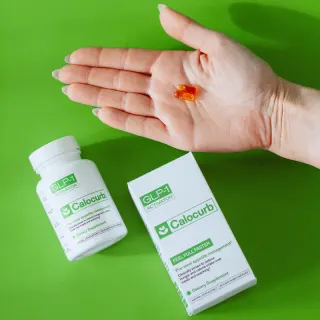
Calocurb GLP-1 Activator
Calocurb · capsuleThe best-evidenced single-mechanism appetite trigger — clinically interesting, but premium-priced and a pre-meal, short-window tool rather than all-day support.
Amarasate is one of the most directly studied appetite ingredients — multiple human RCTs, dosed on-label at 250 mg.
Acute, short-window effect: a pre-meal tool (up to 4 capsules/day), not all-day craving support.

Leanbean
Ultimate Life Ltd · capsuleA maximal glucomannan dose — which is also its risk: top-of-range fiber means you must take it carefully with plenty of water.
Glucomannan dosed at the full 3 g/day EFSA satiety level, fully disclosed.
At 3 g/day, glucomannan sits at the very top of the studied range — large glucomannan doses carry a documented risk of throat, esophageal, or GI blockage if not taken with enough water.