Munchies Timing
When Do the Munchies Kick In? Timing for Smoking, Vaping and Edibles
Dose decides how strong it gets. The route you took decides when it starts.
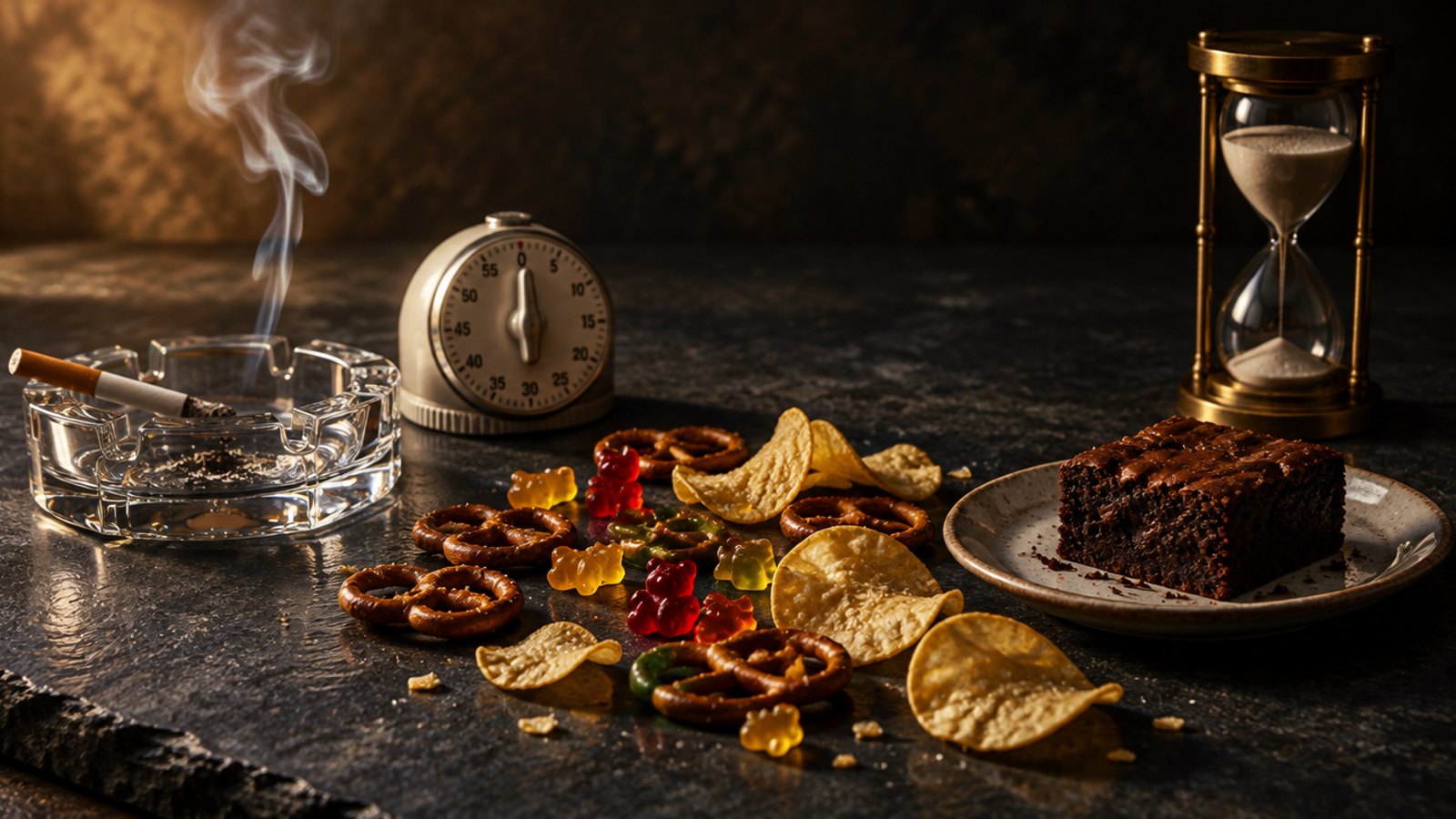
Smoked or vaped, the munchies kick in within minutes. THC peaks in blood about 10 minutes after inhaling, and in the one study that recorded what people ate, the extra eating landed in the first 30 minutes snacks were available. Edibles run on a slower clock: little happens for 30 to 60 minutes, and the peak arrives 1.5 to 3 hours in.
One caveat before the details. No study has asked people to hit a button the moment they got hungry. The numbers here come from when the drug's effects start and from when people in a lab reached for food. That's close, and it's what exists.
When the munchies kick in, by route
- Smoked: within minutes. Blood THC was highest at the first check, 10 minutes after smoking.
- Vaped: the same clock, with slightly more THC delivered per milligram.
- Edibles (brownies, gummies, capsules): 30 to 60 minutes before anything registers, with the peak at 1.5 to 3 hours.
- Edibles after a big, fatty meal: later again, and with more THC absorbed overall.
Smoked or vaped: within minutes
Inhaled THC goes from lung to blood almost at once. Researchers at Johns Hopkins gave 17 healthy adults, none of whom had used cannabis in the past month, smoked or vaporized cannabis containing 0, 10 or 25 mg of THC across 6 sessions (Spindle and colleagues, Journal of Analytical Toxicology 2019). Cannabinoid levels in blood were typically highest at the very first time point, 10 minutes after dosing.
Vaping wasn't the gentler option. At the same dose, blood THC ran higher after vaporizing than after smoking, and the authors called it the more efficient delivery method. A separate National Institute on Drug Abuse crossover study found few differences between the two inhaled routes (Newmeyer and colleagues, Clinical Chemistry 2016). Treat a vape pen and a joint as the same clock.
Now the eating. In a 2025 study, vaporized cannabis increased how much people ate, and it did so in the first 30 minutes of snack and beverage access, whatever the dose and whatever the participant's gender (Hume and colleagues, PNAS 2025). The rat half of that paper showed why it feels so sudden: cannabis vapor shortened the time it took animals to start eating and raised the number of separate feeding bouts.
So with a joint or a vape, the window is open by the time you've put it down. How long it stays open is a separate question, and we mapped that in our timeline of how long the munchies last by route.
Edibles: 30 to 60 minutes, and the peak comes much later
The best edible timing data also comes from Johns Hopkins. 17 healthy adults who hadn't used cannabis in at least 60 days ate brownies containing 0, 10, 25 or 50 mg of THC on separate days (Schlienz and colleagues, Drug and Alcohol Dependence 2020). At every active dose, effects didn't show up until 30 to 60 minutes after eating. Peak effects came at 1.5 to 3 hours.
An earlier brownie study from the same group, with 6 people per dose, found the same 1.5 to 3 hour peak and effects that lasted 6 to 8 hours (Vandrey and colleagues, Journal of Analytical Toxicology 2017).
Here's the honest gap. Neither study measured food intake, and we couldn't find one that timed eating after an edible. If appetite follows the rest of the drug's effects, the munchies from an edible would start somewhere after the 30 to 60 minute mark and pull hardest in the 1.5 to 3 hour stretch. That's an inference from the drug data, so hold it loosely.
It does explain a pattern a lot of people describe. The edible munchies tend to show up after you've decided the edible isn't working. Someone takes a gummy at 8, feels nothing at 8:45, takes another, and both land together around 10 with the snacks already out.
What sets the delay
The route
Swallowed THC has to clear the stomach, get absorbed in the gut, and pass through the liver before it reaches the brain. In the NIDA study, oral dosing produced significantly higher levels of THC's metabolites than either inhaled route, which is the fingerprint of that liver pass. Inhaled THC skips the whole line.
What you ate first
This one runs against the usual advice. In a crossover trial, 28 healthy adults took 5 or 10 mg THC capsules either fasted or after a high-fat meal (Lunn and colleagues, Cannabis and Cannabinoid Research 2019). The meal pushed the blood peak later and raised total exposure to both THC and its active metabolite, 11-hydroxy-THC. (Every author worked for the cannabis company that made the capsules, so read it as one data point.)
In plain terms: an edible on a full stomach is likely to start slower and deliver more. A survey of 370 adult edible users found that 43% had been told to eat a snack or a meal to tone down effects that felt too strong, and the researchers noted that this advice contrasts with what controlled studies show (Dowd and colleagues, Drug and Alcohol Dependence 2023).
Dose and tolerance
Dose changed how strong the effects were in these studies. It didn't change when they started. The 30 to 60 minute edible onset held at 10, 25 and 50 mg, and the first-30-minutes eating effect with vapor held regardless of dose.
Tolerance is the open question. Both Johns Hopkins studies enrolled people who rarely use cannabis. If you use it most days, your clock may not match theirs, and these papers can't tell you which way it shifts.
What it looks like once it starts
Don't expect one big wave of hunger. In a 1988 residential study, 6 men lived in a lab for 13 days while researchers recorded everything they ate (Foltin and colleagues, Appetite 1988). Smoked cannabis raised daily calories by 40%, and none of that came from bigger meals. It came from more snacking occasions, mostly sweet solid foods like candy bars.
That matches the rat data from 2025: sooner to start, more separate bouts. The onset of the munchies is the first reach. What follows is a string of them.
The 2025 study also found that cannabis vapor didn't change circulating appetite hormones, and that the effect ran through CB1 receptors in the brain. So the first reach isn't your stomach reporting empty. It's food suddenly being worth more, which is also part of why the munchies hit hardest at night, when your body clock is already pushing appetite up.
How to use the timing
If you smoke or vape, the decision point is before the session, because there's no gap afterward to make one. Put what you're willing to eat within reach first. The first 30 minutes is where the extra eating showed up, and our ranking of munchies snacks by how full they keep you is a decent place to pick from.
If you take edibles, plan for hours 1.5 to 3, not the first hour. Feeling nothing at 45 minutes is the expected result, and a second dose inside the first 2 hours is how a manageable evening turns into a long one.
If you're thinking about a product to block it, check its clock against these numbers. Anything you swallow has its own absorption delay, which is one of the problems we found when we looked at whether THCV does anything for the munchies. No supplement has been tested on cannabis-driven eating, and we compare the field on what can be verified in our comparison of supplements sold for the munchies. The rest of the category sits in our appetite suppressant reviews and rankings.
The bottom line
Inhaled cannabis opens the munchies window within minutes, and the extra eating in the lab landed in the first 30. Edibles take 30 to 60 minutes to register and peak at 1.5 to 3 hours, later if you ate a heavy meal first. Dose sets how strong it gets. Route sets when.
References
- Spindle TR, Cone EJ, Schlienz NJ, et al. Acute pharmacokinetic profile of smoked and vaporized cannabis in human blood and oral fluid. J Anal Toxicol. 2019;43(4):233-258. PubMed 30615181
- Newmeyer MN, Swortwood MJ, Barnes AJ, et al. Free and glucuronide whole blood cannabinoids' pharmacokinetics after controlled smoked, vaporized, and oral cannabis administration in frequent and occasional cannabis users. Clin Chem. 2016;62(12):1579-1592. PubMed 27899456
- Hume C, Cuttler C, Baglot SL, et al. Cannabis produces acute hyperphagia in humans and rodents via increased reward valuation for, and motivation to, acquire food. Proc Natl Acad Sci U S A. 2025;122(52):e2518863122. PubMed 41439716
- Schlienz NJ, Spindle TR, Cone EJ, et al. Pharmacodynamic dose effects of oral cannabis ingestion in healthy adults who infrequently use cannabis. Drug Alcohol Depend. 2020;211:107969. PubMed 32298998
- Vandrey R, Herrmann ES, Mitchell JM, et al. Pharmacokinetic profile of oral cannabis in humans: blood and oral fluid disposition and relation to pharmacodynamic outcomes. J Anal Toxicol. 2017;41(2):83-99. PubMed 28158482
- Lunn S, Diaz P, O'Hearn S, et al. Human pharmacokinetic parameters of orally administered delta-9-tetrahydrocannabinol capsules are altered by fed versus fasted conditions and sex differences. Cannabis Cannabinoid Res. 2019;4(4):255-264. PubMed 31872060
- Dowd AN, Zamarripa CA, Sholler DJ, et al. A cross-sectional survey on cannabis: characterizing motives, opinions, and subjective experiences associated with the use of various oral cannabis products. Drug Alcohol Depend. 2023;245:109826. PubMed 36871378
- Foltin RW, Fischman MW, Byrne MF. Effects of smoked marijuana on food intake and body weight of humans living in a residential laboratory. Appetite. 1988;11(1):1-14. PubMed 3228283
Citations retrieved via PubMed. This article is for education only and isn't medical advice. Cannabis laws and effects vary; talk to a clinician about your own situation.
FAQ
When do the munchies kick in after smoking?
The munchies kick in within minutes after smoking. In a Johns Hopkins study of 17 adults, blood THC was highest at the first check, 10 minutes after smoking or vaping. In a 2025 PNAS study, vaporized cannabis raised eating in the first 30 minutes that snacks were available, regardless of dose.
How long after an edible do the munchies start?
No study has timed eating after an edible. The drug effects of THC brownies did not appear until 30 to 60 minutes after eating and peaked at 1.5 to 3 hours in two Johns Hopkins studies, so appetite most likely follows that clock.
Does eating before an edible delay the munchies?
Eating before an edible probably delays the munchies. In a trial of 28 adults, taking THC capsules after a high-fat meal pushed the blood peak later and raised total THC exposure compared with fasting. A full stomach is likely to mean a slower start and more THC absorbed overall.
Does a bigger dose make the munchies start sooner?
In the studies we found, a bigger dose did not make the munchies start sooner. The 30 to 60 minute onset for edibles held at 10, 25 and 50 mg of THC, and the first-30-minutes eating effect with vaporized cannabis held regardless of dose. Dose changed how strong the effects were.
Products mentioned

Metamucil 4-in-1 Fiber (Psyllium Husk)
Metamucil (Procter & Gamble) · powderBest Value: cheap, drinkable, and well-evidenced as a fiber — but single-pathway and a heavy gel load.
Pennies per serving — by far the cheapest in the set.
Single pathway — a fiber, not a craving formula.
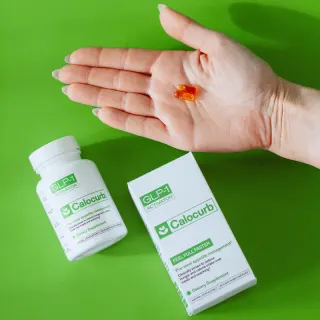
Calocurb GLP-1 Activator
Calocurb · capsuleThe best-evidenced single-mechanism appetite trigger — clinically interesting, but premium-priced and a pre-meal, short-window tool rather than all-day support.
Amarasate is one of the most directly studied appetite ingredients — multiple human RCTs, dosed on-label at 250 mg.
Acute, short-window effect: a pre-meal tool (up to 4 capsules/day), not all-day craving support.

Leanbean
Ultimate Life Ltd · capsuleA maximal glucomannan dose — which is also its risk: top-of-range fiber means you must take it carefully with plenty of water.
Glucomannan dosed at the full 3 g/day EFSA satiety level, fully disclosed.
At 3 g/day, glucomannan sits at the very top of the studied range — large glucomannan doses carry a documented risk of throat, esophageal, or GI blockage if not taken with enough water.