Appetite Science
Why Do I Get the Munchies at Night? The Timing Behind It
Your clock, your sleep and THC all push the same way after dark. None of it is a willpower problem.
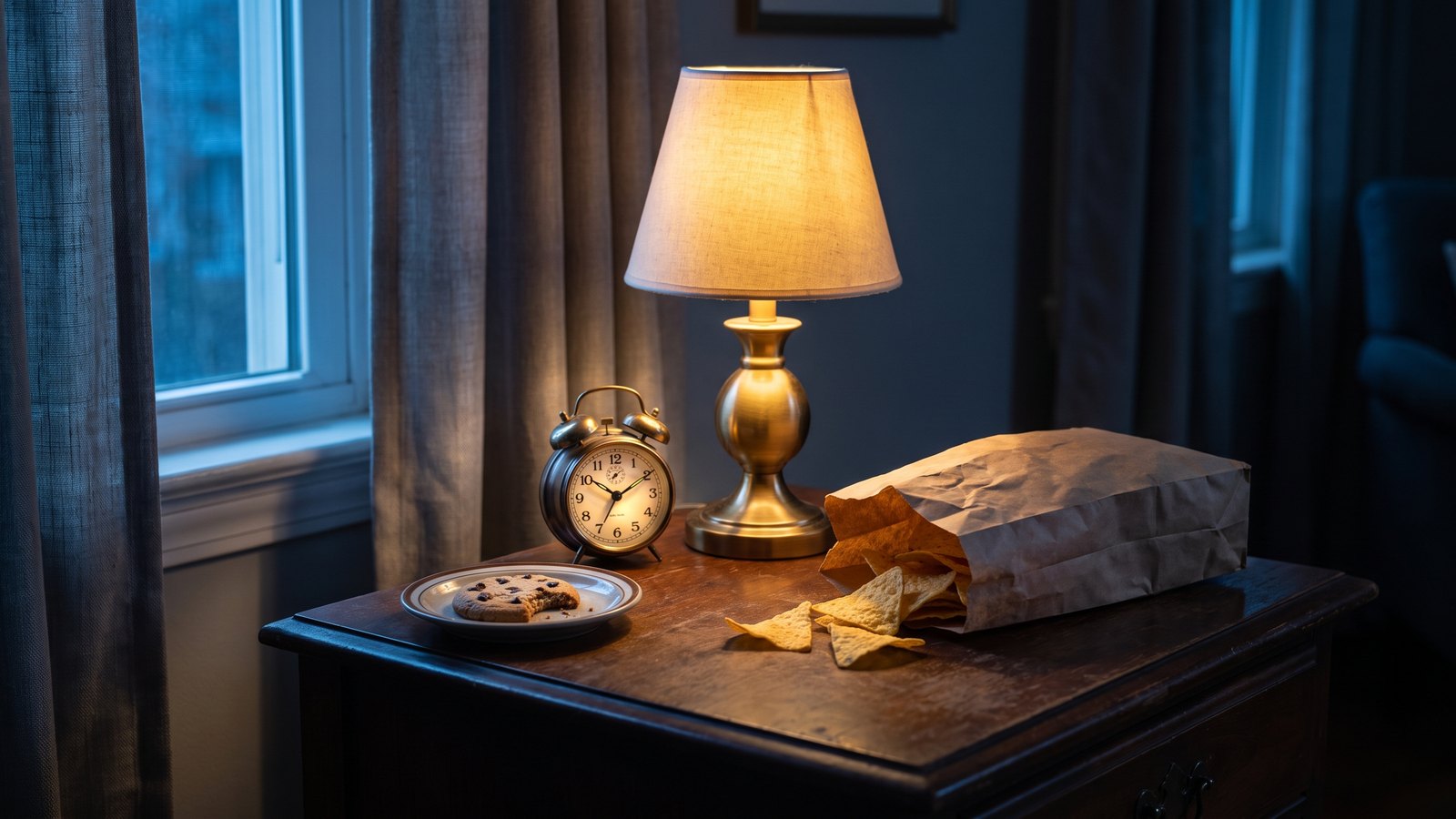
Short answer: three things stack after dark. Your body clock is built to make you hungriest around 8 PM. Short sleep turns that hunger up and pushes it toward calorie-dense food. And if cannabis is involved, THC acts on the brain's own appetite switch, the same system a tired brain is already leaning on.
That's a timing problem, and here is what each piece of the research actually shows, and what it means if you're hungry at night even after a full dinner.
Your body clock turns hunger up in the evening
The cleanest evidence comes from a 2013 study at Brigham and Women's Hospital. Researchers kept 12 healthy adults in a lab for 13 days and spread meals and sleep evenly around the clock, so they could separate the body's internal rhythm from whatever people happened to be doing (Scheer et al., Obesity 2013).
Hunger had its own rhythm. It bottomed out in the biological morning, around 8 AM, and peaked in the biological evening, around 8 PM. The swing was 17%, and appetite for sweet, salty and starchy foods rose and fell on the same schedule, with swings of 14% to 25%.
Now picture that alongside the munchies. The foods you want most at night are exactly the ones your clock is scheduled to make most appealing at night. The authors' theory is that this peak helps people eat a big meal before the long overnight fast. Useful for our ancestors. Less useful when the snacks are 10 feet from the couch.
We cover the practical side of this, what to actually change, in our evidence-based guide to stopping nighttime snacking. This page is the why.
Eating late makes you hungrier, not fuller
You'd think a late meal would carry you through. A 2022 randomized crossover trial in adults with overweight or obesity found the opposite (Vujović et al., Cell Metabolism 2022).
Participants ate identical meals on two schedules, one early in the day and one shifted later, with sleep, activity and light tightly controlled. Late eating increased hunger. It also raised the ratio of ghrelin (the hormone that signals hunger) to leptin (the one that signals you have energy stored), both while awake and across 24 hours, and lowered the energy burned while awake.
So a pattern of skipping food during the day and eating most of it at night doesn't just move calories around. In this trial it made the hunger itself louder.
Short sleep turns the volume up further
In a 2004 crossover study, 12 healthy young men spent 2 nights with restricted sleep and 2 nights with extended sleep, with food and activity controlled (Spiegel et al., Annals of Internal Medicine 2004). After short sleep, leptin fell 18%, ghrelin rose 28%, hunger rose 24% and overall appetite rose 23%. Appetite for calorie-dense, high-carbohydrate foods rose the most, by 33% to 45%.
A later study from the same group looked at stress hormones. After 2 nights of 4 hours in bed, evening cortisol climbed: total cortisol by 30% and free cortisol by 200%. Appetite went up too, and the size of the appetite increase tracked the rise in cortisol (Guyon et al., Journal of Clinical Endocrinology and Metabolism 2014).
Both studies are small, and both mostly used young men. But they point the same way: the night after a short night is the one where you're most likely to be hungry late.
A tired brain runs on the same system cannabis uses
This is the part that connects ordinary late-night hunger to the munchies.
Your body makes its own cannabinoids. One of them, 2-AG, activates the same CB1 receptor that THC does. In a 2016 randomized crossover study, healthy young adults spent 4 nights sleeping 8.5 hours and 4 nights sleeping 4.5 hours (Hanlon et al., Sleep 2016).
2-AG levels followed a daily rhythm in both conditions. Short sleep amplified that rhythm, and the peak arrived later and lasted longer. When sleep-deprived, people reported more hunger and appetite alongside that rise, and they were less able to hold back from palatable snacks.
In plain terms: a short night nudges your brain toward the same reward-driven eating that cannabis produces. Add THC in the evening and you're pushing on a door that's already open.
What THC adds on top
The best human data on the munchies is recent. A 2025 study in PNAS gave participants vaporized cannabis and tracked what they ate. Energy intake went up quickly and robustly, and the extra eating happened in the first 30 minutes of snack access, regardless of dose or gender (Hume et al., PNAS 2025).
Two findings from the same study matter here. First, cannabis vapor did not change circulating appetite hormones, and the rat experiments showed the effect ran through CB1 receptors in the brain, not in the rest of the body. Second, in rats, cannabis increased the motivation to eat and blunted the usual drop in how rewarding food feels once you're full.
That second point explains the "hungry even after eating" feeling. It isn't your stomach asking for more. It's your brain still valuing food when it normally wouldn't.
Mouse work gives a sense of how strange the wiring is. POMC neurons in the hypothalamus normally help end a meal. A 2015 Nature study found that switching on CB1 receptors made those same neurons release beta-endorphin, an opioid, instead of their usual fullness signal, and that this drove feeding in already-fed mice. Blocking opioid receptors with naloxone stopped it (Koch et al., Nature 2015). That's rodent evidence, so treat it as a mechanism, not a proven human explanation.
Put it together and night is close to the worst possible time for cannabis if you care about what you eat. Your clock has appetite at its peak, you may be short on sleep, and THC acts on the brain's reward circuitry rather than on the hormones a filling dinner would have calmed. If you're weighing the products sold to block this, we looked at whether THCV actually stops the munchies and at every supplement sold for the munchies, ranked on the evidence.
Hungry at night even after eating: the likely reasons
If this happens without cannabis (or after a few drinks, which works through a different hunger circuit than THC does), the research above points to a short list worth checking in order:
- It's the evening peak. Some rise in appetite around 8 PM is normal and built in, even when you've eaten enough.
- Most of your food came late. If breakfast and lunch were light and dinner was big, the late-eating trial suggests that pattern itself raises hunger.
- You slept badly last night. Short sleep raised hunger, ghrelin, cortisol and 2-AG in controlled studies, and pushed appetite toward calorie-dense food.
- It isn't really hunger. Reward-driven wanting feels like hunger but doesn't go away when you're full. If it shows up as constant thoughts about food, what researchers call food noise is worth a read.
Hungry at 2 AM: should you eat?
The circadian data has a useful detail here. In the Scheer study, hunger normally declines across the night, which the authors suggest is what stops overnight fasting from waking you up. So waking up genuinely hungry at 2 AM runs against the usual rhythm, and it's worth asking why.
Often the answer is simple: you ate too little that day, or dinner was mostly fast-digesting carbohydrate. If you're truly hungry, a small, filling snack is a reasonable choice over lying awake. Our ranking of snacks by how well they actually fill you up is a good starting point.
If it happens most nights, or you feel you can't get back to sleep without eating, mention it to your doctor. Regular night waking to eat is something clinicians take seriously, and it deserves a proper look rather than a better snack.
The bottom line
You get the munchies at night because your body clock raises appetite in the evening, late eating and short sleep make that hunger louder, and THC works on the brain's reward system rather than on your stomach. None of it means your willpower failed. It means the timing is working against you, and timing is something you can change. For more on this and related topics, browse our appetite and cravings hub.
References
- Scheer FA, Morris CJ, Shea SA. The internal circadian clock increases hunger and appetite in the evening independent of food intake and other behaviors. Obesity (Silver Spring). 2013;21(3):421-423. PubMed 23456944
- Vujović N, Piron MJ, Qian J, et al. Late isocaloric eating increases hunger, decreases energy expenditure, and modifies metabolic pathways in adults with overweight and obesity. Cell Metab. 2022;34(10):1486-1498.e7. PubMed 36198293
- Spiegel K, Tasali E, Penev P, Van Cauter E. Brief communication: Sleep curtailment in healthy young men is associated with decreased leptin levels, elevated ghrelin levels, and increased hunger and appetite. Ann Intern Med. 2004;141(11):846-850. PubMed 15583226
- Guyon A, Balbo M, Morselli LL, et al. Adverse effects of two nights of sleep restriction on the hypothalamic-pituitary-adrenal axis in healthy men. J Clin Endocrinol Metab. 2014;99(8):2861-2868. PubMed 24823456
- Hanlon EC, Tasali E, Leproult R, et al. Sleep restriction enhances the daily rhythm of circulating levels of endocannabinoid 2-arachidonoylglycerol. Sleep. 2016;39(3):653-664. PubMed 26612385
- Hume C, Cuttler C, Baglot SL, et al. Cannabis produces acute hyperphagia in humans and rodents via increased reward valuation for, and motivation to, acquire food. Proc Natl Acad Sci U S A. 2025;122(52):e2518863122. PubMed 41439716
- Koch M, Varela L, Kim JG, et al. Hypothalamic POMC neurons promote cannabinoid-induced feeding. Nature. 2015;519(7541):45-50. PubMed 25707796
Citations retrieved via PubMed. This article is for education only and isn't medical advice. Talk to your doctor before starting any supplement, especially if you're pregnant, nursing, on medication, or managing a health condition.
FAQ
Why do I get the munchies at night?
Your internal clock is built to raise hunger in the evening. In a 13-day lab study, hunger peaked around 8 PM and bottomed out around 8 AM, and appetite for sweet, salty and starchy foods followed the same pattern. Short sleep and late eating both made hunger stronger in controlled trials, and cannabis adds a brain-driven push to eat on top.
Why am I hungry at night even after eating dinner?
Often it isn't stomach hunger. Evening appetite rises on its own schedule, short sleep raised hunger hormones and the brain's own cannabinoid 2-AG in trials, and cannabis increases how rewarding food feels even when you're full. A day where most food came late can also make hunger louder.
Do the munchies come from hunger hormones?
Probably not mainly. In a 2025 PNAS study, vaporized cannabis increased eating within the first 30 minutes but did not change circulating appetite hormones, and the rat experiments showed the effect ran through CB1 receptors in the brain.
Should I eat if I'm hungry at 2 AM?
If you're truly hungry, a small filling snack is reasonable. But hunger normally falls across the night, so waking hungry is worth noticing. If it happens most nights, or you can't get back to sleep without eating, talk to your doctor.
Products mentioned

Metamucil 4-in-1 Fiber (Psyllium Husk)
Metamucil (Procter & Gamble) · powderBest Value: cheap, drinkable, and well-evidenced as a fiber — but single-pathway and a heavy gel load.
Pennies per serving — by far the cheapest in the set.
Single pathway — a fiber, not a craving formula.

Calocurb GLP-1 Activator
Calocurb · capsuleThe best-evidenced single-mechanism appetite trigger — clinically interesting, but premium-priced and a pre-meal, short-window tool rather than all-day support.
Amarasate is one of the most directly studied appetite ingredients — multiple human RCTs, dosed on-label at 250 mg.
Acute, short-window effect: a pre-meal tool (up to 4 capsules/day), not all-day craving support.

Leanbean
Ultimate Life Ltd · capsuleA maximal glucomannan dose — which is also its risk: top-of-range fiber means you must take it carefully with plenty of water.
Glucomannan dosed at the full 3 g/day EFSA satiety level, fully disclosed.
At 3 g/day, glucomannan sits at the very top of the studied range — large glucomannan doses carry a documented risk of throat, esophageal, or GI blockage if not taken with enough water.