Clinical Line
Night Eating Syndrome vs Late-Night Snacking: How to Tell Them Apart
Waking up to eat twice a week for 3 months is a diagnosis. Finishing the chips at 10pm is a habit. The research treats them very differently, and so should you.
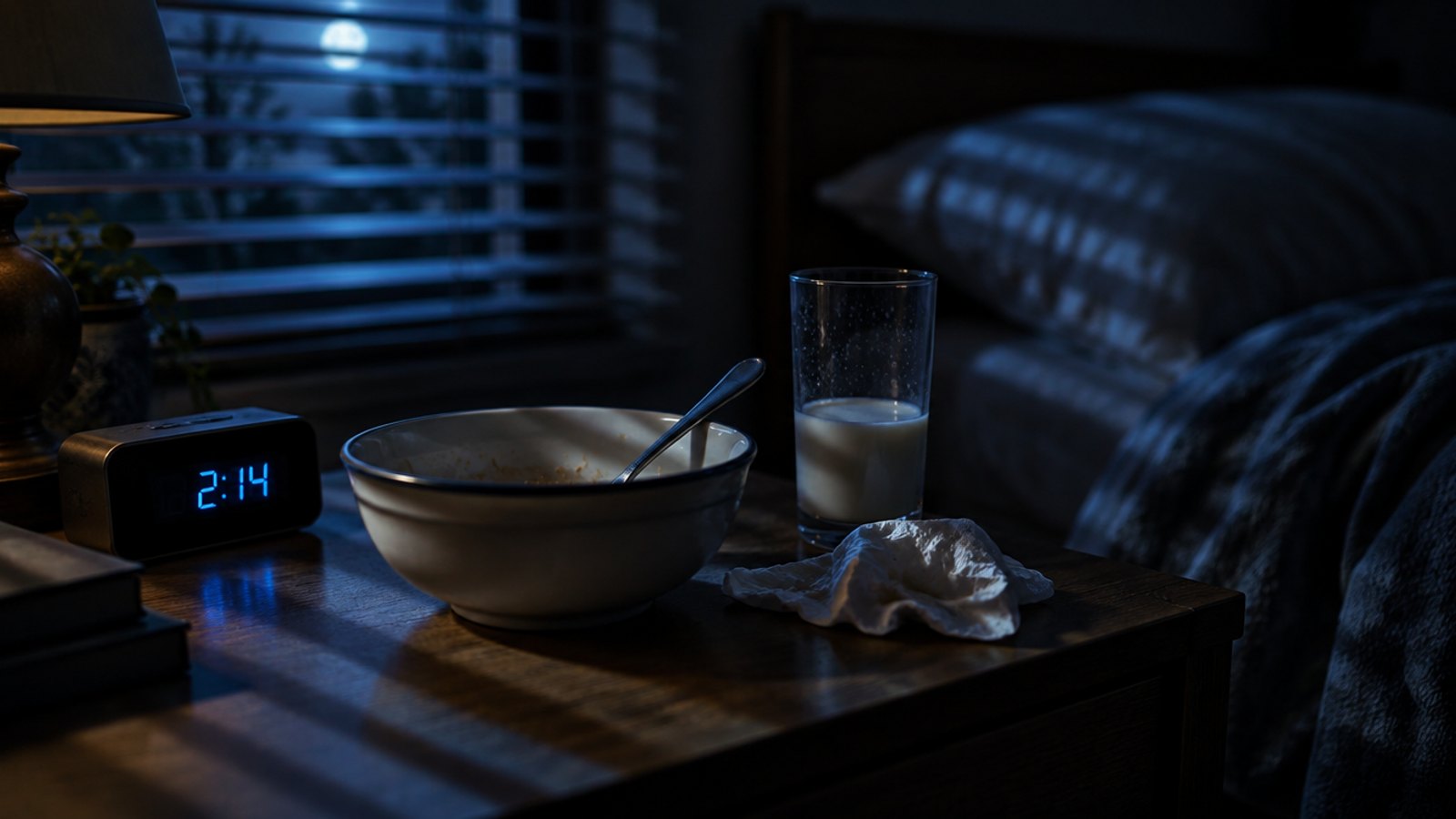
Short answer first. Night eating syndrome is a recognized eating disorder with written diagnostic criteria, a measurable shift in the body clock, and placebo-controlled treatment trials behind it. Late-night snacking is a habit with a mechanism. They overlap at the edges, but they are not the same thing, and treating one like the other wastes months.
This post draws the line. It is not a diagnosis. If the first half sounds like you, the right next step is a conversation with a doctor or an eating disorder specialist, not a product.
What night eating syndrome actually is
The syndrome was first described in 1955, but for 50 years every research group defined it a little differently. In 2008 an international meeting at the University of Pennsylvania settled on consensus criteria, published by Allison and colleagues in 2010 (PubMed 19378289). They are specific, and that specificity is the whole point.
The core criterion is an abnormally large share of food eaten in the evening and at night, shown by at least one of these:
- At least 25% of the day's food is eaten after the evening meal. Not dessert. A quarter of everything, most days.
- Waking up during the night to eat at least twice a week. The person is awake and knows they are eating; this is not sleepwalking.
On top of that, the person has to be aware of the episodes, the pattern has to cause real distress or get in the way of daily life, it has to have lasted at least 3 months, and at least 3 of 5 supporting features have to be present. Those features are: not wanting to eat in the morning or skipping breakfast most days, a strong urge to eat between dinner and sleep or during the night, trouble falling or staying asleep most nights, a belief that you must eat to get back to sleep, and a mood that is low or that gets worse in the evening.
Look at the time stamps in that list. Morning anorexia, evening hyperphagia, insomnia, and evening mood drop. It describes a person whose entire day has slid several hours to the right. That turns out to be literally true, which we get to below.
The DSM-5 lists night eating syndrome under "other specified feeding or eating disorder" (PubMed 26395455). It is a real diagnosis, not a wellness label.
How common it is
Rarer than the internet makes it sound. The first general population survey, 2,097 randomly selected adults interviewed in 1997, put it at 1.5% (PubMed 9140737). A representative German sample of 2,460 people aged 14 to 85 found 1.1% using the Night Eating Questionnaire cut-off (PubMed 24828066).
It climbs in specific groups. Among 1,636 US university students the rate was 4.2%, falling to 2.9% once people who also binge ate were removed (PubMed 24485551). In people seeking bariatric surgery, estimates run from 2% to 20% (PubMed 26395455). A 2025 Israeli community sample of 746 adults reported 8.8% using the stricter cut-off, which the authors themselves flagged as higher than earlier community samples (PubMed 40240692).
Two things to take from the numbers. First, the questionnaire screen catches more people than a clinical interview confirms, so online quizzes will over-call it. Second, body weight does not decide it. In the original 1997 survey, people with and without the syndrome weighed about the same, and the German study found the link with weight was modest. Thin people get this.
The clock is shifted, not broken
The strongest piece of biology comes from a laboratory study of 15 women with night eating syndrome and 14 matched controls, who lived in a sleep lab for 3 nights with blood drawn every 1 to 2 hours over a 25-hour window (PubMed 19150931).
The control group's rhythms were textbook. The night eating group's meals were phase-delayed, and so were their rhythms of total calories, fat and carbohydrate. Leptin, insulin and melatonin each ran 1.0 to 2.8 hours late. Ghrelin, the main hunger hormone, was phase-advanced by 5.2 hours, meaning the hunger signal was arriving early relative to everything else. The glucose rhythm was inverted.
Their sleep-wake cycle, though, was normal. They went to bed and woke at ordinary times. Only the eating clock had slipped. That dissociation, between the master clock in the brain and the feeding clocks in the gut and liver, is the leading model for the condition. It is also the reason bright light therapy, a treatment that nudges the master clock, keeps coming up in the literature.
This matters because it reframes the condition. A person who wakes at 2am and eats is not weak. Their body is sending a hunger signal at a time when a normal clock would be sending the opposite. Your cravings aren't really a willpower problem, and here the hormone timing is measurable.
Ordinary late-night snacking has a mechanism too
Here is where the overlap starts and where most readers actually live. Everyone's appetite peaks in the evening by design, and a short week of sleep makes it worse. In a 14-day inpatient study, 5 nights of insufficient sleep pushed people to eat more than they burned, with the excess landing specifically at night after dinner. They gained 0.82 kg in those 5 days, and returning to adequate sleep cut intake again (PubMed 23479616).
So a run of 9pm and 10pm snacks after a short-sleep week is a predictable physiological response. It is not a disorder. We covered the evening appetite curve and the fixes that have trial data in our guide to what actually stops nighttime snacking, and the timing biology behind it in why the munchies hit hardest after dark.
The difference is scale, awakening, and duration. Snacking happens before bed. Night eating syndrome also happens after you have fallen asleep, repeatedly, and it has run for months with a morning that starts with no appetite at all.
A side-by-side
- When: Snacking is between dinner and bed. The syndrome adds waking from sleep to eat, 2 or more times a week.
- How much: Snacking is a bag of something. The syndrome is a quarter or more of the day's total food after the evening meal, most days.
- Mornings: A snacker is hungry at breakfast. In the syndrome, breakfast is skipped because there is no appetite until afternoon.
- Sleep: A snacker sleeps fine. In the syndrome, insomnia is usual, and the belief that eating is needed to get back to sleep is one of the diagnostic features.
- Mood: Snacking may follow boredom or stress. In the syndrome, low mood that worsens in the evening is part of the picture, and depressed mood, poor sleep quality and the urge to eat upon waking were the 3 most central symptoms in a network analysis of 144 diagnosed people (PubMed 33675062).
- How long: Snacking comes and goes with the week you are having. The syndrome has to have lasted 3 months to qualify.
- Awareness: Both involve being fully awake and aware. If you find wrappers and have no memory of eating, that is a different condition, covered below.
If you recognized yourself in the left side of every line, this is the ordinary pattern, and the boredom eating playbook or the sugar-specific version in why you can't stop eating sugar and what helps is the right place to go next. If you recognized yourself in the right side of most of them, keep reading.
Not binge eating, not sleepwalking
Two neighbors get confused with night eating syndrome. The first is binge eating disorder. Binges are large amounts of food in a short window with a sense of loss of control, at any time of day. Night eating is about timing rather than volume; a nocturnal ingestion is often small, a bowl of cereal, repeated. A 2021 study that put 170 women through a week of wrist actigraphy found that the night-eating-only group had less eating disorder psychopathology overall but more sleep disturbance, and the authors concluded it behaves as a separate entity from binge eating (PubMed 34640635). The two can also co-occur, which is why the student study's prevalence dropped once binge eaters were removed.
The second is sleep-related eating disorder, a parasomnia. The person eats while partly or fully asleep and has little or no memory of it afterward. Awareness is the dividing line: night eating syndrome requires that you know you are eating. No memory of the episode points to a sleep clinic, not an eating disorder program.
What the treatment research shows
This is clinician territory, so we will stick to what the trials found rather than suggest anything.
The most-cited result is an 8-week randomized, double-blind trial of sertraline against placebo in 34 outpatients. 71% of the sertraline group were rated much or very much improved, against 18% on placebo, with fewer nocturnal awakenings and ingestions and less food eaten after the evening meal (PubMed 16648332). A later 12-week trial of a different SSRI, escitalopram, in 40 people did not beat placebo on the primary measure (PubMed 22544016). So the drug result is real but it is one small trial of one drug, not a class effect.
A 2025 systematic review found only 5 randomized trials in total across drugs and psychological treatments. It credited sertraline with the most consistent improvement, noted that progressive muscle relaxation and education reduced evening intake and restored morning hunger, and then graded the certainty of every outcome as low because of how few people have been studied (PubMed 40980047). Cognitive behavioral therapy and bright light therapy are also in use and are listed as options in a review of the field (PubMed 29044551), though the controlled evidence for both is thin.
What the research does not contain is a supplement trial. None of the products we compare in our craving supplement rankings has been tested against a night eating syndrome endpoint, and nothing in the appetite suppressant category is a substitute for an assessment. Those products are built for the ordinary evening pattern, and we would say so to anyone who asked.
When to see someone
Make the appointment if any of these are true for you:
- You wake from sleep to eat 2 or more times a week and have for a few months.
- Most of what you eat lands after dinner, and you skip breakfast because you are not hungry.
- You believe you cannot fall back asleep without eating.
- Your mood sinks in the evening and the eating feels tied to it.
- It is causing you distress, or you are hiding it.
A GP is a fine place to start. Say the words "night eating syndrome" out loud, because it is under-recognized even in clinics (PubMed 40240692), and ask about a referral to someone who treats eating disorders or sleep. Bring a week of notes: what time you ate, whether you woke to do it, how you slept. The Night Eating Questionnaire, a 14-item screen, is what most clinics use first.
And if you did not recognize yourself in that list, you have a habit with a known mechanism, not a syndrome. That is good news. Sleep first, calories earlier in the day, and a planned evening snack move the needle, and the nighttime snacking guide lays out which of those has trial data behind it.
References
- Allison KC, Lundgren JD, O'Reardon JP, et al. Proposed diagnostic criteria for night eating syndrome. Int J Eat Disord. 2010;43(3):241-247. PubMed 19378289
- de Zwaan M, Marschollek M, Allison KC. The night eating syndrome (NES) in bariatric surgery patients. Eur Eat Disord Rev. 2015;23(6):426-434. PubMed 26395455
- Rand CS, Macgregor AM, Stunkard AJ. The night eating syndrome in the general population and among postoperative obesity surgery patients. Int J Eat Disord. 1997;22(1):65-69. PubMed 9140737
- de Zwaan M, Müller A, Allison KC, Brähler E, Hilbert A. Prevalence and correlates of night eating in the German general population. PLoS One. 2014;9(5):e97667. PubMed 24828066
- Runfola CD, Allison KC, Hardy KK, Lock J, Peebles R. Prevalence and clinical significance of night eating syndrome in university students. J Adolesc Health. 2014;55(1):41-48. PubMed 24485551
- Tzischinsky O, Latzer Y. Night eating syndrome prevalence and its association with sleep quality, eating patterns, and psychopathology in an Israeli community sample. Soc Psychiatry Psychiatr Epidemiol. 2025;60(12):2859-2869. PubMed 40240692
- Goel N, Stunkard AJ, Rogers NL, et al. Circadian rhythm profiles in women with night eating syndrome. J Biol Rhythms. 2009;24(1):85-94. PubMed 19150931
- Markwald RR, Melanson EL, Smith MR, et al. Impact of insufficient sleep on total daily energy expenditure, food intake, and weight gain. Proc Natl Acad Sci U S A. 2013;110(14):5695-5700. PubMed 23479616
- Beauchamp MT, Allison KC, Lundgren JD. The nature of night eating syndrome: using network analysis to understand unique symptomological relationships. Int J Eat Disord. 2021;54(5):733-744. PubMed 33675062
- Tzischinsky O, Tokatly Latzer I, Alon S, Latzer Y. Sleep quality and eating disorder-related psychopathologies in patients with night eating syndrome and binge eating disorders. J Clin Med. 2021;10(19):4613. PubMed 34640635
- O'Reardon JP, Allison KC, Martino NS, Lundgren JD, Heo M, Stunkard AJ. A randomized, placebo-controlled trial of sertraline in the treatment of night eating syndrome. Am J Psychiatry. 2006;163(5):893-898. PubMed 16648332
- Vander Wal JS, Gang CH, Griffing GT, Gadde KM. Escitalopram for treatment of night eating syndrome: a 12-week, randomized, placebo-controlled trial. J Clin Psychopharmacol. 2012;32(3):341-345. PubMed 22544016
- Dos Santos LR, Duarte ML, Trevisani VFM, Peccin MS, Melnik T. Pharmacological and psychosocial interventions for night eating syndrome in adults. Front Psychiatry. 2025;16:1626342. PubMed 40980047
- McCuen-Wurst C, Ruggieri M, Allison KC. Disordered eating and obesity: associations between binge-eating disorder, night-eating syndrome, and weight-related comorbidities. Ann N Y Acad Sci. 2018;1411(1):96-105. PubMed 29044551
FAQ
What is the difference between night eating syndrome and just snacking at night?
The difference between night eating syndrome and just snacking at night is scale, awakening and duration. Night eating syndrome means at least 25% of the day's food is eaten after the evening meal, or you wake from sleep to eat at least twice a week, with awareness and distress, for at least 3 months, alongside features like no morning appetite, insomnia and evening low mood. Ordinary late-night snacking happens before bed, is hungry for breakfast the next day, and tracks with the week you are having rather than lasting months.
How common is night eating syndrome?
About 1% to 1.5% of the general population in the two large surveys that used interviews or a strict questionnaire cut-off. It is more common in people with obesity, in bariatric surgery candidates, and in some student and community samples, where questionnaire screens report 4% to 9%. Screens over-call it compared with a clinical interview.
Is night eating syndrome the same as binge eating disorder?
Night eating syndrome is not the same as binge eating disorder. Binge eating disorder is about large amounts of food eaten with a sense of loss of control at any time of day. Night eating syndrome is about timing: food shifted into the evening and night, often in small repeated amounts, with a measurable delay in appetite hormones. The two can co-occur, and studies that separate them find night eating alone carries less general eating disorder psychopathology but more sleep disturbance.
What treatment has evidence for night eating syndrome?
The best-known result is an 8-week placebo-controlled trial in which 71% of people on sertraline were rated much or very much improved versus 18% on placebo. A later escitalopram trial did not beat placebo. A 2025 systematic review found only 5 randomized trials in total and rated the certainty of every outcome low. Cognitive behavioral therapy, progressive muscle relaxation and bright light therapy are also used. No supplement has been tested against a night eating syndrome endpoint. This is a diagnosis for a clinician to make and treat.
Products mentioned

Metamucil 4-in-1 Fiber (Psyllium Husk)
Metamucil (Procter & Gamble) · powderBest Value: cheap, drinkable, and well-evidenced as a fiber — but single-pathway and a heavy gel load.
Pennies per serving — by far the cheapest in the set.
Single pathway — a fiber, not a craving formula.

Calocurb GLP-1 Activator
Calocurb · capsuleThe best-evidenced single-mechanism appetite trigger — clinically interesting, but premium-priced and a pre-meal, short-window tool rather than all-day support.
Amarasate is one of the most directly studied appetite ingredients — multiple human RCTs, dosed on-label at 250 mg.
Acute, short-window effect: a pre-meal tool (up to 4 capsules/day), not all-day craving support.

Leanbean
Ultimate Life Ltd · capsuleA maximal glucomannan dose — which is also its risk: top-of-range fiber means you must take it carefully with plenty of water.
Glucomannan dosed at the full 3 g/day EFSA satiety level, fully disclosed.
At 3 g/day, glucomannan sits at the very top of the studied range — large glucomannan doses carry a documented risk of throat, esophageal, or GI blockage if not taken with enough water.