Meal Timing
What Time to Stop Eating at Night: Count Back From Your Bedtime
Trials favor eating earlier, but the 7 PM rule has less behind it than you'd think.
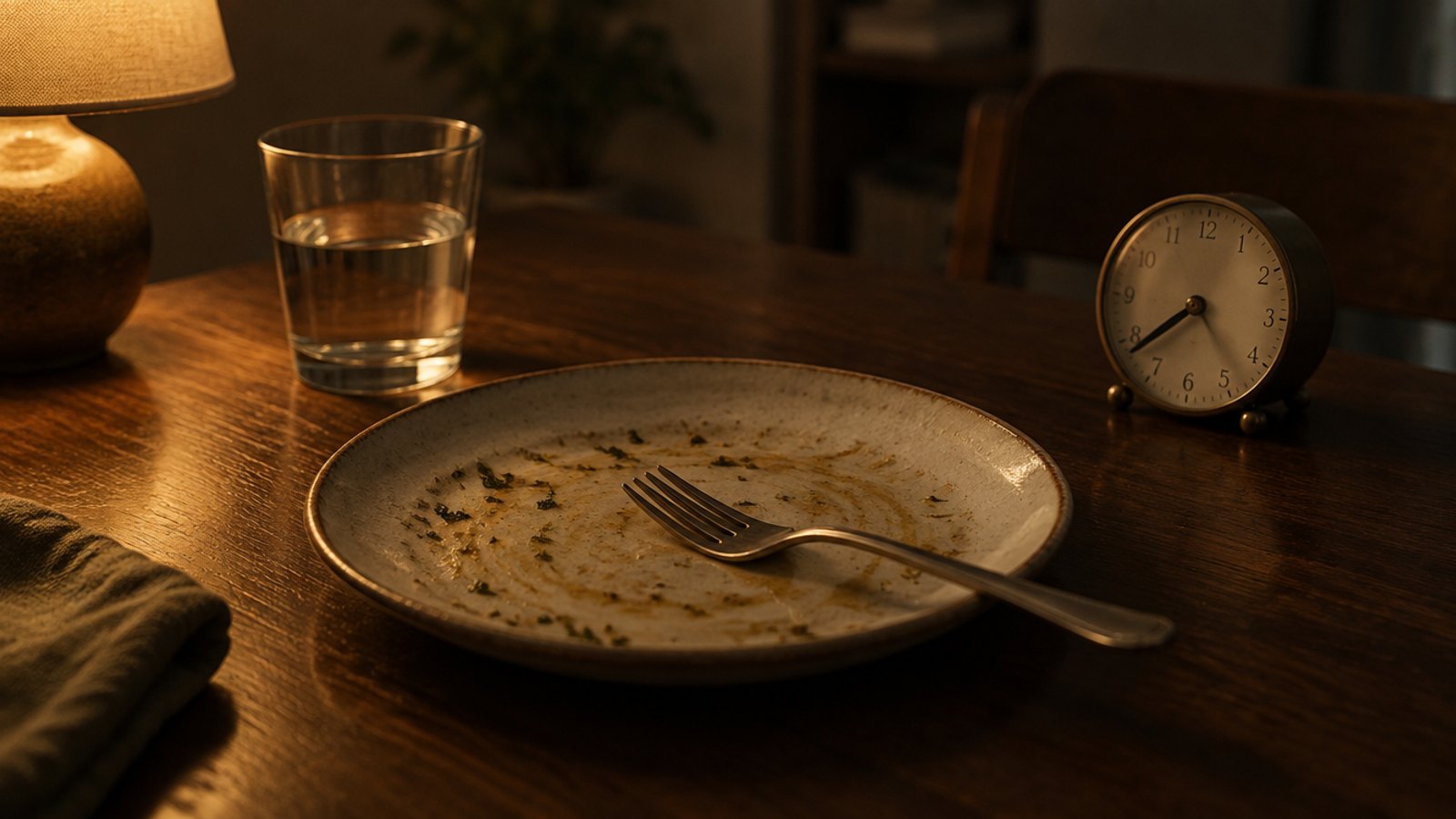
The best time to stop eating at night for most people is about 3 hours before bed, which lands around 8 PM if you sleep at 11. No single clock time works for everyone, because the research points to a relationship between your last meal and your own sleep schedule. Trials do favor finishing earlier, but across 41 randomized trials the gap between early and late eating windows was about 1 kg.
So the cutoff matters, just less than the internet says. Here's what each popular cutoff has been tested against, and how to set your own.
What time to stop eating at night to lose weight
Finishing your last meal earlier in the day has the best support for weight, but the advantage is modest. A 2026 network meta-analysis in BMJ Medicine pooled 41 randomized trials and 2,287 people, sorting eating windows by last meal: early (before 5 PM), middle (5 to 7 PM) and late (after 7 PM) (Chen et al., 2026).
Early windows beat late ones by 1.15 kg on body weight, about 2.5 pounds. How many hours people ate each day gave inconsistent results, so the timing looked more important than the window length.
A second 2026 network meta-analysis of 39 trials and 3,236 people also ranked early windows highest, but its authors urged caution: differences between patterns were limited and certainty ran from very low to moderate (Hamsho et al., 2026).
Read together, that's a real signal at a small size. It also comes with a practical catch, since a last meal before 5 PM doesn't fit most working lives.
No eating after 6 PM or 7 PM: what the trials found
A flat "no eating after 6 PM" rule has weaker evidence than its popularity suggests, because we found no large trial testing it alone. The trials test whole eating windows, and their results split.
- Stop at 4 PM, with calorie limits: 139 adults with obesity ate from 8 AM to 4 PM or with no time limit, all on the same calorie target, for 12 months. They lost 8.0 kg and 6.3 kg, a gap that wasn't statistically significant (Liu et al., 2022).
- Stop at 3 PM, with calorie limits: 90 adults with obesity on a matched weight-loss program lost 2.3 kg more over 14 weeks by eating from 7 AM to 3 PM than by eating over 12 hours or more. Body fat didn't differ significantly (Jamshed et al., 2022).
- Stop at 8 PM, no other changes: 116 adults ate only from noon to 8 PM or had 3 set meals for 12 weeks. Weight loss didn't differ between the groups (Lowe et al., 2020).
That last trial is the one to remember. Skipping breakfast and stopping at 8 PM, with nothing else changed, did very little. A cutoff seems to help most when it removes food you'd otherwise have eaten, which is why it's often the evening snacking habit that matters more than the number on the clock.
Why late eating makes you hungrier
Late eating raises hunger, and that may be its most reliable effect. In a tightly controlled crossover trial, 16 adults with overweight or obesity ate identical food on an early schedule and on one delayed by about 4 hours. Late eating doubled the odds of feeling hungry and lowered waking energy expenditure, even with sleep and activity held steady (Vujović et al., 2022).
A second lab study looked at the night itself. Twenty healthy adults ate the same dinner at 6 PM or 10 PM and slept at 11 PM. The late dinner brought higher overnight glucose and less fat burned, especially in people who usually went to bed earlier (Gu et al., 2020).
Those are small studies of short stretches, and the metabolic part doesn't always repeat. When 30 adults on a calorie-controlled diet ate their biggest meal at breakfast or at dinner for 4 weeks each, weight loss and energy expenditure matched. The big-breakfast weeks simply came with lower hunger (Ruddick-Collins et al., 2022).
So the sturdiest reason to eat earlier may be an ordinary one: you're less hungry, which makes everything else easier. If hunger is showing up soon after dinner, what trials show about hunger after a meal is the better place to start.
The 3-hour rule comes from reflux research
The advice to stop eating 3 hours before bed has its best support in reflux research, not weight research. A Japanese case-control study compared 147 people with GERD and 294 people without it. Those who went to bed less than 3 hours after dinner had about 7 times the odds of GERD compared with those who waited 4 hours or more (Fujiwara et al., 2005).
That's an association, not proof that an earlier dinner fixes anything. Still, it's the origin of a rule that costs nothing to try, and it's the main reason we use 3 hours as the default.
Sleep is a weaker argument. In a follow-up analysis of those 20 healthy adults, dinner 1 hour before bed didn't harm overall sleep stages compared with dinner 5 hours before (Duan et al., 2021). A meta-analysis of 13 studies and 638 people found that in controlled trials, eating windows didn't change sleep duration or quality scores (Jin et al., 2026).
Your stop time depends on when you wake up
Your best stop time is set by your sleep schedule, so count back about 3 hours from bedtime. Most of the trials above enrolled people on ordinary daytime schedules, so treat this as a sensible default rather than a tested formula.
- Up at 6, bed at 10: stop around 7 PM.
- Up at 7, bed at 11: stop around 8 PM.
- Up at 9, bed at 1 AM: stop around 10 PM.
Keeping the same stop time on weekends may also help. A smartphone study found half its healthy adults ate across more than 14.75 hours a day, with over 35% of calories after 6 PM and shifts between weekdays and weekends. In a pilot, 8 overweight people with long eating days cut back to 10 to 11 hours for 16 weeks and lost an average of 3.27 kg. There was no control group, so call it a promising hint (Gill and Panda, 2015).
Later meals also tracked with weaker results in the real world. In a 20-week program of 420 adults, people who ate their main meal later lost less weight, though that study was observational and the meal in question was a Mediterranean lunch after 3 PM (Garaulet et al., 2013). For the behavior side, the eating habits that held up in studies pair well with an earlier stop time, and our metabolism and weight research covers the rest.
What to do if you're hungry after your cutoff
Real hunger after your cutoff is a reason to eat something small, not to tough it out. A rule that sends you to bed hungry tends to end with a bigger snack at 11 PM. If that keeps happening, your dinner may be too small or too light on protein and fiber.
Cravings that don't feel like hunger are a different problem, and they follow their own clock. Our guide to why hunger peaks at night covers the timing behind them.
A few people should skip the DIY cutoff. If you take glucose-lowering medication, are pregnant or have a history of an eating disorder, talk to your clinician before limiting when you eat. If you often wake to eat or feel you can't sleep without eating, read about night eating syndrome and how it differs from late snacking, and bring it up with a doctor.
References
- Chen YE, Tsai HL, Tu YK, Chen LW. Effects of timing and eating duration of time restricted eating on metabolic outcomes: systematic review and network meta-analysis. BMJ Medicine, 2026. PubMed 41586347
- Hamsho M, Shkorfu W, Terzi M, et al. Early, midday, and late time-restricted eating impact on anthropometry and cardiometabolic health: a network meta-analysis of RCTs. Frontiers in Nutrition, 2026. PubMed 42625842
- Liu D, Huang Y, Huang C, et al. Calorie restriction with or without time-restricted eating in weight loss. New England Journal of Medicine, 2022. PubMed 35443107
- Jamshed H, Steger FL, Bryan DR, et al. Effectiveness of early time-restricted eating for weight loss, fat loss, and cardiometabolic health in adults with obesity: a randomized clinical trial. JAMA Internal Medicine, 2022. PubMed 35939311
- Lowe DA, Wu N, Rohdin-Bibby L, et al. Effects of time-restricted eating on weight loss and other metabolic parameters in women and men with overweight and obesity: the TREAT randomized clinical trial. JAMA Internal Medicine, 2020. PubMed 32986097
- Vujović N, Piron MJ, Qian J, et al. Late isocaloric eating increases hunger, decreases energy expenditure, and modifies metabolic pathways in adults with overweight and obesity. Cell Metabolism, 2022. PubMed 36198293
- Gu C, Brereton N, Schweitzer A, et al. Metabolic effects of late dinner in healthy volunteers: a randomized crossover clinical trial. Journal of Clinical Endocrinology and Metabolism, 2020. PubMed 32525525
- Ruddick-Collins LC, Morgan PJ, Fyfe CL, et al. Timing of daily calorie loading affects appetite and hunger responses without changes in energy metabolism in healthy subjects with obesity. Cell Metabolism, 2022. PubMed 36087576
- Fujiwara Y, Machida A, Watanabe Y, et al. Association between dinner-to-bed time and gastro-esophageal reflux disease. American Journal of Gastroenterology, 2005. PubMed 16393212
- Duan D, Gu C, Polotsky VY, Jun JC, Pham LV. Effects of dinner timing on sleep stage distribution and EEG power spectrum in healthy volunteers. Nature and Science of Sleep, 2021. PubMed 34017207
- Jin X, et al. The effect of time-restricted eating on sleep: a systematic review and meta-analysis. Nutrition Reviews, 2026. PubMed 40498475
- Gill S, Panda S. A smartphone app reveals erratic diurnal eating patterns in humans that can be modulated for health benefits. Cell Metabolism, 2015. PubMed 26411343
- Garaulet M, Gómez-Abellán P, Alburquerque-Béjar JJ, et al. Timing of food intake predicts weight loss effectiveness. International Journal of Obesity, 2013. PubMed 23357955
FAQ
How long before bed should you stop eating?
Stopping about 3 hours before bed is the usual advice, and its best support comes from reflux research. In one case-control study, people who went to bed within 3 hours of dinner had about 7 times the odds of GERD compared with those who waited 4 hours or more.
Is it bad to eat after 8 PM?
Eating after 8 PM isn't automatically harmful, and the time on the clock matters less than the gap before bed. If 8 PM is 3 hours before you sleep, it's a reasonable cutoff. Lab studies do link later eating with more hunger, so an earlier dinner may be easier to live with.
Will I lose weight if I stop eating after 7 PM?
A 7 PM cutoff may help modestly, most likely by removing evening calories, but we found no large trial testing that rule alone. In a 12-month trial of 139 adults, an even earlier 4 PM cutoff added no significant weight loss to a calorie-controlled diet.
Is stopping eating at 6 PM better than 8 PM?
Stopping at 6 PM fits the research on earlier eating better than 8 PM, though the expected gain is small. Across 41 trials, last meals before 5 PM beat last meals after 7 PM by about 1 kg. A 6 PM stop only works if it doesn't leave you hungry enough to snack at bedtime.
Products mentioned

Metamucil 4-in-1 Fiber (Psyllium Husk)
Metamucil (Procter & Gamble) · powderBest Value: cheap, drinkable, and well-evidenced as a fiber — but single-pathway and a heavy gel load.
Pennies per serving — by far the cheapest in the set.
Single pathway — a fiber, not a craving formula.

Calocurb GLP-1 Activator
Calocurb · capsuleThe best-evidenced single-mechanism appetite trigger — clinically interesting, but premium-priced and a pre-meal, short-window tool rather than all-day support.
Amarasate is one of the most directly studied appetite ingredients — multiple human RCTs, dosed on-label at 250 mg.
Acute, short-window effect: a pre-meal tool (up to 4 capsules/day), not all-day craving support.