Munchies Science
Does Weed Make You Gain Weight? The Munchies vs the Long-Term Data
The munchies add calories. Regular users still weigh less on average. Both are true.
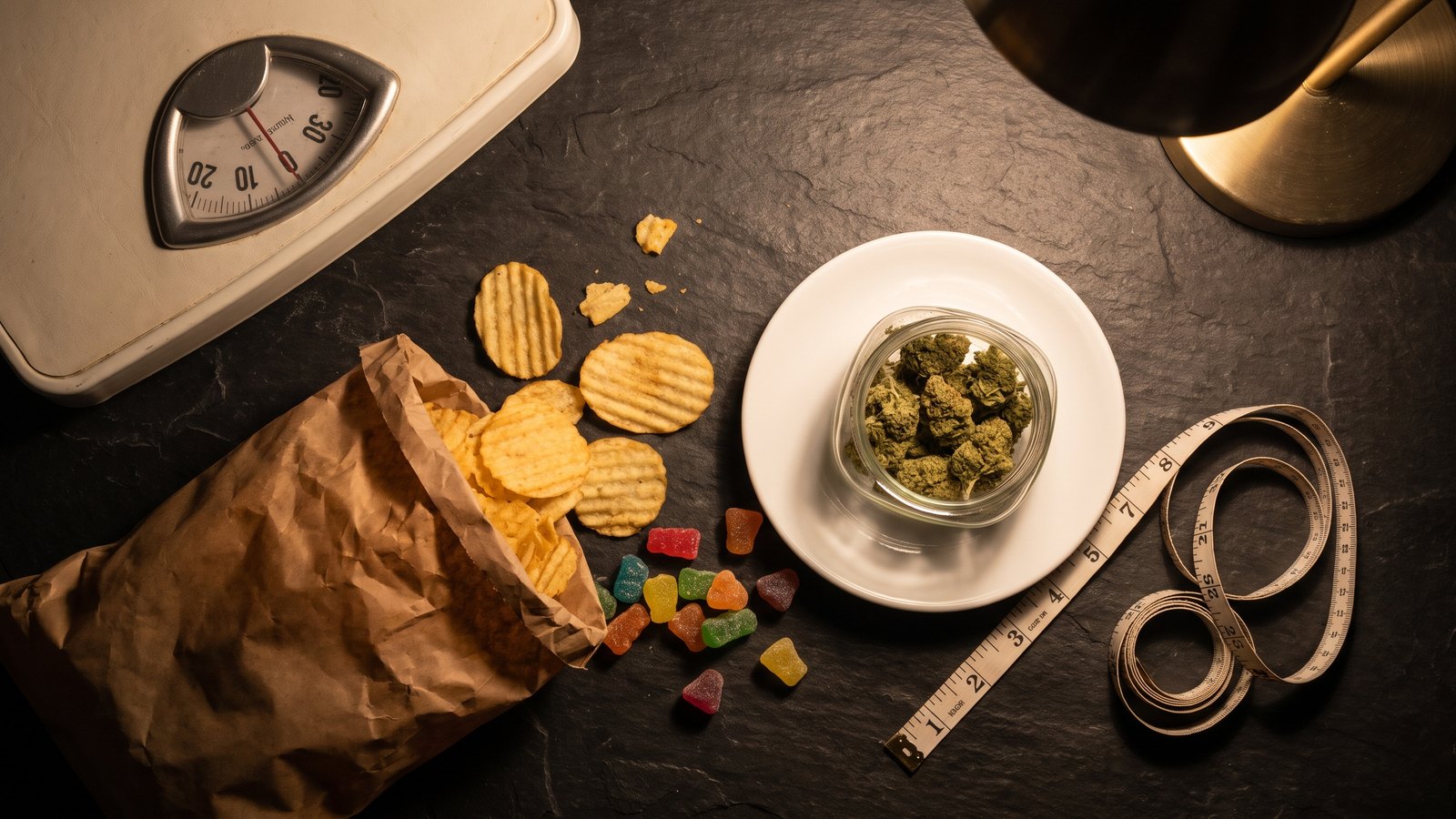
Weed can make you gain weight on the nights the munchies win, because THC reliably adds snack calories in the moment. But across large US surveys, people who use cannabis regularly are less likely to be obese and gain less weight over 3 years than people who never use it. Both findings are real, and neither one proves cannabis causes weight change.
The two kinds of study measure different things. Lab work captures one night of eating. Surveys capture years of body weight, with everything else in a person's life mixed in.
THC adds snack calories in the short term
THC raised daily calories by 40% in the best-known lab study of cannabis and eating. In 1988, Foltin and colleagues moved 6 adult men into a residential laboratory for 13 days and recorded everything they ate. Active cannabis (2.3% THC) or placebo was smoked twice a day (Foltin et al., Appetite 1988).
Meals didn't get bigger. The extra calories came from snacks, and from more snacking occasions rather than larger portions. The biggest jump was in sweet solid foods like candy bars. The authors also noted that weight went up more during active cannabis days than the extra calories alone predicted.
So if the question is "can a high make me eat more today," the answer is yes. We cover the brain side of that in how THC flips the brain's fullness circuit, and the timing in how long the munchies last by route.
Regular cannabis users weigh less on average
Obesity was less common among frequent cannabis users in two nationally representative US surveys. Le Strat and Le Foll analyzed the National Epidemiologic Survey on Alcohol and Related Conditions (NESARC) and the National Comorbidity Survey Replication, both from the early 2000s (American Journal of Epidemiology 2011).
The adjusted obesity rates:
- NESARC: 22.0% in people with no cannabis use in the past year, 14.3% in people using it 3 or more days a week.
- NCS-R: 25.3% versus 17.2%.
Tobacco smoking didn't explain the difference. That's a big gap, and it runs the opposite way from what the lab study would predict.
It's still a snapshot. A survey taken at one point in time can't say whether cannabis lowered anyone's weight, or whether lighter people were simply more likely to use it.
Regular users also gained less over 3 years
The follow-up study tracked about 33,000 US adults and found that cannabis users' BMI rose less than never-users' BMI. Alshaarawy and Anthony went back to the NESARC participants roughly 3 years after the first interview (International Journal of Epidemiology 2019).
BMI went up in every group. It went up least in people who kept using cannabis, by about 1.26 BMI units less than never-users. People who started during the study and people who quit both landed in between.
The authors were careful with it. They called for confirmatory studies with better measurement, since cannabis use and body size were both self-reported in interviews. That's the right level of confidence: a consistent pattern, not a mechanism.
Users ate more and still weren't heavier
The heaviest cannabis users in a 15-year study ate about 600 more calories a day than non-users, yet didn't have a higher BMI. The CARDIA study followed 3,617 Black and white young adults in the US (Rodondi et al., American Journal of Cardiology 2006).
People who had used cannabis on 1,800 or more days reported eating 3,365 kcal a day, against 2,746 kcal in never-users. They also drank more: 10.8 drinks a week versus 3.6. None of that showed up as a higher BMI.
Self-reported food intake is famously unreliable, so don't treat the 600 as a measured number. But it lines up with Foltin's lab finding that cannabis adds eating, and it makes the lower weight harder to explain, not easier.
Why the two findings don't cancel out
Nobody has pinned down why frequent users weigh less, and the explanations on offer are hypotheses. Researchers who found the same pattern in a 12-month study of 109 people being treated for schizophrenia (users gained less BMI than non-users) offered two possibilities: chronic use may suppress appetite directly, or indirect factors like skipped meals and tobacco may be doing the work (Scheffler et al., Schizophrenia Research 2018).
Other reasons the surveys could mislead:
- Who uses cannabis. Frequent users skew younger and differ in many habits, and no survey can adjust for all of them.
- Reverse direction. Body size might shape who uses cannabis, rather than the other way round.
- Self-report. Height, weight and use were all answered in interviews, not measured.
What the population studies can't tell you is what happens to you if your nightly high comes with a bag of candy. The average user in a survey isn't eating your snacks.
Trials of cannabis products show small weight changes
A 2023 meta-analysis of randomized trials found cannabis and cannabis-derived products lowered body weight by about 1.87 kg on average. Reis and colleagues pooled controlled trials of cannabis and its compounds (International Journal of Obesity, published online 2023).
Read that number loosely. The confidence interval ran from 3.71 kg down to 0.03 kg, which barely clears zero. The trials tested a mix of products and compounds, not someone smoking a joint at night with snacks in reach. And waist size didn't change significantly.
Pooled together, the evidence says cannabis is not a reliable cause of weight gain at the population level. It doesn't say weed helps with weight loss, and it doesn't cancel out a pattern of nightly snacking.
The munchies are where weight gain happens
If cannabis adds weight for you, the calories almost certainly come from the snacking window, not from the THC itself. Foltin's data is clear on the shape of it: repeated trips for sweet snacks, not bigger meals.
That makes the fix practical. Decide what's within reach before you get high, since the problem is the number of snacking occasions. Pick foods with protein or fiber over candy; we ranked real options in our ranking of healthy snacks for the munchies. And plan for a longer window with edibles, which we cover in our guide to edible munchies and timing.
If the hunger keeps showing up the morning after, that's a separate pattern with its own causes, laid out in why you wake up hungry after smoking. For products sold to blunt the munchies, see our evidence-ranked list of munchies supplements and the rest of our appetite and craving suppressant reviews.
References
- Foltin RW, Fischman MW, Byrne MF. Effects of smoked marijuana on food intake and body weight of humans living in a residential laboratory. Appetite. 1988;11(1):1-14. PMID 3228283
- Le Strat Y, Le Foll B. Obesity and cannabis use: results from 2 representative national surveys. Am J Epidemiol. 2011;174(8):929-33. PMID 21868374
- Alshaarawy O, Anthony JC. Are cannabis users less likely to gain weight? Results from a national 3-year prospective study. Int J Epidemiol. 2019;48(5):1695-1700. PMID 30879064
- Rodondi N, Pletcher MJ, Liu K, Hulley SB, Sidney S. Marijuana use, diet, body mass index, and cardiovascular risk factors (from the CARDIA study). Am J Cardiol. 2006;98(4):478-84. PMID 16893701
- Scheffler F, Kilian S, Chiliza B, et al. Effects of cannabis use on body mass, fasting glucose and lipids during the first 12 months of treatment in schizophrenia spectrum disorders. Schizophr Res. 2018;199:90-95. PMID 29519756
- Reis MG, Ferreira AJF, Sohouli MH, et al. Effect of cannabis and subproducts on anthropometric measures: a systematic review and meta-analysis. Int J Obes (Lond). 2024;48(1):44-54. PMID 37935909
Citations retrieved via PubMed. This article is for education only and isn't medical advice. Cannabis laws and effects vary; talk to a clinician about your own situation.
FAQ
Does weed make you gain weight?
Weed can lead to weight gain when the munchies add regular snack calories, since THC raised daily calories by 40% in a 13-day lab study of 6 men. In large US surveys, though, frequent cannabis users were less likely to be obese and gained less BMI over 3 years than never-users. Those surveys show an association, not proof that cannabis prevents weight gain.
Why are cannabis users thinner on average?
Researchers don't know why frequent cannabis users weigh less on average. Proposed explanations include direct appetite effects of long-term use, skipped meals, tobacco use and differences in who chooses to use cannabis. Self-reported weight and use in the surveys add more uncertainty.
Do edibles make you gain weight?
Edibles carry the same THC appetite effect as smoking, so any weight gain would come from what you eat while high. Edible effects last longer, often 6 to 8 hours in controlled dosing studies, which leaves more time for snacking than a joint does.
Does quitting weed make you gain weight?
People who quit cannabis in a 3-year US study of about 33,000 adults still gained less BMI than people who had never used it. Individual appetite changes after quitting weren't measured, so the study can't predict what happens to one person.
Products mentioned

Metamucil 4-in-1 Fiber (Psyllium Husk)
Metamucil (Procter & Gamble) · powderBest Value: cheap, drinkable, and well-evidenced as a fiber — but single-pathway and a heavy gel load.
Pennies per serving — by far the cheapest in the set.
Single pathway — a fiber, not a craving formula.

Calocurb GLP-1 Activator
Calocurb · capsuleThe best-evidenced single-mechanism appetite trigger — clinically interesting, but premium-priced and a pre-meal, short-window tool rather than all-day support.
Amarasate is one of the most directly studied appetite ingredients — multiple human RCTs, dosed on-label at 250 mg.
Acute, short-window effect: a pre-meal tool (up to 4 capsules/day), not all-day craving support.