Sweetener Science
Stevia and Cravings: What the Research Actually Shows
The pooled meta-analysis of 11 trials found no effect on appetite at all. Individual trials found a 105 kcal drop at lunch, a rise in C-peptide, and a subgroup where the desire to eat went up.
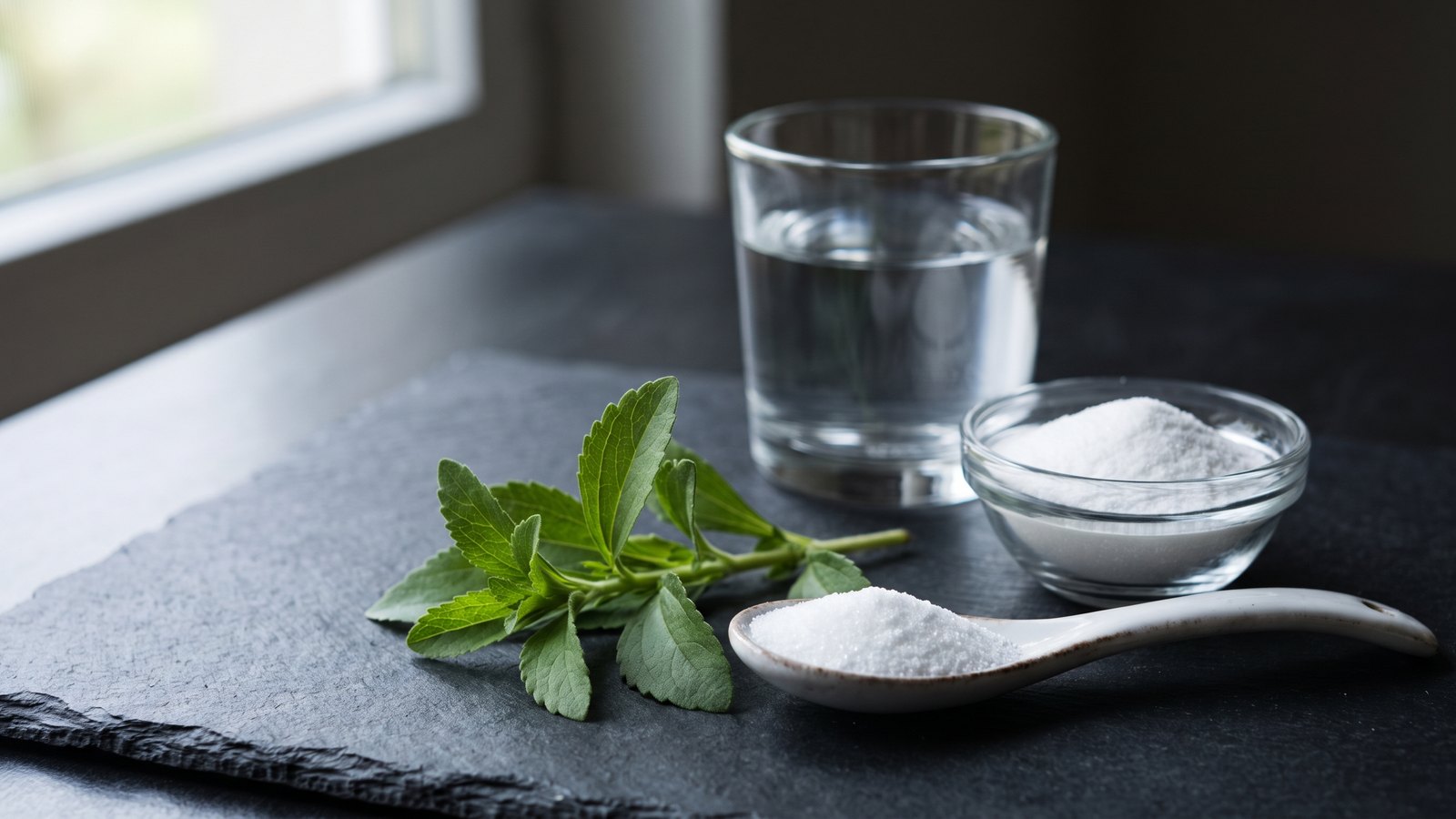
Stevia is the sweetener people move to once they've decided the artificial ones are the problem. It comes from a leaf, it's been used in South America for a very long time, and it doesn't carry the baggage that sucralose and aspartame do.
So the natural question: does swapping to it do anything for hunger, or does sweetness without calories still leave you wanting more?
There's a real answer, and it's more interesting than either camp would like. The pooled result says nothing happens. Several individual trials say something does. Both are correct, and the gap between them is the actual story.
The short version, from the largest analysis
In 2025, a team at Tehran University of Medical Sciences published the first dose-response meta-analysis of stevia and appetite in Obesity Reviews (Zare et al., 2025). They pulled 11 clinical trials covering 428 participants, screened and extracted in duplicate, and graded the certainty using GRADE.
The finding: no significant change in any appetite score after stevia consumption. Not hunger, not fullness, not prospective consumption.
Two caveats that matter more than the headline. First, the certainty of that evidence ran from very low to moderate, which is the polite way of saying the underlying trials are small and heterogeneous. Second, one subgroup went the other way: in trials where stevia was taken orally rather than delivered enterally, the desire-to-eat score increased (WMD 0.45; 95% CI 0.009 to 0.89; P = 0.046).
That's a small effect sitting right at the edge of significance, and it's the kind of subgroup result that often evaporates when someone runs a bigger trial. But it's pointing at something specific: tasting the sweetness may not be neutral even when the pooled numbers are.
The authors also wanted to meta-analyze energy intake and couldn't. Too few trials reported it. For a question that's fundamentally about how much people eat, that's a real hole.
The trial that found a difference
The most-cited result in this area comes out of the University of Manchester (Stamataki et al., 2020). Double-blind, randomized, crossover, 20 healthy adults, 5 separate visits.
Each visit they drank 330 mL of one of: water, glucose, sucrose, maltodextrin, or 240 ppm stevia matched to the glucose drink for sweetness. Thirty minutes later, an ad libitum lunch.
Total energy intake, drink plus meal, came out at 727 kcal after stevia against 832 kcal after water (P = 0.013). About 105 kcal, and specific to stevia. The caloric drinks didn't differ from water at all (P = 1.00 for all three), meaning people compensated fully for 160 kcal of liquid sugar and then some.
Blood glucose behaved exactly as you'd want. The stevia AUC was 320 mmol x min x L against 304 for water, versus 425 to 462 for the three caloric beverages.
Then the part that gets left out of the summaries. The researchers ran a visual-dot-probe task to measure attentional bias toward food cues, which is the neurocognitive test for whether sweetness primes you to notice and want food. It didn't differ across any condition (P = 0.140). Sweet taste without calories didn't make anyone's attention snag on food.
That's a direct test of the central claim behind "artificial sweeteners make you crave sugar," run on stevia, and it came back empty. We went through the wider version of that argument in the craving research, where the same pattern keeps showing up.
Feeling less hungry and eating the same amount
A three-arm crossover trial at Liverpool Hope University put 30 people through water, 60 g of sugar, or 1 g of stevia before an ad libitum pizza lunch (Farhat et al., 2019).
Hunger and desire-to-eat ratings were lower after stevia than after water (P < 0.05). Energy intake at the meal didn't budge (P = 0.78), and neither did intake across the whole day (P = 0.33).
So: people felt less hungry and ate the same amount. That split between subjective and objective appetite runs through almost every trial here, and it's worth taking seriously in both directions. Feeling less hungry is not nothing if it's what gets you past 9pm without opening the pantry. It's also not a calorie deficit.
Twelve weeks, and a caveat you should weigh
The same Manchester group ran a 12-week trial in 28 healthy adults, 14 taking a daily stevia extract and 14 as controls (Stamataki et al., 2020).
Glucose and insulin responses to an oral glucose tolerance test: no significant difference at 12 weeks. Body weight: a significant group effect (F(1,26) = 5.56, P = 0.026), with the stevia group holding steady at -0.22 kg and the control group gaining 0.89 kg. Energy intake dropped significantly in the stevia group over the 12 weeks (P = 0.003) and didn't move in controls (P = 0.973).
Now the caveat, which the authors state themselves: this was open-label, with no placebo. Everyone knew which group they were in. In a trial whose main outcomes are self-reported food intake and body weight, that's a large hole. People who know they're in the healthy-sweetener arm behave differently.
Directionally encouraging, methodologically thin. Worth exactly that much.
The evidence that stevia isn't inert
Here's the result that complicates the plant-based-so-it-does-nothing story.
A team in Chile gave 33 women with insulin resistance a preload 10 minutes before an oral glucose load: plain water, water with 15.3 mg of stevia, or d-tagatose (Sambra et al., 2022).
C-peptide incremental AUC, a marker of how much insulin the pancreas actually released, was significantly higher after stevia (median 1033 ng x min x L) than after control (730; P = 0.012). Serum glucose ran higher after stevia at both 30 and 60 minutes (P < 0.01).
The appetite pattern was split in an odd way. Greater satiety at 60 minutes than control, then greater desire to eat at 120 minutes. Food intake at the buffet didn't differ (P = 0.06, so close but not there).
The authors' own summary: these sweeteners are not inert. 15.3 mg is a genuinely tiny dose, this was a single acute exposure in women who already had insulin resistance, and nobody has replicated it. But it lines up with what mechanistic work keeps suggesting, that steviol glycosides do things beyond sitting on a sweet-taste receptor.
Gut hormones didn't move
The best-designed test of stevia and satiety hormones comes from the EU-funded SWEET consortium, published in EBioMedicine (Gibbons et al., 2024). 53 adults with overweight or obesity in England and France ate biscuits with fruit filling daily for three separate 2-week periods: sweetened with sucrose, with stevia rebaudioside M, or with neotame.
Appetite sensations fell about the same amount on all three. Postprandial insulin was substantially lower on stevia than sucrose (d = -1.01), and glucose was lower too (d = -0.39).
Ghrelin, GLP-1 and pancreatic polypeptide showed no differences at all between the sweetener versions and the sugar version. Acute or after 2 weeks of daily eating, the gut hormones behaved the same.
Which is the sober read on the "natural GLP-1" framing that gets attached to stevia in marketing copy. Replacing sugar with it lowers your glucose and insulin response, because you removed the sugar. It doesn't appear to change what your gut hormones do. If you want the actual mechanics of how those hormones govern appetite, the gut-brain axis explainer covers it properly.
Where stevia genuinely looks better
The microbiome is the one place the natural-versus-artificial distinction holds up in human data.
A randomized, double-blind trial gave 59 healthy adults 16 oz daily of either a stevia beverage at 25% of the acceptable daily intake or a beverage with 30 g of sucrose, for 4 weeks with a 4-week washout, and profiled the gut microbiome by shotgun sequencing (Kwok et al., 2024). No significant differences at phylum, family, genus or species level. No differences in fecal short-chain fatty acids. The one thing that did separate the groups: BMI rose 0.3 kg/m2 in the sucrose arm relative to stevia (P = 0.013).
A separate 12-week study at Manchester followed 14 stevia users and 13 controls with 16S sequencing (Singh et al., 2024). No significant change in alpha or beta diversity, no clear taxa differences. One honest wrinkle the authors flag: a random forest model still sorted samples into stevia and control groups with about 75% accuracy, so some pattern exists that the standard diversity metrics don't capture. Small study, and they say so.
Then the comparison that makes the point. In the 2022 Cell trial from the Weizmann Institute, 120 adults were randomized to saccharin, sucralose, aspartame or stevia for 2 weeks at below-ADI doses (Suez et al., 2022). All four shifted the microbiome. Only saccharin and sucralose significantly impaired glycemic responses. Stevia did not. We laid that trial out in full in the gut bacteria piece.
Who paid for this
You should know before you weigh the results. Corey Scott of Cargill is a co-author on the Manchester pre-lunch beverage trial and the corresponding author on the 4-week microbiome trial, and a Cargill scientist appears on the SWEET biscuit trial as well. Cargill sells steviol glycoside sweeteners.
That doesn't make any of those papers wrong. Industry funds most sweetener research because nobody else will, the SWEET trial found no gut-hormone benefit at all, and the microbiome trial's headline result was a null. Those aren't flattering outcomes for a sponsor. But you should hear it from us rather than find it in the fine print, which is roughly how our methodology page puts it.
Where we'd land
Stevia doesn't suppress your appetite. The pooled analysis of every trial available says so plainly, and one subgroup inside it hints mildly the other way.
What it does do, on reasonable evidence: it replaces sugar without the glucose and insulin response, it doesn't appear to prime attention toward food, and unlike saccharin and sucralose it hasn't impaired glycemic responses in the best-powered human trial run so far.
Practical read:
- Swapping sugar for stevia is well supported. That's a subtraction, and subtraction is the mechanism.
- Adding stevia to a diet that already runs on water shouldn't be expected to do anything to hunger. No trial here promises that.
- The 105 kcal pre-lunch result is real but comes from 20 people in a single trial. Treat it as a lead, not a protocol.
- If you have insulin resistance, the C-peptide finding is a reason to pay attention to your own response rather than to assume zero calories means zero effect.
- For actual appetite work, the evidence sits with fiber, protein and gut-hormone pathways, not with any sweetener. That's most of what our appetite coverage is about.
The honest position on stevia is unglamorous. It's a good way to remove sugar and a poor way to remove hunger, and the research has been fairly consistent about both for a decade. If you're comparing it against the alternatives on the shelf, allulose is worth a look for a different reason: it's a sugar that mostly isn't metabolized, which puts it in a separate category from all of this.
References
- Zare M, Zeinalabedini M, Ebrahimpour-Koujan S, Azadbakht L. Effects of stevia consumption on appetite in adults: a systematic review and dose-response meta-analysis of randomized controlled trials. Obes Rev. 2025;26(6):e13902. PMID 39887829
- Stamataki NS, Scott C, Elliott R, McKie S, Bosscher D, McLaughlin JT. Stevia beverage consumption prior to lunch reduces appetite and total energy intake without affecting glycemia or attentional bias to food cues: a double-blind randomized controlled trial in healthy adults. J Nutr. 2020;150(5):1126-1134. PMID 32125421
- Farhat G, Berset V, Moore L. Effects of stevia extract on postprandial glucose response, satiety and energy intake: a three-arm crossover trial. Nutrients. 2019;11(12):3036. PMID 31842388
- Stamataki NS, Crooks B, Ahmed A, McLaughlin JT. Effects of the daily consumption of stevia on glucose homeostasis, body weight, and energy intake: a randomised open-label 12-week trial in healthy adults. Nutrients. 2020;12(10):3049. PMID 33036155
- Sambra V, Vicuña IA, Priken KM, et al. Acute responses of stevia and d-tagatose intake on metabolic parameters and appetite/satiety in insulin resistance. Clin Nutr ESPEN. 2022;49:217-224. PMID 35623816
- Gibbons C, Beaulieu K, Almiron-Roig E, et al. Acute and two-week effects of neotame, stevia rebaudioside M and sucrose-sweetened biscuits on postprandial appetite and endocrine response in adults with overweight/obesity: a randomised crossover trial from the SWEET consortium. EBioMedicine. 2024;102:105005. PMID 38553262
- Kwok D, Scott C, Strom N, et al. Comparison of a daily steviol glycoside beverage compared with a sucrose beverage for four weeks on gut microbiome in healthy adults. J Nutr. 2024;154(4):1298-1308. PMID 38408729
- Singh G, McBain AJ, McLaughlin JT, Stamataki NS. Consumption of the non-nutritive sweetener stevia for 12 weeks does not alter the composition of the human gut microbiota. Nutrients. 2024;16(2):296. PMID 38257188
- Suez J, Cohen Y, Valdés-Mas R, et al. Personalized microbiome-driven effects of non-nutritive sweeteners on human glucose tolerance. Cell. 2022;185(18):3307-3328.e19. PMID 35987213
Citations retrieved via PubMed. This article is for education only and isn't medical advice. Talk to your doctor before changing your diet or starting any supplement, especially if you're pregnant, nursing, on medication, or managing a health condition.
FAQ
Does stevia cause cravings?
The largest analysis available says no. A 2025 systematic review and dose-response meta-analysis of 11 randomized trials in 428 adults found no significant change in any appetite score after stevia. One subgroup, trials where stevia was taken orally rather than delivered enterally, showed a small increase in desire-to-eat scores that sat right at the edge of statistical significance. A separate double-blind trial specifically tested whether stevia shifts attention toward food cues, using a visual-dot-probe task, and found no difference versus water or caloric drinks.
Does stevia reduce appetite or help you eat less?
Feelings and behavior split apart in these trials. One double-blind crossover trial in 20 adults found total energy intake was about 105 kcal lower after a stevia beverage before lunch than after water. A separate three-arm trial in 30 adults found stevia lowered hunger and desire-to-eat ratings but changed energy intake neither at the meal nor across the day. The pooled evidence doesn't support treating stevia as an appetite suppressant. Where it clearly helps is by removing sugar calories rather than by suppressing hunger.
Is stevia better for your gut than artificial sweeteners?
On current human data, yes, though mostly because it does less rather than because it does something good. A 4-week randomized trial in 59 adults found no significant difference in gut microbiome composition or fecal short-chain fatty acids versus a sucrose beverage, and a 12-week study found no change in microbial diversity. In the best-powered sweetener trial to date, 120 adults randomized to saccharin, sucralose, aspartame or stevia for 2 weeks, all four altered the microbiome but only saccharin and sucralose significantly impaired glycemic responses. Stevia did not.
Does stevia affect blood sugar or insulin?
Replacing sugar with it lowers both, for the obvious reason. In a 2-week trial of reformulated biscuits, stevia rebaudioside M produced substantially lower postprandial insulin and lower glucose than the sucrose version, with no differences in ghrelin, GLP-1 or pancreatic polypeptide. Stevia isn't entirely inert, though. A trial in 33 women with insulin resistance found a 15.3 mg stevia preload raised C-peptide release and produced higher serum glucose at 30 and 60 minutes versus water. That's one small acute study in a specific population and it hasn't been replicated, but it argues against assuming zero calories means zero physiological effect.
Products mentioned
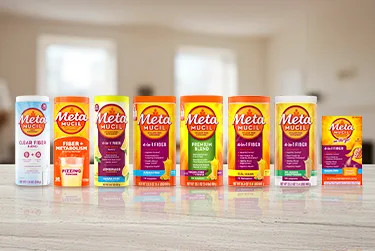
Metamucil 4-in-1 Fiber (Psyllium Husk)
Metamucil (Procter & Gamble) · powderBest Value: cheap, drinkable, and well-evidenced as a fiber — but single-pathway and a heavy gel load.
Pennies per serving — by far the cheapest in the set.
Single pathway — a fiber, not a craving formula.
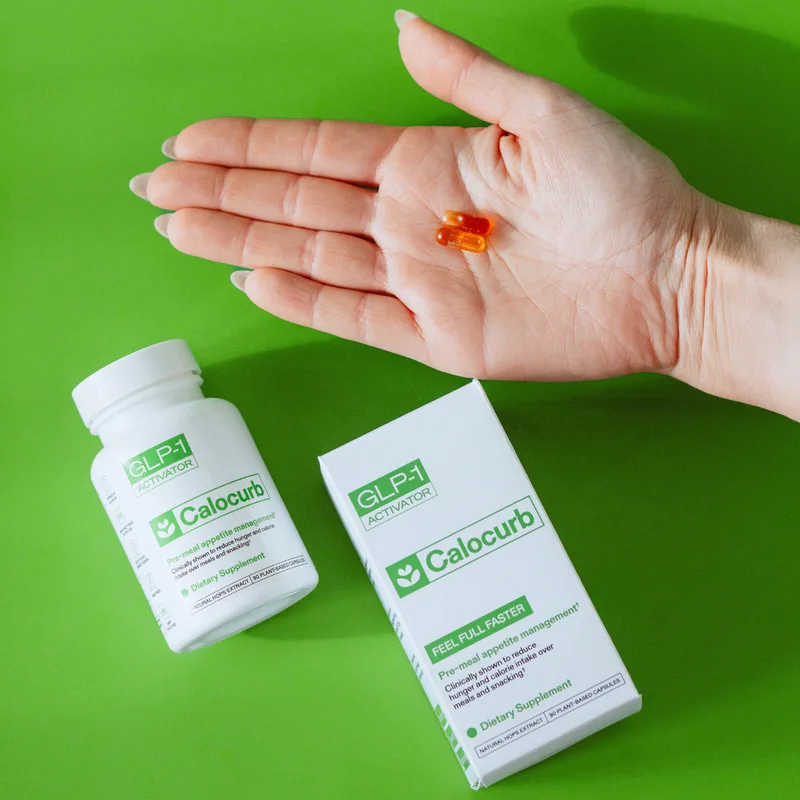
Calocurb GLP-1 Activator
Calocurb · capsuleThe best-evidenced single-mechanism appetite trigger — clinically interesting, but premium-priced and a pre-meal, short-window tool rather than all-day support.
Amarasate is one of the most directly studied appetite ingredients — multiple human RCTs, dosed on-label at 250 mg.
Acute, short-window effect: a pre-meal tool (up to 4 capsules/day), not all-day craving support.
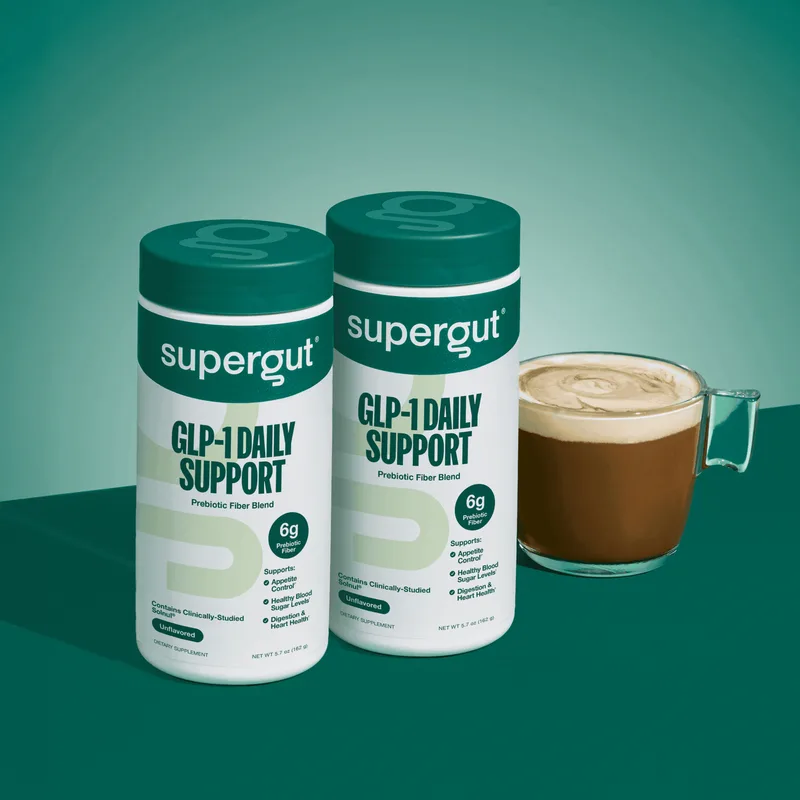
Supergut GLP-1 Daily Support
Supergut · powderA drinkable, gut-first option — but it leans on a proprietary fiber blend and a heavy fiber load.
Drinkable and caffeine-free.
Individual fiber doses are hidden inside a proprietary blend.